India: A Foreigner’s First Impression

My initial arrival in India was apparently much like everyone else’s.  Two in the morning – or should that be night? You can never be quite sure in Delhi.  Hot and dusty as all my friends in Japan had said when I told them I was going to India.  First experience of an Indian ‘Q’ at an exchange counter; somehow fought my way out with some cherished rupees.  Through the near-absent customs check – keep up now, we’re all in a hurry – and into the maelstrom which, fortunately for me, had at its centre a 20-something guy holding my name on a discoloured piece of A4.  Whisked away without a word into a beaten-up blue van and off into the night.  India smells different from anywhere I’ve been before, I thought.  Driver and his pal got me to the hotel but became angry when I only tipped them Rs. 20.  I trusted no-one, not even the albino gecko on Hotel Vivek’s lobby wall, until I was locked away in my room and could put my head down on a pillow and…

…sleep.

…read more at The NRI…

Indian Students in Tech Elite

“It has really been a dream come true for all of us.” Aranya Choudhury probably never imagined he would stand inside the most advanced high-energy physics research facility ever created.  The Large Hadron Collider became operational on 10th September 2008, and Choudhury, 20 years old, was one of 11 Indian undergraduate students selected to spend 8 to 13 weeks there as an intern, rubbing shoulders with some of the brightest minds of our time.

For the uninitiated, LHC is essentially a 27-kilometre-long tunnel concealed beneath Switzerland.  It’s the flagship project of CERN (the European Organisation for Nuclear Research) and is designed to smash the tiniest known particles into each other with the intention of, among other things, recreating the conditions present at what we call The Big Bang.  As a layman, perusing documents and articles explaining why it came into being, who brought it to fruition and what potential discoveries it may trigger visions of a sentient technology that could finally bring about the human apocalypse à la the Terminator or Matrix films.  “The Large Hadron Collider begins to learn at a geometric rate.  It becomes self-aware at 2:14 a.m. Eastern time, December 7th.  In a panic, we try to pull the plug.”  Something like that.

Who Wants To Be An NRI?

My first full-time job was at a BP petrol station in a heavily immigrant-populated suburb in Auckland, NZ.  Fresh out of high school and with two months to kill before heading down south for university, there was no way my mum would let me lounge around the house all summer, so off I went into the bottom end of the job market.  The staff were a wonderful motley crew – under a Sri Lankan manager were a few seen-it-all Kiwis, a couple of Chinese, a Saudi, a Pakistani and another new high school graduate like me.

By far the largest complement, however, were the NRI boys; among them a fresher from Hyderabad, a family man from Delhi, a quiet Tamil and a cricket-obsessed Punjabi.  I knew from the proliferation of Indian restaurants and South Asian faces behind convenience store counters that the ongoing influx of NRIs was, by the standards of NZ’s tiny population, an explosion.  I hadn’t actually found myself in a position to interact with them in any meaningful way, though; NZ’s changing ethnic makeup remained something about which I had little understanding.  Until, that is, the day I joined BP.

…read more at The NRI…

Gandhiji the Commodity

Mont Blanc, the Swiss accessories giant, recently launched a limited edition gold pen bearing the image of Mahatma Gandhi to coincide with the great man’s birthday anniversary.  At around US$25,000, it’s hardly a mass market item, but the very idea of it has many people up in arms.  India’s own Gandhiji?  Hero of the masses, champion of equality, reduced to being bought by the wealthy as a status symbol or investment and exploited cynically by a foreign company for profit?  A Kerala advocate, Dijo Kappen, has openly stated his intent to pursue legal proceedings against Mont Blanc, and a public debate has begun.

It’s reasonable to say that the name Gandhi is amongst the top four or five most widely known in the world today.  His image is perhaps even more widely known, and the irony of such a symbol of dignity and non-exclusivity appearing on a precious gold item for the elite is not lost on most.  His mission of nonviolence has impacted and influenced people all over the world, and he has come to belong not only to India and Indians but global society as a whole, so the indignation is coming from all quarters.

…read more at The NRI…

Kick-Starting Indian Football

At the London Olympics in 1948, something happened that even a year earlier would have seemed utterly outlandish, the extravagant daydream of an overly proud Mohun Bagan supporter. The national football team, barely a year after India’s day of independence, were to face off against perennial European powerhouse France in their first Olympic fixture.

And while the pitch may only have been lowly Ilford FC’s Lynn Road ground rather than the hallowed turf of Wembley or Highbury, this historic event took place in England, the home of football. India lost the match 1-2, but Sailen Manna – revered by some as India’s greatest ever footballer – and his teammates could look back on their achievement with pride.

…read more at The NRI…

Aussie Aggro Takes Aim at Indians

Hando: What’d you run into me for?

Tiger: I didn’t mean it, mate, that guy pushed me.
Hando: What’d you run into me for? What are you doing here? *What* are you doing here?
[grabs Tiger by the shoulder]
Hando: I’m gonna tell you something. I want you to listen to me now, OK? This… is… not… your… country.
[proceeds to beat him up]

-‘Romper Stomper’ (1992)

According to recent reports, Australia is not the promised land of barbeques, sardonic wit and running with glee from poisonous things. It’s a place where foreigners, including Indians, get beaten up. With thousands of ex-pats leaving Mumbai, Bangalore, Trivandrum etc. behind each year to work or study in Oz, there has understandably been quite a vocal response in Australia and here in India to the spate of attacks Indian residents endured in Sydney and Melbourne recently.

…read more at The NRI…

Inside or Outside?

So, here in Kerala, I am a ‘saip’, or white man, and will be that before anything else as long as I am here. Whether I’m tucking into beef curry for dinner, wearing a lunghi, sporting an impressive moustache or even someday speaking fluent Malayalam, I am unlikely to ever escape the outsider category I came with.

I experienced a somewhat similar phenomenon in Japan, my previous home. The Japanese approach to foreigners tends to be dominated by the dichotomy of ‘uchi’ (inside) and ‘soto’ (outside). As a foreigner, you are destined always to be ‘soto’, regardless of how Japanese you have become – even if you renounce your country of birth and take Japanese citizenship. You look different, therefore you must be different.

…read more at The NRI…

One Simple Thing I Did To Change My Life

I’m a celebrity!

On the street, heads turn wherever I go; in bars, patrons put down their glasses and look up at me. My presence sets women abuzz with chatter and invites men to look at me with bewilderment or smile with uncontrollable glee…  To think that all this time, I only had to go 7000 miles from home to attain that much-desired ‘women want to be with him, men want to share a beer with him’ status!

The thing is, I’ve done nothing to warrant my celebrity status.  I’m not a successful musician or actor, or even the Paris Hilton-esque ‘famous because I’m famous’.  The simple fact is this:  I am a white man in Kerala, or saip as locals would say in Malayalam.  From New Zealand, via Japan, and settled here for the indefinite future.

…read more at The NRI…

Tracks I never tire of: ‘Raver’

‘Raver’, by Burial, from the album Untrue

Nostalgia is a beautiful, brutal thing, and so it has come to hit me in the face once more with remembrance of how I discovered Burial. The reclusive UK dubstep/grime producer released his second album Untrue in late 2007, and on the tip of some good online folk, I checked it out. My subsequent (and repeated) rocking out awkwardly to his beats, seated in front of my laptop in a tatami-floored Japanese room by the sea, is not something anyone else needs to ever see or think about, but if the dearest moments in one’s life are marked by the purest self-realization yet experienced, I’d hold that as dear as just about anything.

Unlike most of my favourite albums, Untrue did actually grab me immediately, warranting a second listen straight after the first. However, it wasn’t until after a week or so that I realized it was Raver that stuck in my head as I cycled to and from the supermarket. It is the closing track, after all, but that’s not why I couldn’t shake it.

There are several reasons for this. First, it stands out clearly as being unlike anything else on the album. The moody, echoed, organic textures of ‘Archangel’, ‘Ghost Hardware’ and ‘Untrue’ are offset by the quiet reverberating tones of ‘Endorphin’ and ‘In McDonalds’, but ‘Raver’ offers a more upbeat conclusion with its straightforwardness and clarity of tone. As such, it could be dismissed as more shallow than what’s come before, but repeated listens prove this isn’t the case.

Opening with echoed cymbal hits, it starts off much like the other tracks. Then that driving beat kicks in, followed by a pushing, wobbling bassline – can I even call it a bassline? It kicks in at about 00:18 – and I’m swept along every time. Layers are added steadily until the chorus which seems to burst, powerfully but at a respectful distance, out of the metronomic beat. Its simple up-and-down tones cut to the heart of whoever feels like listening.

One of the more beautiful things about Burial’s music is that he cuts the vocal samples so that they could be heard and interpreted in several different ways. To me, the initial plaintive cry on ‘Raver’ asks us to “choose life” and later agonizes over “the world’s fear” and how we “never grow”. A simple message that could be purely my own. Perhaps the way cuts the lyrics is an effort to include the listener in what meaning should be ascribed to his work.

It’s hopeful, it’s emotional. Everyone’s been dancing for hours and this is the last song before the club closes, or something. Burial himself once said that one way he would be inspired would be to recall the sounds of the club echoing in his head when he got home (see question 9), and that’s exactly what ‘Raver’ reminds me of. Still nodding your head as you unlock the door, then breaking out some clumsy moves with your girlfriend as you both stagger into the bedroom. Or closing your eyes and pointing to the sky with passion as you begin to comprehend what being away from home REALLY means. Your choice.

DON’T STOP NOW

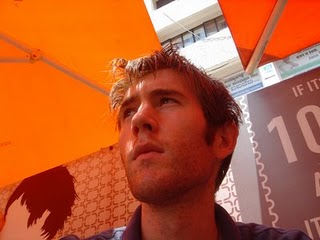
The rendezvous point was Barista on MG Road, so I took an expensive (by Indian standards, about $4 for a 15-minute ride) autorickshaw there and waited patiently for P, a friend of a friend, who with E was to make my experience in Bangalore a memorable one from the outset. Here’s me at Barista, fresh off the train:

After a blackcurrant smoothie and some sort of crushed ice/tropical fruit beverage, he turned up and we started a conversation that was really only interrupted by sleep and work during the three days I stayed with them. It’s such a great feeling to be made to feel immediately welcome in a new environment. Granted, they’d heard a lot of positive things about me from our mutual friend and as a result were more willing to greet me with warmth and openness, but it’s still something very rare to be allowed into people’s lives and hearts without fuss or the standard amount of obstacles that are usually put up in your way. It’s unfortunate that this is something worth commenting on because it ought not to be special – it ought to be the norm – but that’s something to look into another time.

We talked about our respective pasts, the places they’ve brought us to now, and where we want to be in the future as people. We talked about trust, how it’s so easy to scale back in your life depending on how much you let yourself be affected by the times it’s been betrayed. We talked about respect, something so fundamental in our nature that our Western (or Westernized) cultures are leading us further away from. And we talked about communication, which takes so many forms and the improving of which is so vital to our relationships, be they familial, intimate, or friendly. None of us were entirely comfortable with how we live these aspects of our lives – is anyone? – but we all felt a deep desire to better ourselves, and if we didn’t hit upon any concrete maxims to follow, we did agree how positive it is to be around people who care about these things and won’t coast through life without making some effort to grow.

In the meantime, Bangalore was quite different from the small part of Delhi I experienced. Many more smiles and friendly interest, and a feeling that people want to help you, not fleece you or exploit you. Still, the gulf between India’s burgeoning middle class and those at the lower end of the socio-economic scale is apparent everywhere you go. There is a hierarchy and clear structure to begging here, for the most part – for example, amputees are more likely to gain charity, so some people choose or even are forced to lose a leg or arm so they’re more profitable – but still… these are people who have virtually nothing, whether they’re acting cynically or against their will or whatever as they bat at your arm and hold out their hand. One has to remain somewhat hardened and view it as an industry just like any other, but it’s impossible not to let one’s guard down once in a while and give a few rupees to a starving woman and child.

So there’s that during the day as you go out for groceries, then at night you can go to a bar which looks and feels just like you’re in England or America with leather couches and all manner of cocktails and great food. Really good places, really good atmosphere, and you do forget about those less fortunate than you. They are right outside the door, though. I don’t have more than a tourist’s understanding of, let alone any solution to, this ongoing and very visible dark side of India, but I sincerely hope that as the economy continues to boom and money keeps rolling in, some of it trickles down and that middle class expands to healthier levels. This may take many decades and a complete overhaul of society, and I don’t even know if India needs that.

Anyway, I’ve made Bangalore out to be this horribly poor and depressing place when it’s actually one of the fastest-growing cities in the world, so please don’t get the wrong idea. I had a great time there, met a good few fantastic people and would go back any time. At the very least, it’s no more poverty-stricken than any other city in this part of the world. As time went on, however, my mind turned further and further towards my next port of call, my destination (for now at least), the rumoured seaside paradise that would fulfil all of my dreams. The place I am now. Varkala. Very soon, the Jdanspsa me will finally catch up with the real me.

***

My online diary dried up at this point, for various reasons; for a poor segue into my life having settled in India, take a look at some of my posts for The NRI under the category ‘India’ or the tag ‘The NRI’.