Brokeback Mountain (2005) (R)

IMDb / Ebert / Cale
Written by Larry McMurtry & Diana Ossana
Based on the short story by E. Annie Proulx
Directed by Ang Lee

Ennis: “I figure we got a one-shot deal going here.”
Jack: “It’s nobody’s business but ours.”
Ennis: “You know I ain’t queer.”
Jack: “Neither am I.”

I want to say these are two simple, uncomplicated men, with simple lives and simple desires, but it just isn’t true. To say that would confound us all as being simple. We reach for simplicity, for plain happiness and peace of mind, but the reality is never quite like that, and the case of Ennis and Jack is no different. Love isn’t ever straightforward, and it can become so complex that it rips you apart. You will have heard Brokeback Mountain described as ‘that gay cowboy movie’, but to be honest, sex/gender is irrelevant to a large extent. It’s about two people who long for and love each other, and how no matter how strongly their love is tested, it will not die.

This is a film remarkably free of pretension or obviousness. The direction is careful and restrained, as one expects from Ang Lee; working in tandem with one of my favourite cinematographers, Rodrigo Prieto, he crafts stunning compositions that are truly beautiful to behold. From a wide shot of sheep being herded through a valley, to a tight closeup of an actor’s pained performance, to one of the best final shots I’ve seen in a film, he uses the full frame superbly to extract the most out of every scene. Everything is placed perfectly: the actors, a campfire, a pack of cigarettes, a bottle of beer. It all adds up to some of the most impressive images in recent memory, particularly as most of the subjects are everyday things that one wouldn’t normally give any thought to.

In the steady hands of an assured director, all the actors shine. Michelle Williams and Anne Hathaway are good as the wives of Ennis and Jack, and Linda Cardellini and Anna Faris offer good support in brief roles. However, the movie is about the characters played by Heath Ledger and Jake Gyllenhaal, and they absolutely nail their roles. Ledger is garnering most of the praise in the press for his subdued, grunting performance, and I can understand that as it is some distance away from his real-life persona. For me, though, Gyllenhaal’s turn is marginally more impressive. He shows sensitivity, fragility, strength, and a deep sadness and regret; I’d be quite happy to see him take him the Best Supporting Actor Oscar. They both are really very good, though. Their scenes together, right from the film’s opening, are compellingly well-acted and affecting.

I wonder how people are reacting to this film. I’ve read about religious zealots condemning the film (and in a couple of cases refusing to screen it), but I’m not interested in them. I want to know what the average male cinemagoer feels when a movie gets him to care strongly about – and love – two male characters. Has it provoked angry reactions, or maybe rethinks of personal philosophies? Personally, a heterosexual, I welcomed the opportunity to empathise with gay men in a film, as it challenges me and forces me to consider things I would otherwise avoid. Anyway, as stated earlier, gender was pretty much stripped away by the sensitivity of the portrayal. That’s the way it should be. It’s love, just as we know it – intoxicating, difficult, impossible to predict or prevent. There are significant elements in the plot concerning homophobia and the concealing of the relationship, but they are an aside, rather than the crux of the story. The focus is on the struggle of two people, and the effect their struggle has on the people close to them.

Overall, it loses a couple of points for covering a long period of time in too short a time-frame and for being a little episodic. Brokeback Mountain isn’t a great film, but it is a very good one – a serious, thoughtful, mostly subtle exploration of the Greatest of All Things. It deals with homosexuality in a very mature manner: while it plays an integral role in the characters’ lives, it isn’t what defines them. Their love for each other is what defines them, and ultimately, what destroys them.

Farewell My Concubine (1993) (R)

Original title: ‘Ba wang bie ji’
IMDb / Ebert
Written by Lillian Lee, Bik-Wa Lei & Wei Lu
Based on the novel by Lillian Lee
Directed by Kaige Chen

This is the second film I’ve seen recently that relates to opera and China, the other being the disappointing M. Butterfly. Thankfully, Ba wang bie ji is not a confused adaptation of a confused stage play; rather, it is a quality adaptation of a popular novel. Unfocused and abrupt in some sections, but expertly orchestrated in others, it tells an involving and epic story with often stunning visuals and confident direction.

While I was watching, I was struck by how much more substance was present than in Yimou Zhang’s recent epics, Ying xiong and Shi mian mai fu. Those films are stunningly beautiful and extremely entertaining, but they just don’t have the depth of Ba wang bie ji. Very basically, it’s a love story – two characters and their loves for the opera stage, a woman, and most of all each other – but their detailed exploration makes it more than that. These are complex characters, full of hope, sadness, regret, and great love that spills all over the screen; I remember someone referring to those Zhang films as ‘China discovering Shakespeare’, but to me this is more Shakespearean because it deals in important themes while telling a good story.

Because Mandarin is so different from English, I usually find Chinese acting stilted and awkward and lacking in emotion. Not so here. The three leads (Leslie Cheung, Fengyi Zhang and Gong Li) are compelling and offer affecting portrayals of tragic characters; the child acting in the earlier Full Metal Jacket-esque scenes is also very good. In particular, Cheung is superb as the confused Dieyi; he has too much love to give, and it is heartbreaking to watch as it slowly destroys him. It is particularly sad to watch now, as he committed suicide three years ago.

I’m particularly unfocused with this review; perhaps that’s because the last half hour covered too much ground too quickly. A film of nearly three hours should feel complete and satisfying, and such feelings are nearly impossible when it crams a lot of plot development into the final reel. By that stage the themes are well established and we are just waiting for them to be rounded out, but the introduction of these plot elements is distracting. It’s not enough to derail the film, but I would like to think they could’ve spent a bit less time further back in time in order to give the later periods better coverage.

Overall it’s worth seeing, at the very least for a few scenes which were so good they sent shivers down my spine. It’s the best film I’ve seen from the Republic, and probably better than any Hong Kong film I’ve seen, too. Kaige Chen shows that he is an extremely capable director (I couldn’t believe this was the same guy who made Killing Me Softly), and the actors offer impressive characterisations. I guess my lack of focus with this review shows that I wasn’t completely struck by greatness, but then again, maybe I shouldn’t have watched it in two goes. Another viewing, a complete viewing, would probably make my opinion more solid. It doesn’t matter; it’s good cinema.

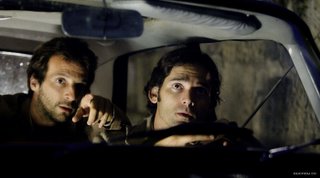
Munich (2005) (R)

IMDb / Ebert / Cale
Written by Tony Kushner and Eric Roth
Based on ‘Vengeance’ by George Jonas
Directed by Steven Spielberg

I hate it when movies are lumped with political agendas. Nothing distracts more from a good story than obvious political content, and it is equally frustrating when that content is forced upon the film by statements in media. Munich suffers from the latter, but tellingly, not the former. (Here and here are two very insightful pieces of comment by Spielberg himself, defending his film.) Words have been spoken at length in the press about its supposed defamation of Palestinians, or of Jews, etc etc etc. I was aware of all this going in, and to my delight, these statements were proved to be totally reactionary. This film sides with no group or individual; it sides with humanity, our collective desire, and shows how misguided we can become in our pursuit of the fulfilment of that desire. It’s a film made by people who care about people, not a piece of propaganda designed to convert minds to a different way of thinking.

Munich is based on true events – the series of hits carried out in the wake of the killing of 11 Israeli athletes at the 1972 Munich Olympic Games. However, its focus is not so much political, but more on the implications of these incidents on one man. And, in keeping with my own philosophy for filmmaking, this refined focus offers a more inclusive and substantial view of the human condition than a wider scope could have. We watch as Avner (Eric Bana) leads his team through several hits, his life becoming more and more complicated; we don’t condone his actions, and neither does the film, but we sympathise with him because he has real concerns that we can relate to. Family, morality, legacy. The big issues, the ones that really matter.

The screenplay drives the film forward nicely, becoming more focused as it progresses (which I like); it also has room for brief moments that do nothing to advance the plot, but flesh out the characters infinitely better. The acting is decent; Bana is not a great actor, but he is a good one, and he carries the film well – we want to know what happens to his character, and we understand what’s going on through his eyes. It’s every inch Spielberg’s film, though. Many shots are masterfully composed, shifting our focus from one character to another with considerable skill and a great deal of style. It moves at a swift and even pace, making the long running time fly past. And, as I have stated many times already, it is very well focused for a film tackling such grand issues. My hat is off to the guy; he’s hardened a lot since E. T., that’s for sure. Of particular note are the assassinations: they are brilliantly executed, exhilirating set pieces that linger long in the memory.

A few overly dramatic choices bring it down a bit. The sex scenes that bookend the film are gratuitous, especially in that they are integral to the overall message; there had to have been a more toned down way to get the point across. Some of the accents were not very convincing, especially Daniel Craig’s – a minor quibble, but it is distracting. And occasionally, the violence is a little bit too brutal. It’s horrifying and realistic, but too much of it can be numbing, and Munich comes close to reaching that stage.

Some of us may have a collective goal, but are we justified in doing everything in our power – including killing other people – to obtain that goal? And how does it compare to watching our children grow up, or looking into the eyes of a friend and knowing that there is mutual trust and respect? Munich raises many questions, none of which have simple answers. Like The Constant Gardener, it promotes an awareness of what atrocities are being committed in the world, and it promotes a better attitude towards each other and ourselves. Everything isn’t just going to be all right if we carry on like this, so let’s all do something about it. Classic Spielberg themes, in a way, but rarely have they been better handled.

Ran (1985) (E)

IMDb / Ebert 1 / Ebert 2
Written by Akira Kurosawa, Hideo Oguni & Masato Ide
Based on ‘King Lear’ by William Shakespeare
Directed by Akira Kurosawa

I was first introduced to King Lear at age 15 (I think) when the Pumphouse Theatre in Takapuna put it on. I remember thinking it was a great story, awesomely tragic and powerful, but I wondered if all productions of it were so disjointed and confused. A fuller understanding of the play came at age 17 when we studied it in Mrs. Keith’s 7th form English class, and I enjoyed it very much. Mrs. Keith made sure to let us know that she’d never seen it performed well, and wondered if it was possible for it to be done; she wondered aloud about a Japanese film from the 80s that supposedly did a good job of it, but she hadn’t seen it, so she couldn’t say.

Ran is the film she was referring to, but it wasn’t just her mention of it that led me to eventually see it. Recently I was exposed to the above image, and was so captivated by it that I immediately went to the library and put a request in for the DVD. Having now seen it, I can say that it lives up to all the hype. It is a particularly fine Lear adaptation, conveying the madness and eventual tragedy of the Lord, the treachery of two of his offspring, and the nobleness of the third. It is also visually a remarkable film filled with such extraordinary images as the one above; indeed, that shot is only one part of an extraordinary battle sequence, surely the one of the most incredible ever filmed, and there is another at the end of the film which rivals it.

It’s the scale of it all that astonishes me. You look at Peter Jackson’s Lord of the Rings trilogy, and the battle scenes are amazing, but 70-80% of them is created solely on a computer, and there’s plenty of cutting that makes it easier for them to convey chaos. Ran, on the other hand, is all real, except for the blood. Those are real people charging around, falling off horses and being trampled, shooting vast numbers of arrows into the enemy’s ranks. Virtually all of it is shot from a reasonable distance, so you can always see what’s going on, and you can marvel better at the audacity of it all. Look again at that above image: that’s a real castle (built especially for the film) burning to the ground, so they only had one shot at getting it – and they got it.

The carnage only comes in brief bursts, though. Ran focuses more on the human elements of the story, cutting to the heart of Shakespeare’s themes and displaying them clearly through the characters. As Lord Hidetora, the film’s Lear figure, Tatsuya Nakadai offers a remarkable range of facial expressions that one feels Western cinema could never pull off without seeming overly broad; they are somewhat over the top, but they do a better job of getting us inside the character’s head than any subtle underplaying would. The rest of the cast also performs well, particularly Mieko Harada in a Lady Macbeth-type role; her icy words are chilling, and her eventual fate is superbly handled.

This is my fourth Kurosawa film, after (in this order) Shichinin no samurai, Ikiru, and Rashomon. They have been phenonemal works, clearly showing a director very much in total command of the art form. Rashomon is probably still my favourite, but only just; in any case, I plan to own them all one day, and I plan to see all of Kurosawa’s films before too long. If you haven’t seen any, what’s the deal? Get on it. This guy really does deserve his reputation as one of the top few film directors ever. An interesting fact: as he was a trained painter, his storyboards for all his films were full paintings. It shows. There is a perfection to his images, a clarity of purpose, a genuine cinematic beauty. Even Herzog only manages it a few times per film; with Kurosawa, it’s present in nearly every frame.

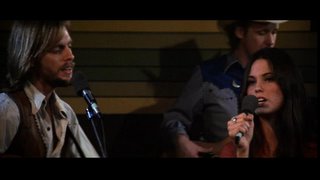
Nashville (1975) (E)

IMDb / Ebert 1 / Ebert 2 / Cale
Written by Joan Tewkesbury
Directed by Robert Altman

The ensemble drama has been particularly popular in recent American film. Primary exponents are Paul Thomas Anderson (Boogie Nights, Magnolia), Steven Soderbergh (Traffic) and Paul Haggis (Crash). However, the king of the genre is undoubtedly Robert Altman. These more recent examples offer distinct worlds that are easy to be drawn into, with fascinating characters that we do care about; the difference with Altman’s films is that every person on screen – from the part with the most dialogue, to the guy with a mullet and goatee standing in a huge crowd – comes across as a real person. The others I have seen are Short Cuts and Gosford Park, and it’s that attention to the smallest roles that sets him apart, placing him among the greatest American filmmakers.

Nashville, I would suggest, is his finest hour. (Without having seen MASH or The Player I’m not really in any position to judge, but too bad.) No better film chronicle of Americana exists that I’ve seen. All the required elements are present and correct: country music, NASCAR racing, and most of all, the sorts of interpersonal relationships that could only happen like this in America. Husbands and wives in difficulty, for various reasons (extramarital affairs, career overtaking love etc.); groups of friends in disarray; outsiders regarding the environment with fascination and ignorance, whilst being regarded with (much of the time) utter disdain. I say again, not for a second does any of it seem contrived, not even the famous climax that we know is coming but we still don’t believe will really happen.

If for no other reason, it’s all real because it’s unusually unromanticised. I expected Nashville to be a celebration of the American Dream, and in a way it is, but it is deeply critical of it; from the start it has characters singing about peace, love and understanding, then as soon as the song ends they settle back into their bitter, disagreeable, and troubled persona. Dreams don’t crumble in this film so much as they are denied outright. Everybody wants for more – that great reconciliation, that deserved recognition, that wider success – but it’s always out of reach. Some realise this and some don’t, and it is heartbreaking to watch those in both camps as they either deal with a crushing realisation, or continue to delude themselves.

I make it sound like there’s no hope in this story, but there is, and it’s summed up by the fact that the one character who really takes advantage of her big break only gets it through the extreme misfortune of another. That’s to say, outright hope doesn’t necessarily exist: through narrow-mindedness we ignore the flip side of the coin, but it is there, and it might make itself known at the least opportune time. Still, Altman sees the humanity in everyone, and they all come across as sympathetic characters in one way or another. We aren’t perfect! Nobody is! But a lot of us, deep down, have the right things at heart. A simple old message, but rarely better illustrated than it is here.

I really liked the way much of this film was shot in medium to long shot – it was another good way of making everyone seem on equal footing. The music is great, too, particularly Haven Hamilton’s opener ‘200 Years’. The acting is excellent across the board, and it would be pointless to pick a standout because there are literally dozens of good performances here. The only slightly troublesome element was that there were so many plot strands that it did get a little bit confusing sometimes… but hey, that’s what second viewings are for.

P. T. Anderson, the pretender to Altman’s throne, got Henry Gibson (Haven Hamilton in this film) to play a small role in Magnolia, and that surely is his way of recognising his roots. I imagine there are hundreds of young filmmakers in America and around the world who would cite Altman as an influence. This is another legendary director who has never won an Oscar, and as such he will receive a ‘We Fucked Up‘ one this year. He’s a pioneer, an innovator, a true cinema artist, and those unfamiliar with his work should certainly start with Nashville.

Good Night, and Good Luck. (2005) (H)

IMDb / Ebert / Cale
Written by George Clooney & Grant Heslov
Directed by George Clooney

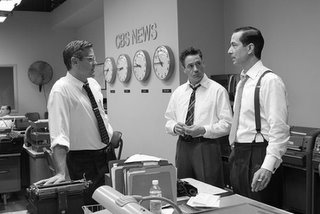
George Clooney’s Good Night, and Good Luck. is unusual among modern films in that it has a great deal of respect for its audience. It simply presents a series of events that occurred in the 1950s involving Sen. Joseph McCarthy and CBS News, particularly the host of ‘See It Now’, Edward Murrow; it doesn’t ever become preachy, or manipulative, or attempt to guide the viewer through what is going on. It’s like it’s been brought forward from that great decade in American film, the 70s – it can be compared to All the President’s Men, because it is very much in the same class.

To begin with, this is not only a very good film, but such a good rendering of its time period to be practically an archival document. Shot by Robert Elswit in glorious black and white, everything feels as though it has been lifted straight out of the 50s. The best way to illustrate this is by observing the seamless integration of McCarthy archive footage into the film – indeed, test audiences suggested to Clooney that he should have hired a different actor to play McCarthy because of his overacting, not realising it was the man himself. Everything feels just right: immediately we are immersed in immaculate period detail, and it is no struggle to remain immersed throughout the duration of the film.

That the film is biased towards Murrow and his colleagues makes no difference to me. In fact, I prefer it that way, and not just because I agree with their strong belief in free speech and their disagreement with scare tactics by extremely powerful people. I think it makes for a more effective film, because McCarthyism is not something one reacts to with ambivalence; you have to decide which side you stand on, and the fact that Clooney wastes no time with the opposing views makes the film a lot tighter and ultimately more effective. Perhaps the most impressive aspect is that while it is a film about that period of great nationwide fear, it also directly reflects parallel events in current times. Back then, a newsman and his team were willing to stand up to a fearmonger and say “this isn’t right”, but today lies and outright ineptitude in American politics go largely unchallenged by mainstream media. It is not surprising that in Murrow’s final speech, he mentions American foreign policy in the Middle East; it is the only time in the film where Clooney explicitly offers the audience a connection, and it works very well.

In the role of Ed Murrow, David Strathairn is magnificent. He carries the film with remarkable authority and integrity; as he looks directly into the camera and speaks those immortal words of the title, we trust him, because he means it. His serious, focused remarks are balanced with some wonderful lines of sardonic wit. Only once does he show vulnerability for a moment, but he immediately picks himself up and gets on with the job again – a true professional. Equally as good is Ray Wise as the doomed colleague Don Hollenbeck: the scene in which O’Brien’s piece is read out to him is phenomenal, as he tries – but fails – to maintain a cheery demeanour. It’s surprisingly affecting. Everyone else in the cast – Clooney, Langella, Downey Jr., Clarkson, Daniels – is functional, doing the job as well as they need to without distracting from Strathairn’s great performance. I would, however, single out one scene between Downey Jr. and Clarkson as being terrifically acted, and that is just after Daniels’ character has spoken to them. We expect to see disappointment, but their tenderness towards each other is just wonderful… a superbly well-written and well-acted moment.

If anything, Good Night, and Good Luck. finishes a little too quickly. We could probably have done with another twenty minutes to convey a bit more detail, because those unfamiliar with the events going in would perhaps struggle to keep up, and anyway, I would’ve been delighted to stay in that lush black and white world a bit longer. Still, this is an absurdly early contender for the best film to be released this year. The fine acting, the wonderful pans and re-focuses, the taut directing – it’s finely honed cinema, great to watch and it makes you think.

2005: Good Movies

My review of the year 2005 continues with the top ten movies I saw in cinemas. They had to play either on general release or in a festival, thus North by Northwest in a one-off at the Regent and Cremaster 3 in Film Society were not considered.

1. Grizzly Man – Werner Herzog
Nothing else screened in 2005 could approach the brilliance of Herzog’s Grizzly Man. In the guise of a nature documentary, the great Bavarian sums up life, the universe and everything, and in doing so embraces the darkness that defines our existence. More than in any of his other films I’ve seen, more even than in Lessons in Darkness, Herzog stares into the abyss and refuses to turn away; rather than trying to lionise a very troubled human being, he condemns his madness while at the same time celebrating him. Only Herzog could produce an effective film that both damns and praises its subject, while at the same time turning his gaze to the audience and demanding that they re-evaluate their own lives. It fits perfectly with his overall body of work, and stands in my opinion as one of the greatest films – documentary or fiction – ever made.

2. My Summer of Love – Pawel Pawlikowski
I had high hopes for this on the back of Pawlikowski’s excellent debut Last Resort, not to mention the presence of the incomparable Paddy Considine; still, I was stunned by how good this was. Virtually everything about this film was perfect. The screenplay was very focused on character, involving a sequence of events that make up a plot (rather than a plot that drives a sequence of events). Each scene seems to top the last, and the dialogue is powerful and real. The cinematography is first class, just beautiful in places. The acting (essentially a three-role film) from Considine and leads Nathalie Press and Emily Blunt is as good as you’ll see. The use of music is unequivocally the best of the year. The directing, man… absolutely perfect. Seriously, when I start making movies, this will be my model for a perfectly directed film. No shot is wasted, no aspect of the actors’ performances left untapped; with few locations, few actors and relatively small crew, Pawlikowski creates the most affecting and believable film story of the year. Only the ending prevents me from placing it at #1 – while excellent, it was so surprising as to seem a bit out of place. On second viewing, I’m sure it’ll seem more right. See this one, at all costs.

3. DiG! – Ondi Timoner
Like Grizzly Man, this was a documentary mostly about one completely mad guy. It was also one of the funniest and most entertaining films of the year. You would keep wishing that Anton Newcombe would just give himself a break sometime, but he would always trump himself by doing or saying something even more ridiculous (sending the Dandy Warhols shotgun shells with their names on stands out as a particularly insane act). Taking place over 7 years, this documents Newcombe’s constant rise and fall, and his rivalry with the Dandys’ Courtney Taylor (who narrates). As good a film about rock and roll as has been made, you come to the end feeling as though you personally know the principal figures, which I always think is some sign of success.

4. Palindromes – Todd Solondz
Solondz, the master absurdist, again makes fun every single member of the audience whatever their views are. It’s not as simple as that, though; he’s not merely taking aim at our collective ridiculousness through the medium of film. It’s not a protest. It just shows us for what we are: opinionated, narrow-minded fools who search for meaning everywhere in our lives when there simply isn’t any. I saw this the day after Grizzly Man, which was somehow fitting; both films are audacious enough to say that everything in our lives is absurd and trivial, but convince us that it’s nothing to worry about. It’s just the way we are. I see Palindromes not as an exploration of the abortion debate on film, but an extension (and improvement upon) the director’s earlier Happiness – an offering of freaks and outliers of society that represent all of us far better than the winners.

5. Sideways – Alexander Payne
I really need to see this again, since I’ve only seen it the once back in February. In any case, it was clearly going to be one of the year’s best even as early as that. The combination of Payne and Jim Taylor’s screenplay with a fine four-piece acting ensemble resulted in a wonderful reworking of the buddy comedy and road movie genres. Several scenes are great (most memorable being Miles’ lines on the beach), but they all contribute to an overall tone and theme that leaves you thinking for days. This is an extremely genuine film, amusing and (for a film about wine drinkers) remarkably free of pretentiousness. If for no other reason, see it for Paul Giamatti’s superlatively great performance; if you need another, see it for the skill of Payne, who after only four features has honed his craft to near perfection.

6. The Constant Gardener – Fernando Meirelles
A powerful, angry thriller by John le Carré was expertly transformed into a provocative and affecting film by the soon-to-be legendary Brazilian Meirelles. Filmmaking is rarely as politically charged as this, and because it was handled well, I was happy to climb aboard with the film’s agenda. It’s well acted and well shot, and as well as making you think, it’s a damned good thriller; structurally Meirelles messes you around, before slowly joining the threads back up. Some scenes could have been handled better, and it is a little difficult to handle the influx of information in the third act, but overall it is a quality exercise in filmmaking. And anyway, a film that so clearly states that it wants to change your opinion should be applauded for being so up front.

7. Sin City – Robert Rodriguez
The most brutal film of the year was also one of the most hyped, but for once, it lived up to great expectations. I’ve never been much of a fan of Rodriguez, but the technical skill on display here is so mindblowing that it has to be seen to be believed; it really is as if a comic book has come to life. And what a violent comic book it is. Many, many moments are excruciatingly grotesque (several of them, unbelievably, involve Elijah Wood), and contribute to an overall sense of sub-baseness that pervades every frame. This is all style and absolutely no substance… but what style, man. It’s so much fun it’s practically a guilty pleasure, and I must say, I’m quite looking forward to instalments 2 and 3.

8. Batman Begins – Christopher Nolan
None of the trailers or stills excited me, and the pedigree of the previous Batman films was not a little off-putting, but the presence of Nolan as director and Christian Bale as star forced me along to see this on opening night. I was far from disappointed; in fact, I really bloody liked it. This immediately re-states the parameters for Bruce Wayne/Batman, removing any comparison with the earlier films; if it seems a bit odd for the first half hour, don’t worry, you’ll eventually settle into it. This is a rare blockbuster that focuses on character rather than action, offering one of the most entertaining and enthralling screen heroes of the new millennium. Unfortunately, while a lot of the action is bad-ass, most of the fight scenes are epileptically edited with seemingly billions of cuts per second – the only disappointing aspect of an otherwise fine film.

9. Inosensu: Kokaku kidotai – Mamoru Oshii
English title: Ghost in the Shell: Innocence. This is a sequel to the 1995 original, Ghost in the Shell, which was a very direct influence on The Matrix, and I found it to be a better film. Typically for an Oshii work, it was very confusing and often totally violated all traditional rules of film storytelling; still, that never derailed a fascinating, beguiling film. I’d need to see it again to understand it, but I was happy to just be swept up in the wonder of it all – it’s visually extraordinary with its mix of traditional and CG animation, and always mindblowing. Probably only good for anime fans, and probably needs to be seen on a big screen; fortunately, I and the venue fit these criteria, so I enjoyed it very much.

10. Gegen die Wand – Fatih Akin
English title: Head-On (literally Against the Wall, a much better title if you ask me). This film’s first hour and a half is so good, I just wish they could have kept it up for the final half hour. Still, that doesn’t stop this being a powerful film, well directed and acted and with great use of music. It creates characters that we quickly care about and want to see succeed, despite their extreme anti-social qualities; however, we also quickly know that everything isn’t going to end well, so it is difficult to hold out hope. Winner of the Golden Bear at Berlin and Best Film at the European Film Awards, this signals the arrival of a major new directing talent, and looks closely at lives without any sort of direction. It’s tough and shocking at times, but well worth your time.

One thing to note: the first four spots are all taken up by Film Festival films, which goes to show how shitty the general release slate was last year. I get the feeling we’re on an unstoppable slide: 2004 was good overall, 2005 rubbish with great moments, so 2006 will surely be the worst year for studio film yet. I hope I’m proved wrong.

King Kong (2005) (R)

IMDb / Ebert / Lieberman
Written by Peter Jackson, Fran Walsh and Philippa Boyens
Based on the 1933 story by Merian C. Cooper and Edgar Wallace
Directed by Peter Jackson

Just like his Lord of the Rings trilogy, the entertainment of Peter Jackson’s King Kong lasts only for its duration: it does not stick in the mind, leave you pondering, or remain at all as anything more than a few traces. However, while you are in the cinema, it fully occupies your senses and your imagination for three remarkably swift hours. This is a big, big movie, currently the sixth most expensive of all time, but it is money well spent. Compare it with the year’s next most expensive, Revenge of the Sith, and there is no comparison – where Lucas made an uninvolving, not even cool movie, Jackson has produced the purest cinema entertainment for our delectation. And I loved it.

Of the 187 minutes, virtually every single second is completely ridiculous hokum – schmaltzy and totally outside the realms of reality. Practically all of the dialogue is straight out of a 30s or 40s matinee – that is, it exists only to drive the story on, and would never be heard in real life. The characters are quickly drawn and remain consistent throughout, without great development arcs or anything, but that’s fine. What matters most is that Jackson presides over each frame with dutiful care, investing it with all the love he has built up for the original, the big budget film in general, and the personal joy he takes in making these enormous cinema entertainments. He just wants you to enjoy yourself – there are no further pretensions, and that is truly wonderful to find in today’s mainstream cinema.

The star of the show doesn’t appear until nearly halfway through the film, but it is worth the wait, and from then on every scene involving Kong is one to savour. He is an animal, not anthropomorphised to any great extent, which is remarkable in itself in these times of Pixar’s and DreamWorks’ litany of wisecracking flora and fauna. Because he remains a beast, he cuts deeper into my heart than if he had been given more complex facial expressions and verbalisations. He grunts, he beats his chest, he roars, and he is sometimes fascinated and/or delighted. A creature. There were several moments, mostly when he interacts with Naomi Watts’ Ann Darrow, when I thought he would slip into human mode, but each passed with a sigh of relief on my part as he resisted. Not once does he grin or grunt knowingly. That would be tantamount to winking at the screen, or spouting a witty one-liner, as it would have the same diminishing effect on the power of the story.

It’s a simple story, too, but a good one – a story that appeals to our deepest sense of adventure, the sort of stuff you want to do when you’re a kid. And when Kong finally stands atop that skyscraper, with Darrow at his side and biplanes flying around him like mosquitoes, it’s exhilarating and a little bit affecting. Jackson’s qualities as a director don’t generally lie in shot composition, but the fall of Kong is visually very well executed. A girl behind me bawled her eyes out, and if you get someone in the audience to cry, surely you’ve done something effective with your filmmaking craft.

So, the dialogue is ridiculous, principal characters come through extraordinary danger hysterically unscathed, and many scenes in the first hour and a half could have been pared down or cut altogether. But come on! A fucking giant gorilla FIGHTS A Tyrannosaurus, ripping its jaw apart with alarming brutality, and it is rendered well enough to be believable! You slap down your cash, you go into the cinema and sit down, and you are entertained for the duration. That’s what Jackson promises, and that’s exactly what you get.

Being There (1979) (R)

IMDb / Ebert 1 / Ebert 2 / Cale
Written by Jerzy Kosinski, based on his novel
Directed by Hal Ashby

I think I’ll just let Ebert and Cale do the talking for this one – I needn’t add much to their very good reviews. I will say two things:

1) This was my second Ashby film after The Last Detail. I like this guy. He doesn’t overdo anything, ever. In fact, he deliberately avoids manipulative devices – rarely does music accompany the visuals (when it does, he usually chooses something surprising), there is no gross editing trickery. He just shoots the script, alternating between long, mid and close-up to great effect. You know the phrase ‘They don’t make ’em like that anymore’? Well, his films may be where it applies best. Allowing the audience to come to their own conclusions has almost become taboo in Hollywood today, but in the 70s (even as late as ’79) a studio like Warner Bros. would produce a film like Being There because the material was good. If only it were still that daring and simple.

2) I loved the ending. Loved, loved, loved it. It encapsulated the whole film into a single 30-second shot without trivialising all that had gone before; it makes for a fitting end to a very good film, but leaves you pondering for some time afterwards. Beautiful and possessing great depth, like the film as a whole.

The Constant Gardener (2005) (R)

IMDb / Ebert / Cale
Written by Jeffrey Caine
Based on the novel The Constant Gardener by John le Carré
Directed by Fernando Meirelles

After only two feature films, Fernando Meirelles has developed a filmmaking style that is recognisably his own. Every frame of The Constant Gardener, like his brilliant debut Cidade de Deus, is clearly stamped with his seal – this is something that few filmmakers can attest to so early in their career (others that spring to mind are Sofia Coppola, Darren Aronofsky and Pawel Pawlikowski). His style is characterised by an (nearly) always moving camera (often handheld), washed out tones, and a lot of quick cuts. Personally, it’s not the kind of style I would use to make films – I prefer things to be slower, more meditative – but it is undeniably effective, especially given the subject matter he has tackled.

Justin Quayle, a diplomat, meets and marries activist Tessa. Both of them have a lot of work in Africa, particularly Kenya, and Justin starts to suspect Tessa is keeping secrets from him. She is then murdered, leaving Justin with a lot to find out, particularly concerning international pharmaceutical corporations. Don’t worry, it gives nothing away to mention Tessa’s murder, because that is what opens the film; it is the event that forces Justin to stop treading carefully, and start demanding answers to very big questions.

For the first 45 minutes or so, The Constant Gardener is deliberately beguiling – it moves so quickly that it takes an effort on the viewer’s part to keep up with what is happening. We see Tessa in various situations – urging Kenyans to take AIDS tests, confronting people from big pharmaceuticals, and questioning her marriage. We don’t know exactly what it all means because the puzzle pieces don’t fit yet, but eventually the answers will come – we feel like Justin, because we care about this woman and want to know what happened to her, but we have only snatches of information from which to seek answers. It’s so rare for a filmmaker to simply provide the viewer with little details and leave the dots unconnected at first, before eventually rewarding our interest by steadily revealing more information. Cidade de Deus was similar, if more clear (probably because it used voice-over); I love that he respects the audience and gets us thinking before offering more. Too many films spoonfeed information leaving us with no work to do; this, however, is serious, intelligent, adult filmmaking to be savoured.

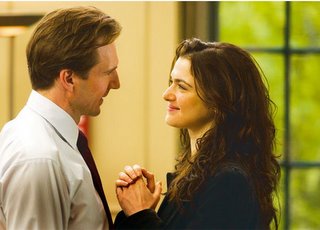
In the role of Justin, Ralph Fiennes (my distant cousin, hooray) is good, effective. unspectacular. He does awkward well at first, but develops a hardness as the character becomes more and more disillusioned with his surroundings. Rachel Weisz as Tessa, however, is even better – a very complex character with positive and negative qualities, a character we love in spite of our reservations. Given not a lot of screen time overall, she brings this character expertly to life – it’s one of those pieces of acting that make you forget the actor. Weisz is a beautiful, talented woman; I believed this before The Constant Gardener, and am completely sure of it now.

It does lose its way a little towards the end, however, as the influx of details is a little hard to cope with and may be unsatisfying for some; still, that is what repeat viewings are for. And what was the deal with Pete Postelthwaite’s accent? Still, this is overall a very effective film. Just as Justin is forced to question the world around him, so are we; how can we accept the atrocities being carried out by corporations and government officials all over the world? We must confront not only the sorry state of our world, but also our own morals and ethics. Place yourself in Justin’s situation. Would you be willing to put yourself in danger in the search for answers, or would you protect yourself and not rock the boat? Stay in your seat for the final credits: there is a postscript from John le Carré that gives the story a little more power.