Things of 2024

Listen to this post as a podcast:

Front Page
Close-up of bright orange and yellow lichen growing on a rock, surrounded by green grass.

Devoted father and husband. Committed contrarian. Impostor, loner, optimist, troll. Pushing 40. No, hang on. I am 40.

I am a contrarian because in any conversation, my instinct is to first pander and validate, then to get to the substance of it, the opposing argument, the counterfactual. Yeah, they shouldn’t have said that, absolutely – but maybe they’re still carrying some trauma from what happened before. It has indeed been a difficult year – incredibly difficult – but let’s not lose sight of everything we’ve achieved, personally and professionally, which is considerable.

Amid the hand-wringing and despair, which is admittedly tempting, I insist — mostly to myself — there is hope everywhere if you look for it. Marches for peace, iwi-led green restoration projects, the local vege co-op offering a bagful for $15 a week, even if they do often weigh it down with brassica. Then I read ‘The Three-Body Problem’ with its doomsday cult actively seeking the end of humanity and I wonder whether I’m deluding myself. On one hand this, on the other hand that. Most of all, my views are contrary to my other views.

For me, the best thing about getting older is steadily realising how little I know or understand, and consequently how much more there is to learn. Here’s a snapshot of what I noticed in 2024.

Books
A mother reading a storybook to her two daughters while sitting on a bed, surrounded by colorful bedding and plush toys.

I read 52 books in 2024. Earliest published: 1974. It’s a while since I last had a year of reading so skewed to the last half-century.

These books offered a rare combination of audacity, craft, and ideas that made them impossible to forget:

  • ‘We Are Here: An Atlas of Aotearoa’ by Chris McDowall and Tim Denee
  • ‘Gifts’ by Ursula Le Guin
  • ‘The Books of Jacob’ by Olga Tokarczuk
  • ‘In the Skin of a Lion’ by Michael Ondaatje
  • ‘The Unbearable Lightness of Being’ by Milan Kundera (re-read)

Hard to recommend a favourite but if pressed, I would go for ‘In the Skin of a Lion’. It’s a short read, for a start; no-one who reads this post is going to pick up ‘The Books of Jacob’ when they realise it’s 912 pages long. (Those who do may also be sufficiently moved to write their own short story aping it.) Ondaatje’s book has breathtaking scenes to hook any reader and a profound respect for labour, especially the dirty kind. Like one of its central characters, you won’t be able to shake the smell of the leather tanning pits afterwards, and you’ll think differently about the power and value of the collective.

These books left an impression, not as deeply but enough to still linger as another year begins:

  • ‘Dartmouth Park’ aka ‘How to Make a Bomb’ by Rupert Thomson
  • ‘Werner Herzog: A Guide for the Perplexed’ by Paul Cronin
  • ‘Seven Brief Lessons on Physics’ by Carlo Rovelli
  • ‘The Hundred Years’ War on Palestine’ by Rashid Khalidi
  • ‘Small Island’ by Andrea Levy
  • ‘You Are Here’ by David Nicholls
  • ‘Amma’ by Saraid de Silva
  • ‘Being Mortal’ by Atul Gawande
  • ‘Feijoa’ by Kate Evans
  • ‘The Gosden Years’ by Bill Gosden
  • ‘Cloudspotting for Beginners’ by Gavin Pretor-Pinney
  • ‘Outline’ by Rachel Cusk
  • ‘The Three-Body Problem’ by Liu Cixin
  • ‘The Dispossessed’ by Ursula Le Guin

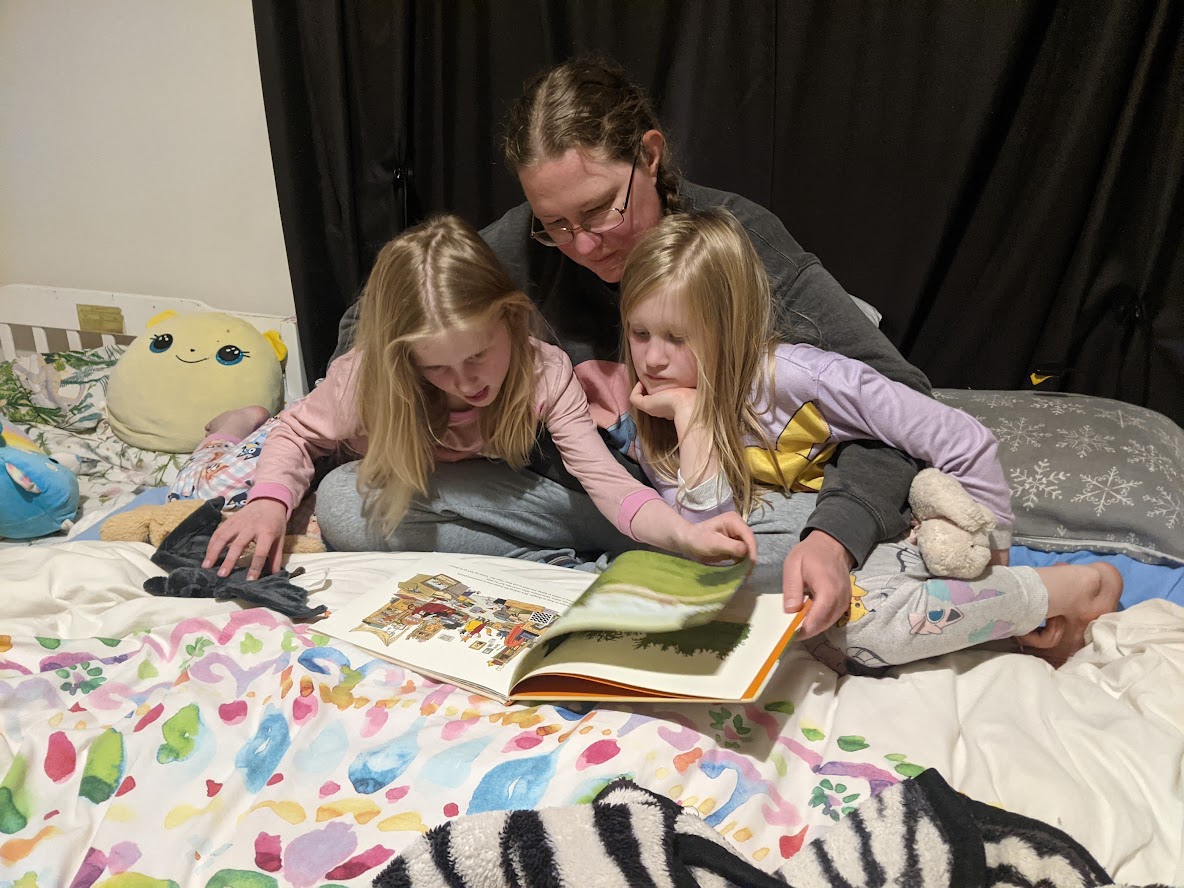
The kids are at a hybrid stage in their reading. They’re capable enough to read by themselves in bed before turning off the light themselves, and they want to do that most nights. But they want us to read them a couple of chapters or picture books first, all cuddled up in a pile on the sofa.

This means I’ve become quite familiar with Yvette Poshoglian’s Ella and Olivia series of early readers — slight, comfortable narratives in which something goes a little bit wrong but everything works out okay in the end. And we all need to be reminded of that sometimes.

The biggest breakthrough, though, was with Cece Bell’s ‘El Deafo’, a full-length comic about how Bell came to terms with sudden onset deafness as a young child. There’s an increasingly popular genre of autobiographical children’s comics dealing with serious issues like these. Raina Telgemeier, author of ‘Smile’ (corrective dentistry) and ‘Guts’ (psychogenic vomiting and therapy) is the champion, and Bell’s contribution is a worthy — and funny — addition.

At heart, these books are about learning to deal with other people knowing what’s different about you. I’m on the fence as to the value of sharing all these awful bits of other people’s childhoods with my sensitive kids because they’re as likely to keep them awake at night as to reassure them. Are they better off not knowing? Would they handle the shunts of the peer group better without a bunch of thought-provoking texts to refer to? I don’t know, but I do think books that reflect the reality of childhood and plot a relatable path through it are a public service, and I often wish there’d been more of them when I was little.

Music

My favourite ten seconds of a song in 2024 were the lead-in and drop for the first chorus of ‘Things You Didn’t Know’ by Clara La San, from fave album of the year Made Mistakes. It’s aloof to that point, a spark in the gloom: four repeated ascending notes, La San’s lead vocal and the “ooh boy” backing it up, and some simple bass and percussion loops. But then a rich bass synth kicks in, and the elements from before shine more brightly. It’s like the floodlights have come on, revealing that what you thought was a small bedroom is in fact an enormous, reverberating cavern.

Clara La San had worked and reworked this half-hour of echoing R&B, her first album, over a few years. The tracks feel lived-in for it, spacious, with an elusiveness that I would say is her signature if it weren’t for her post-breakup lyrics playing it absolutely straight. But I’ve never cared that much about the words. It’s the feeling a song evokes, more than the content. And you can swim in the feelings here. To me she inhabits a space that’s always dark and a bit mysterious, as if she’s addressing you from the other end of a long, unlit tunnel. She released a second album in December, too late in the year for me to properly absorb, and my first impressions were of some sparks of light emerging. But I still want it dark.

A close second was the second part of the chorus in Nilüfer Yanya’s ‘Made Out Of Memory’, the bit that starts with Yanya crying “people wanna blame someone” as if it’s an epiphany, like – finally I understand, it wasn’t personal.

BRAT, the biggest album of the year, didn’t pass me by either. The record about which my increasingly dismissive kids would say, “You ALWAYS listen to this!” Several standouts (and for me, quite some filler too) but the one I’ve come back to most is ‘Sympathy is a knife’ and another bone-rattling bass drop to kick off the chorus.

Other albums that held my attention in 2024:

  • Mon Amour Mon Chéri by Amadou & Mariam
  • Magda by Donato Dozzy
  • Chapultepec by Lao
  • Bright Space by Mikey Enwright
  • Silence Is Loud by Nia Archives
  • No More Water: The Gospel of James Baldwin by Meshell Ndegeocello
  • Everything Squared by Seefeel
  • PRUDE by Drug Church
  • Fragments of Us by Midland
  • Nobody Loves You More by Kim Deal

I’m talking albums still, yep. Spotify continues to push Smart Shuffle at me, switching it back on with every update as if I’d turned it off by accident. Apparently, it’s normal nowadays to open Spotify and browse for something to listen to, which I find gobsmacking when a) the interface expressly discourages exploration, and b) there are still so many other sources from which to discover new music.

There may not be any money in it but I am here to tell you the album is not dead. Go to the new releases on any media outlet that reviews music and test-drive anything you like the sound of. For me, it’s Metacritic and Resident Advisor, with the occasional dip into the ocean of noise that is Album of the Year dot org. From these, I piled up a decent set of absorbing repeat listens — here’s a playlist of samples assembled, naturally, on Spotify.

Movies

Close-up of a blue cartoon character with an open mouth, appearing surprised or excited, displayed on a television screen in a cosy room with houseplants and furniture.

A ranking of new films I saw in 2024. This won’t take long.

  1. THE ZONE OF INTEREST
  2. ENO
  3. FLOW
  4. THE BOY AND THE HERON
  5. INSIDE OUT 2
  6. ORIGIN
  7. POOR THINGS
  8. KUNG FU PANDA 4

I saw ENO and FLOW on the same day, making it two years in a row I’ve done the ‘dialogue-free animation about animals / music industry titan whose name starts with EN and ends in O’ double-feature at the New Zealand International Film Festival (in 2023, it was ROBOT DREAMS and ENNIO). Both films attempt to do something different and new, and although the artificial intelligence conceit at the heart of ENO felt like more of a gimmick than an artistic success, the man’s charisma and intelligence shone brightly. FLOW felt unfinished technically, especially the lighting of the animals, but its sense of the cinematic couldn’t be dimmed. Now that it’s getting all this awards attention, I wonder if there’ll be a director’s cut with retouched shading.

Jonathan Glazer’s THE ZONE OF INTEREST towered above both. It’s a film of operational delivery and domestic routines with an extraordinary soundtrack: genuinely, there are two films here, the one you see and the one you hear. I wasn’t convinced by all the choices made, and I think it’s right to expect perfection of a film about Höss family values and dynamics. I am however happy to follow Glazer into the abyss again and again, because he has that gift of both putting on a show and making you think, often uncomfortably. There’s no-one else like him working today.

A few highlights from the few other films I caught up with in 2024:

  • SHOWING UP
  • ALL OF US STRANGERS
  • AFTERSUN
  • PAST LIVES

All enjoyed in a two-week period in the middle of the year. That was just before I got my Switch.

Tech and Gaming

Screenshot from a video game showing characters receiving experience points and gold coins.

I’ve kept the most profitable entertainment industry of this era mostly at bay for years, content to wallow in Doom mods and Championship Manager 01/02. But then I was gifted a Nintendo Switch in July 2024, and since then, the numbers speak for themselves. In the second half of the year, 100+ hours on FC 24 and Dragon Quest XI respectively, plus another 40-50 hours on a range of other games. An average of two hours a day for six months.

Hence so few movies, and hence zero activity on this blog since June. Nothing stimulates the brain like gaming: flashing lights, bright colours, and a sense of control, even mastery, you’ll rarely experience in daily life. Some games upend these norms, but not many. So, high on this new device, I played some games.

  • FC 24 — it’s a football game, so it was always going to consume my life to some extent. I took Cambridge United from League One obscurity to Premier League glory. More time-pass than obsession, but I cannot be interrupted while playing.
  • Dragon Quest XI: Echoes of an Elusive Age — 100+ hours over six months seems like a lot to be sure. But then Bex said she completed it much faster than your average player would, as in a matter of days, and I felt a bit different about the way I’d gone through it. This JRPG is heavily burdened with cutscenes and dialogue, like an epic TV series you can run around in, so the kids have come to enjoy watching me play it. Indeed, we may have spent more time together with Dragon Quest XI than with anything else in 2024.
  • Golf Story — a 2D golf role-playing game and the first game to sink its claws into me. Good writing and fun gameplay made this a satisfying experience.
  • Lonely Mountains Downhill — mountain biking simulator with fun, exploration friendly tracks and an asymptotic mastery curve. Surprisingly, of all games, this is the one Tara and I have bonded over the most.

Also, have you noticed the explosion of ‘AI’ as a byword for ‘current’? Most major tech companies put it front and centre on their websites, and anyone who wants to keep up with current events now needs to educate themselves, ongoing, like a university professor, so they aren’t duped by deepfakes. I took a friend to task for featuring AI-generated images on his website and he was more bemused than affronted. It’s not that big a deal to most, perhaps because the technology is still relatively nascent. The scary thing is how thoroughly the world’s richest have thrown all their eggs into it. With their commitment, AI — however intelligent — will define our lives for years to come.

Politics

I feel a profound need to just chill, a political imperative to do so, before industrialised society is everything but chill. Otherwise I feel some paralysing mixture of angry, contemptuous, distressed, and amused at the rolling coverage of metaphorical and literal atrocities swamping my socials and my news feeds. Next up from your favoured news outlet, a feature story on the First Lady’s hat. Surely it’s best to sit out the next four years of news.

We’ve come through the waves of COVID-19 and turned the boat backwards. Ka mua, ka muri, goes the whakataukī: walking backwards into the future. This too shall pass. In 2024, I became a school board member, finally fulfilling a long-held promise to myself to get involved in the community somehow. Local is where you can make the biggest impact. Basically anywhere you can kōrero kanohi ki te kanohi (talk face to face). But don’t forget to check in on those friends abroad who can’t absent themselves from the news cycle playing out all around them.

As a colleague once said, storming off to the kitchen to make another coffee: “everyone needs to just fucking chill”. Most of all the planet.

Travel

The snow and ice far beneath us scrolled by. The frames of the Sky Waka pylons were encrusted with stalactites. The weather was good, a photogenic mixture of clouds and sun — a sun that in the vanishing distance illuminated Ngāuruhoe’s striking cone, with Tongariro broad and massive behind it, both dwarfed by the mountain we were ascending. I’ve never seen it like this, I thought.

It — the Sky Waka trip up Ruapehu — was the literal high point of one of our most successful family holidays yet. We used to squabble constantly on our family holidays, worn thin from lack of sleep and unmanaged expectations. Now the kids are older, we’re all better rested and better able to follow through on our grand plans, or deal with it when the plans go out the window. We embrace imperfection, like the boil-water notice in our Alfriston AirBNB — “why are we on a farm?? This is not ‘staying in Auckland’!” — but still cram in the activities, big and small.

It pissed down on us at Rainbow’s End, a proper soaking while on the log flume of all things, and my kids (six years old at the time) said they were cold one time only and then ran to the next thing. Hot pools, whānau meetups, zoo animals, botanic gardens, museums, and the mountains of the central plateau on full and glorious display once again on the way back down. A remarkable week.

Sport

Two things. First, cricket. The most incredible 24 hours of New Zealand cricket of my lifetime, and probably of all time. One Sunday evening in October, the White Ferns won the Twenty20 World Cup against all expectations.
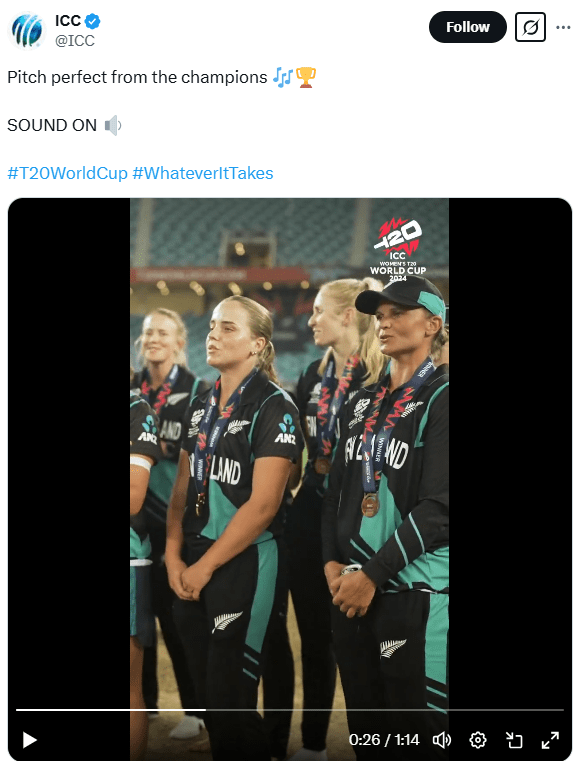
No team has my heart like the White Ferns. I can ride any up or down with the Black Caps, having plumbed many depths with them over the past three decades. But my hope and expectations and belief in the White Ferns is fresh, and vulnerable. I’m overjoyed when they win and bitterly disappointed when they lose. And they lost a lot in the lead-up to that tournament — ten matches in a row — making the march to victory even sweeter, like tumbling off a precipice on a hunt for a mountain spring and finding the water is best at ground level.

In the clip linked above, the players stand barefooted (or sockfooted) on the Dubai turf, grounded at the scene and in the moment of their greatest triumph, acknowledging their captain who’s been through it all in 18 years of international cricket. There’s another, more raucous video of Georgia Plimmer tearing around the changing room and air-guitaring ‘Don’t Stop Believin” with the trophy. But it’s those feet on the ground, swaying in time to the waiata, that stay with me.

Not that the Black Caps aren’t dear to me. I have, after all, plumbed many depths with them over the past three decades. That same day, the Black Caps beat India in a Test match in India, which we’d managed twice in 36 previous Test matches and not since the 1980s, against an India side that had only lost four times in 50 matches during the 2010s. It was completely unexpected; even more surprising, the Black Caps went on to win the second and third Tests as well. No visiting team had ever done that before.

As far as I’m concerned, this is the New Zealand men’s cricket team’s greatest ever achievement. A bigger deal than the World Test Championship win of 2021 or the Champions Trophy win of 2000.

Second, Olympics. Hours and hours on the in-laws’ sofa next door, where their 75-inch TV broadcast the Olympics day and night. The kids having that moment of fascinated inspiration I had as a kid — knowing the Olympics would mean something to me for the rest of my life — and making posters at school saying they want to be in the Olympics doing artistic gymnastics when they grow up. “They’re good gymnasts,” said one of the coaches at the gym they go to for an hour every Wednesday. However long they carry on with it, the spark of sports and athleticism is alive in them.

People

Family selfie with two children and two adults smiling outdoors, wearing hats, in front of a modern building.

We, our family of four, all sleep in the same room. It’s been like this since the kids were three. For at least two years we’d battled to keep them in their own beds, every night another capitulation, with me folded onto a too-short sofa and Tara being kicked in the stomach by at least one child. Then we went on holiday in early 2021 and bunked in all together in various configurations, and all slept sounder than we had since they were born. It seemed foolhardy to return to those nightly battles after that — though we did, for a brief and insane trial period when the kids were five, and gave up quickly.

I’m coming to think of our sleeping arrangement as a metaphor for our shared existence. Biology and circumstance threw these four people together in a giggling, screaming pile; a tight-yet-expanding bubble of all our best and worst selves. We love each other so much and drive each other properly spare. And we do all this in the middle of the night, too.

It is a temporary arrangement. My children are meeting more of the world on their own terms every day, forming their own relationships with school, books, the high bar at the gymnasium, and the rivers and trees and rocks of the great outdoors. But they still want us to watch and tell them how well they’ve done, and they still want us in the room with them when it’s dark. They’ve said a few times that they’re going to kick us out soon, but they haven’t yet summoned the necessary boldness. Our co-dependence is part of who we are.

The same is true of Tara and I. In the four years after we met, we moved in together, moved overseas, came back home, got married, and became parents to twins. We knew pretty early on that we wanted to make a life together, but as with all relationships, you don’t know how that’s going to work day to day until you’re in the thick of it. Now we are eleven years in and more or less incapable of making decisions independently.

Part of how we manage our co-dependence is to needle each other almost constantly. For example, if I say “that’s annoying” about something — a malfunctioning TV remote, a buzzing fly, some new horror on the news app — and I’m within Tara’s earshot, she’ll say, “Did you see your face in the mirror?” And it’s old, and tired, and often much more annoying than the thing I was initially annoyed by. But if she didn’t say it… well, what would be the point of being married? I have no stats on this but I’ll wager a substantial proportion of relationships in the Western world rely on cheap gags about a partner’s face.

I don’t know whether this constant giving of shit (and attendant low-key swearing) offers a good example to our kids. I do know they get that from Tara’s conscientiousness in all aspects of parenting, especially the banal. Keeping the pile together and looking ahead to the next thing.

What’s next? The kids will want their own rooms soon. We’ll stop picking up after them quite so much. We’ll have a big family holiday overseas, one we’ve planned and saved for since 2018. And we’ll stay close to our parents, as much as we can. Trying to keep our feet on the ground and be where we are, just like the White Ferns.
Kickstand

A few years ago, I picked up a copy of After Dark by Haruki Murakami in a library book sale. Five for a dollar! I peeled the duraseal off, scrubbed away the patches of glue it left behind, and put it away for later. (See: tsundoku.)

Flash forward four years, and I finally got around to reading it last week as part of my 2017 Only Reading Books From Years Ending in Seven project (the English translation was published in 2007). The book is slight, a diversion, although – in typical Murakami style – it does hint at an opaque world of unsolvable, half-drawn mysteries.

One such mystery particularly caught my imagination, and it comes not from the mind of Murakami but from a previous reader. Library books are supposed to have many readers, after all; you can usually only guess at how many, and who they were, and what impression the book left on them. This reader, however, made three notes over the course of After Dark’s 200-odd pages. Each is in the same black ballpoint pen.

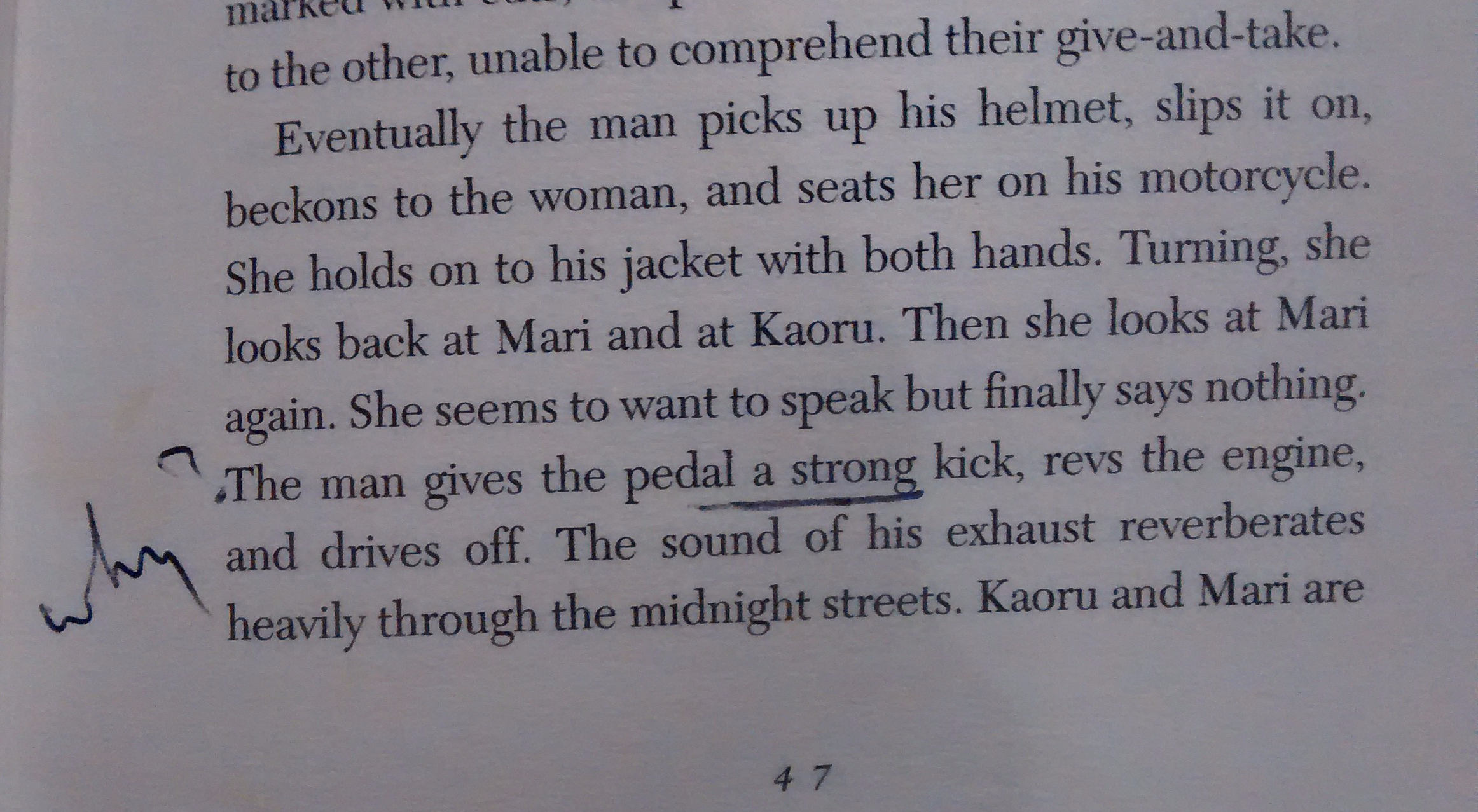
Here’s the first, from page 47:

After Dark: a strong kick, why?

There’s plenty of overwriting in After Dark. Murakami quite indulges himself by giving his omniscient, disembodied narrator full licence to describe the least consequential aspects of a scene and wax rhapsodical about these tiny moments of city life and what it all means. This technique is effective in building a small world of rich detail, but it can make for dull reading.

This previous reader, though, got hung up on Murakami’s (and translator Jay Rubin’s) decision to modify the motorcyclist’s ‘kick’ with the adjective ‘strong’. Now, I’m no line-by-line editor, but this choice seems quite reasonable to me; it draws attention to the motorcyclist’s physical presence, and to the machine’s weight. I feel like underlining their ‘Why?’ and writing the same thing alongside it.

Later, on page 79:

After Dark: a big kick

Now the kick is ‘big’, and that’s caught the reader’s eye. There’s no annotation in the margin this time. I can appreciate that ‘big’ is not as descriptive as ‘strong’, but is its inferiority as an adjective the reason for its underlining? Perhaps the reader thought ‘strong’ was too much, where ‘big’ is just right. Perhaps the reader is a motorcyclist and takes issue with Murakami’s representation of ignition. We can only speculate, because the reader isn’t giving us any more.

Finally, on page 172:

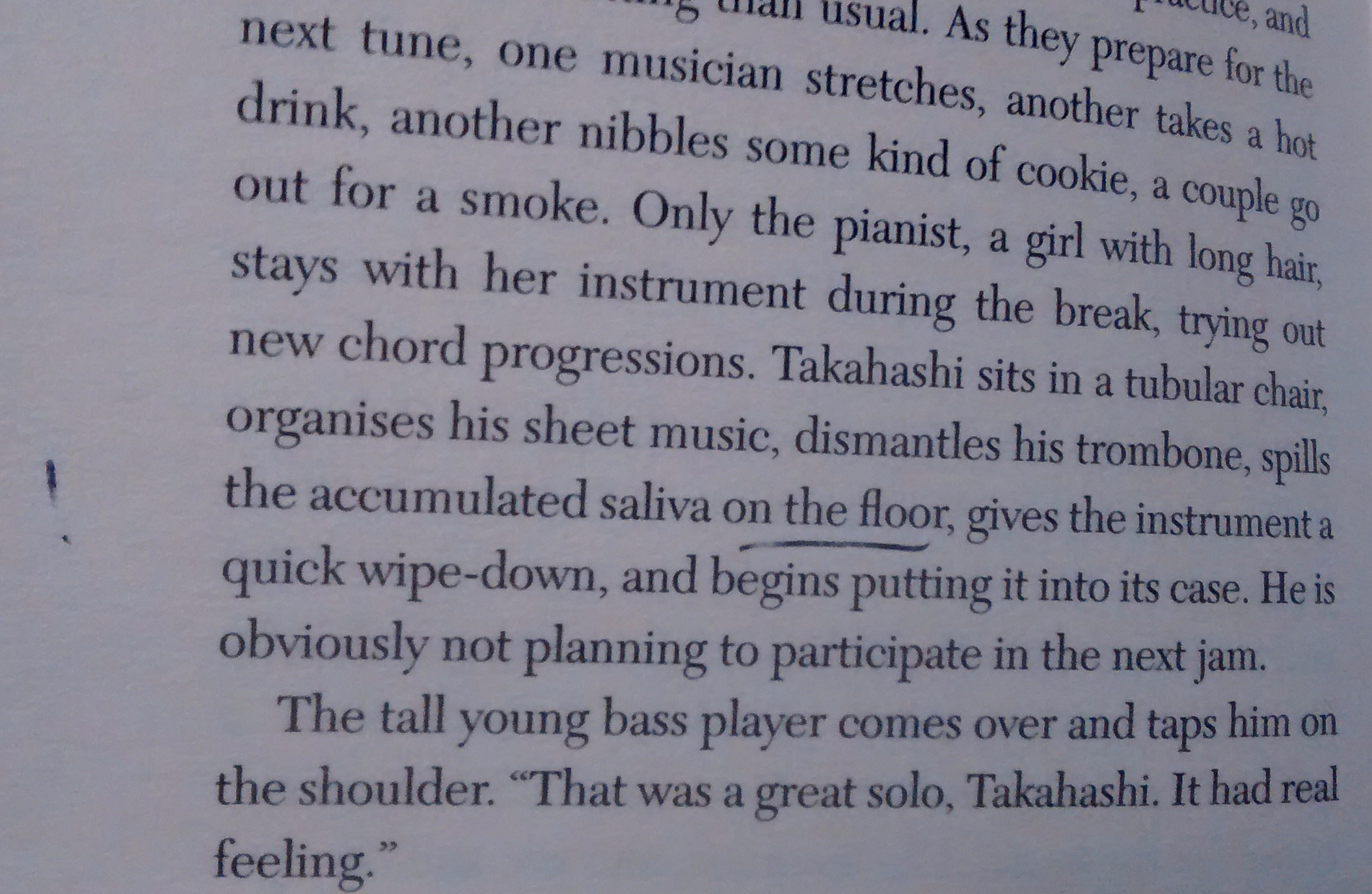
After Dark by Haruki Murakami, with accumulated saliva on the floor

Now there’s an image worth underlining, an image with real feeling. (!)

(See also: Inside David Foster Wallace’s Private Self-Help Library, a great piece in The Awl by Maria Bustillos. Now there’s a person who could write a good annotation.)

Chaos out of chaos

Fluffy Chaos (via xdxd_vs_xdxd on Flickr)

I used to write in a journal every day, except I called it a diary. ‘Journal’ seemed too American. I, a stubborn an impressionable 16-year-old, was proudly aligned to British English after the influence of my crusading older brother and my Received Pronunciation-tinged mother. Both have either said or written the words ‘don’t forget your roots’ to me in the years since, usually in relation to a point of language.

(For some reason, ‘journal’ is acceptable to me now, and seems more appropriate than ‘diary’. Perhaps I have become Americanized, despite the best efforts of my kin.)

The storm of angst in my teenage head poured out into those Word documents at the end of each day. As I became more and more reliant on my journal to make sense of my thoughts, and of my burgeoning selfhood, I took to writing in it first thing in the morning, during free periods at school, and after dinner — whenever some frustration in my head demanded the indulgence of my complete attention.

The first few years of entries are often unreadable and fall largely into two categories: 1) angry screed against authority figure, or 2) hopeless pining for crush. Confrontation was too terrible to contemplate, and the idea of actually telling a girl how I felt about her was even more mortifying. Thank goodness I had my journal. Without it, I might have exploded and started a war by now.

I remember taking great pride in some of my entries, such that I wished I could share them with other people. But that was simply out of the question, as likely as walking down the street naked. I resigned myself to the fact that I would have to keep my journal all to myself; to revel privately in my finer paragraphs.

Sometimes, even early on, I would address my future self directly, and as an authority figure. Don’t fucking write this off as the stupid fucking ramblings of a fucking teenager, etc. (I swore as much as possible.) I have to admire my committed defence of my thoughts, just as I would admire a carefully considered rebuttal of climate change, no matter how blind it were to the truth. I seem to have known exactly how immature my thoughts were, and sought to preempt criticism by firmly stating that my experience was nonetheless valid: that there was order in the chaos of my mind.

*

When I got into my first proper relationship, aged 22 and living in a foreign country, my journal faded into the background of my life. For years it had provided me with a non-judgmental space in which to bash out how I really felt about something. Now I was spending a lot of my time with another person, and often confiding in her, rendering the journal obsolete — except when I wanted to analyse our stuttering relationship, which occasionally brought me back to the keyboard. Fuelled largely by the fear of losing her, these entries were laden with far more painful frustration and inadequacy than the pining of my teenage years.

But these occasions were irregular. I feared she would discover my journal, and that was unthinkable, so I kept away from it as much as possible, only returning when things got really bad. You could chart the good times in our years together by the gaps in my journal.

She did eventually read the journal — without my permission — and was aghast as the tide of negativity swamped her. It didn’t matter, though. The relationship was already lost.

*

Since meeting my current partner, my journal entries have become even more sporadic than they were during that earlier relationship. The main difference is that I have less time to write in it. She refuses to waste any opportunity for a new experience, leaping out of bed on sunny Saturdays and planning a hike or some other outing, or planning a minute-by-minute itinerary for our holidays.

After some initial resistance, I have been swept up in her zest for exploration. Weekend trips away often transpire in a chaotic flurry of activity: of last-minute packing; of wrangling other family members; of board games and large meals and swims in the sea. My participation began as a somewhat grudging attempt to connect with her, coming as it did at the cost of the hours I used to spend sitting at home, but I now go willingly. Getting out and doing things gives me more satisfaction than staying in and thinking about them.

But what of the difficult times? In my previous relationship, the worst of both of us was privately poured out and dissected in my journal. The openness I share with my partner makes that analysis redundant. We aren’t perfect communicators, but where possible, we figure things out together.

I remember it all much less clearly than I used to when I noted and discussed everything I did in my journal. But the moments themselves are more vivid, like a sheer curtain has been pulled away. It’s a trade-off I happily accept, and my hope is that as we grow older, we can keep our experiences alive by filling the gaps in each other’s memories.

A tribute to Peter Roebuck

Peter Roebuck © Cricinfo

Former Somerset cricket captain and respected cricket writer Peter Roebuck has died aged 55 in Cape Town. He was covering Australia’s tour of South Africa. Ian Fuge, managing editor for sport at the Sydney Morning Herald, a paper for which Roebuck was a regular columnist, said “Peter was a wonderful writer who was the bard of summer for cricket-loving Australians. He was also an extraordinary bloke who will be sorely missed.” [source]

For me personally, Roebuck’s death signifies the passing of a writing hero. I grew up reading the sports section every morning before school, hoping that if I wouldn’t some day realise my dream of being an All Black or a Black Cap, I could at least write about them for a living. Of all the sports writers I’ve discovered through those years and into adulthood, Roebuck’s byline is the one that will ensure I read the piece. He seemed such a naturally gifted writer, one who could’ve written about any subject he chose but found himself most entranced by cricket. He wrote honestly, never afraid to confront the darker aspects of ‘the gentleman’s game’, One could be certain that nothing less than the highest quality would be attached to his name.

Now that he’s gone, I am of course discovering that his exceptionally high standards were a hallmark of his career with Somerset, as well. From this citation for his being recognised as one of Wisden’s Cricketers of the Year in 1988:

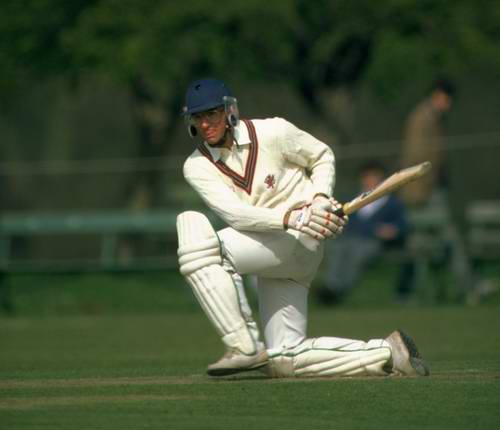
Roebuck in action for Somerset © Getty Images

His current vice-captain, Victor Marks, a friend of many years, said, He seems to thrive on contest, competition and conflict. He rises to the occasion, is very much alive and always reacts in a positive way. He has improved dramatically over the past few years, with the security of his position and the captaincy. He puts a great deal more energy into his job than most people could. Somerset’s coach, Peter Robinson, recalled many hours spent with the bowling machine, ironing out technical faults which he, Roebuck, had found.

Roebuck also contributed routinely insightful columns to Cricinfo. Fellow cricket writer Suresh Menon wrote of his work:

Roebuck’s short commentaries distill a lifetime of experience through history and anecdote. There is a purity in the form that is at once attractive and challenging. Of all cricket writers, Roebuck is the least imitated because he is the most difficult to imitate.

I suspect millions of cricket fans over the coming days will be scouring Cricinfo and the web for information about Roebuck and, like me, discovering things they might never have looked up had he not died so devastatingly young. As much as anything else, this could be a commentary on the incredible value offered by his columns: I never sought to know more of the man to whom such a distinctive, essential voice belonged. His ever-articulate words were enough to form a deep impression – of decent character, of high quality and of deep understanding.

May Peter Roebuck rest in peace, and all his fans continued to inspired by his words for decades after he’s gone.

*

Here’s an excerpt from what turned out to be his final column, about the Australians’ performance in an utterly bizarre first test. It is a technically minded piece, not the best representative of his work, which tends to be wide in scope and lofty in ambition. But notice the economy of language with which he makes his points:

Apart from technical flaws, the collapses raised even more fundamental issues. How long can Shane Watson continue as a front-line bowler and opening batsman? History provides few instances of a cricketer able to sustain both workloads. The time is ripe to put him in the middle order.

[…]

Brad Haddin also needs to rethink his batting. His reckless shot was a droppable offence and confirmed his confidence is in his boots. He, too, has a single match to turn around his fortunes. A new broom sweeps clean.

Ironically Johnson, a bowler, is the most likely player to be dropped. However the team for the first Test against New Zealand has become harder to predict. Mind you, a lot can happen in a week. It just did.

*

UPDATE: I’ve been reading a lot of Roebuck today. Here’s an excerpt from one of his 116 columns for Cricinfo entitled ‘Stuck in the middle’:

As a breed, batsmen are haunted by the prospect of failure. It hardens them, tightens them, sometimes exhausts them. A centre-forward unable to score can still chase and create. A tryless winger can tackle and support. A batsman must score runs: it is as simple and stark as that. No words can protect the player from this truth. His existence depends on his productivity. Arthur Miller could have written a play about it. Every time he goes to the crease, a batsman confronts doom.

[more]

Also, the cause of Roebuck’s death has not yet been announced, so conspiracy theories will surely follow – especially in light of reports that he seen talking with police and ‘in an agitated state’ on the same night. Whatever is written in the coming days, and regardless of what actually happened, I hope everyone can remember that we would do better to mourn a fine writer than play pseudo-detective. I’m sure Roebuck would agree. After all, he wrote in 2007 of his disgust at the hackery that followed Bob Woolmer’s death:

But let us not allow one man to carry the can. Although it was reasonable to accept the experts’ initial verdict that Woolmer had been strangled, too many of us were too easily prepared to believe that Pakistani players or at any rate supporters were the culprits. In our own way we were as guilty as those involved in the burning of the witches in Salem or the rounding up of supposed American communists in the 1950’s.

[…] At such times we must be thankful for due process, that a man may be condemned only by fact and not prejudice.

In praise of Roger Ebert

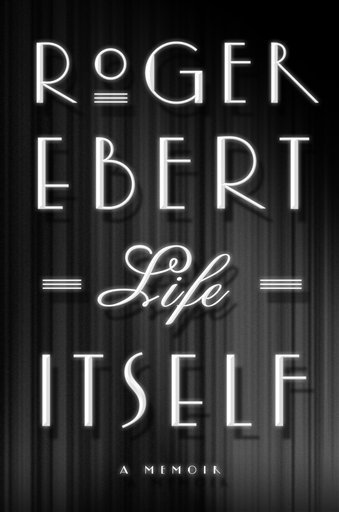
'Life Itself' by Roger Ebert, on release this week

“But now it’s getting late, which means he has his own work to do. Chaz heads off to bed. Millie, for the moment, hasn’t been seized by night terrors, and the brownstone is quiet and nearly dark. Just the lamp is lit beside his chair. He leans back. He streams Radio Caroline — the formerly pirate radio station — and he begins to write. Everything fades out but the words. They appear quickly. Perfect sentences, artful sentences, illuminating sentences come out of him at a ridiculous, enviable pace, his fingers sometimes struggling to keep up.”
-‘Roger Ebert: The Essential Man’, by Chris Jones, Esquire, March 2010

Roger Ebert, more than anyone else, is the reason why I wanted to be a writer. I think most of us have an initial reference point from whence our passions arose, like a car enthusiast’s formative obsession with the 1961 Lincoln Continental convertible or a young swimmer watching Michael Phelps sweep eight golds at the Olympics. I write because I have always written, since I was a small child, but I take my inspiration from Ebert above all others. His writing is honest, principled, informative and articulate, always entertaining, never boring.

When I first started this blog on Blogspot back in 2004, it was to practise writing film reviews, and I said in the first entry (since deleted, time wasn’t kind to those words) that I hoped I would one day be Ebert. I hadn’t actually been reading him for very long at that point – maybe a year or so at most – but he’d already become the standard to which I aspired, for reasons I’ll attempt to put into words further down the page. It was my plan to write reviews of most of the films I saw in an effort to get better at watching them, but my bigger hope was that I would at least become a better writer, if not a successful one.

Over time I’ve written less and less about film, and taken on a wide range of other writing influences. To my great surprise, it is India that has given me the inspiration, impetus and support to be a bit more successful as a writer, and not film. However, I’ve continued to read Ebert – who in fact has also written less and less about film, proportionally at least. In addition to the weekly film reviews he’s been filing regularly for over 40 years, and the other writing he’s compiled in the form of interviews, features and books, Ebert now has a blog, too. He writes on many subjects besides film, most of them aspects of his colourful life Every entry is a joy to savour. The blog was the main reason behind his winning the 2010 Webby Award for Person of the Year – not only for the quality of the blog entries he posts but also for the quality and depth in the comments he receives, which are sometimes even more fascinating than the entries themselves.

The definition of a good writer is elusive, and likely subjective. The standard of one’s readers, like the myriad folks who comment on Ebert’s blog, might be a pretty good one. But a definition that appeals to me is this: a good writer articulates thoughts in ways the reader might not have arrived at on their own. Even if they are thoughts with which the reader strongly disagrees, the writing itself can still be compelling in the hands of a vivid wordsmith. Take, for example, Arundhati Roy’s work in recent years, which can be as misguided as it is literary. On the other hand, saying what a lot of people are thinking can be even harder; one has to work the words on the page into a form that somehow impacts on a reader who agrees with them before he or she even reads them.

With Ebert, whether I completely disagree with him, completely agree or am ambivalent (I usually agree), there is always something new to discover in his words. Perhaps some film fact I never knew, or the name of a new actor to watch; most often, it is the sentences themselves that offer the greatest delight. They frequently surprise me, flicking a ‘how did he do that?’ switch in my head.

I find Ebert’s words returning to me at unexpected moments as a way of articulating what I see before me, or to offer something of value to a conversation with someone else. Ebert’s words are often so tightly formed that they sometimes seem to have always existed, like he plucked them from the sky and set them before me. And his words become part of me even as I read them.

After decades of getting those words in small chunks (though nowadays, with his blog and Twitter and Facebook etc, those chunks arrive more frequently), now we have Roger Ebert’s memoir ‘Life Itself’. Thousands upon thousands of those words, all arriving at once, and I am certain they will be just as much a joy. Thank you, Mr Ebert, for being such an inspiration.

The Land of Open Expression

Over in the central Palace Hall, there seemed to be more of a calm that befitted such a princely and tradition-filled room. I remained there for the rest of the weekend as part of an extraordinarily varied audience. There were: distinguished local retirees with a passion for language; twentysomething Malayali men asking me for my mobile number within minutes of meeting; young tourists in summer dresses and sunglasses; local professionals, well groomed and dressed; adolescent children sitting unusually still; fellow resident foreigners of all backgrounds; and many of the authors themselves, catching another speaker’s session.

…read more at The NRI…

Writing a NOVEL now, wahey

I just realised that I self-promoted my National Novel Writing Month all over Facebook, Twitter and the NaNoWriMo forums, but didn’t make it obvious on my own site… so in case you didn’t know about it, and are interested in how my NOVEL is progressing – with all the searing insights gleaned thus far – click on ‘NANOWRIMO’ in the buttons at the top of the page.

If you can’t be bothered scrolling all the way up to the top of the page, or are sneakily reading this via Google Reader or similar, click here.

“the blog has given me a reason and the freedom to enjoy writing again”

Jill Haszard is the author of Just Bung It In, a blog about being a mum, wife and PhD student. She is also my sister-in-law, married to my DJ brother, and mother to my nephew and one of my nieces. After spending a few years in Sydney in the early part of the 00s, she and her family decided NZ was the place they wanted to be and started making a life in Dunedin; her posts reflect the various aspects of family life in NZ’s deep south – school, work, holidays, the neighbourhood, renovating, househunting etc.

Her words and photographs are obviously very meaningful to me as a close family member, but my enjoyment of them is not merely obligatory. I feel her writing style has just the right amount of detail and is very easy to get lost in – not to mention some charming experiments with the structure of her posts. Seeing my niece and nephew grow through her blog is an important part of my life, and it’s also fascinating and informative to learn more about her PhD study in nutrition.

Like most of my interviewees, Jill is a very busy person, but still found time to answer my questions. I suppose that busy people are much better at getting things done!

***

Why did you start blogging?

To connect with friends and family that live far away. To share photos of my children with those that I want to be a part of their lives.

Have you ever kept a personal journal? If so, do you see Just Bung It In as an extension of that journal?

I have kept journals in the past but I think the blog is quite different because it has that immediate audience. However, I do see my blog as a diary of sorts. It is a record of bits of my life and I really enjoy reading over past blogs and looking at the photos, as I would a photo album or a scrapbook.

What is your first memory of writing creatively?

When I was 5 years old I wrote a story that was at least a whole page long. I drew a picture to go with it and I felt that I had written this epic masterpiece. Mum sent it into the local newspaper and they printed it – I was so proud but it was a reality check to see my story printed in only two lines…. I guess my hand-writing was quite large when I was 5.

I’ve always enjoyed writing to some extent. What I’ve lacked is the confidence that I’m any good at it and I eventually came to the conclusion that it will never be a great skill of mine. However, the blog has given me a reason and the freedom to enjoy writing again.

Describe something that is beautiful to you.

There are only two things in this world that actually make my tummy flip with their beauty: my children. Sorry to be such a cliché Mum!

My daughter’s smattering of freckles; my son’s brown eyes; their knees; their necks; their skin; their lips; all the little parts that amaze me. When they are busy and lost in their own little worlds I don’t want to take my eyes off them because they are absolutely stunning to me and perfect in that moment. Nothing in this beautiful world even comes close to the beauty that I see in my kids.

You maintain a posting frequency of about once or twice a week, despite being very busy. Do you set specific time aside in your weekly routine to write, or is it whenever you get a chance?

If I go for longer than a week without posting a blog Mum rings me up and complains. I write for my Mum!

I do prioritise blogging because it is something that is important to me. I also know that if I left it three weeks, or more, it would become this massive task to catch up and I don’t have the time to do that. So even if it is just a small story, a thought or a stack of photos, I keep it chugging along so that things don’t get away from me. I don’t put too much pressure on myself to make it perfect, I just do it (hence ‘That’ll do’) and that works for me. Usually a Saturday night offers itself to blogging.

Has your blog helped you in other areas of your life?

Interesting question. I’m going to say yes to that one because it helps to form my ideas and thoughts more. When I’m mulling over something I want it to develop and mature a bit before it becomes a blog topic. Also, having a blog about my life helps me to see the good side of things. It helps me to see myself as worthwhile. Oh, and I can’t forget that the regular writing will probably have been a good thing when I come to write my thesis – eek!

Do you feel that you have complete control over ‘Just Bung It In’, that it has a life of its own and evolves on its own, or somewhere in-between?

I feel I have total control over it. It’s my life story really and I pick what goes in there!

Is there a post on your blog that you are most proud of?

No I don’t think so. The blog posts that I enjoy rereading the most are the ones with pictures of holidays and the little stories of things that my kids and husband do. In the end, this blog is for me.

Name two countries: one you’d like to visit, and one you’d like to visit again.

At this time in my life I have no pressing urge to travel the world. I love New Zealand. My dream holiday is the one that we take every Summer: camping on a classic NZ beach with friends and family. If I won Lotto I wouldn’t change the destination, I would only buy a bigger tent and a flasher beach lounger.

Ask me this question in 10 years and it may be a different answer!

Do you believe in God?

I believe that every individual has their own reality so God does exist for some. I don’t deny the existence of God for others. However, my reality does not have a God. I believe in nature and the wonder of the world. I believe that there is more. But I don’t believe in a God.

***

This interview is part of Inside the Bloggers Studio, an ongoing project of short interviews with bloggers I read and admire.  (Apologies to James Lipton.)  To view the archive, click here.

“Inaie the blogger is the one who cannot keep her mouth shut, and she tells on all other Inaies”

At Yosemite, California

Inaie Ramalho is the author of Inaie – out and about, a blog about her life and travels as a serial expat. Her homeland is Brazil but she has lived in Australia, New Zealand and the UAE, and is currently based in Bahrain with her husband and two daughters. She writes mostly about her and her family’s travels and lives, with plenty of accompanying photos, but also about all the people close to her in her life.

‘Out and about’ is certainly true, then, but one realises that she has her eyes wide open with curiosity as she goes from place to place, person to person, experience to experience. Her writing is typically open-hearted and direct – she has little use for self-censorship – but a sense of what really matters to her shines through, as well as a desire to learn and understand more about herself and the world around her.

I discovered her blog after she left a comment on mine, and was immediately intrigued by the fact that she double-blogs in English and in Portuguese (which she clarifies further below). Having looked into her archives and found them at times hilarious, at other times moving, I asked if she would answer a few questions, and she responded in record time. All photos used with permission.

***

Why did you start blogging?

When I left Brazil I started writing  emails with “my stories” to friends back home. They were emails with my feelings, my discoveries and a bit about everything. A way to stay connected. 10 years later, I was still sending the same emails, but my “receivers” list was much larger and incorporated friends from all countries where I lived. I was writing my emails twice. In English and in Portuguese.
If I were tired, fed up, or just had nothing to say and did not write frequently enough, these friends would send me angry emails, complaining about my absence.
Because of it, I made a point of writing regularly, but Yahoo was blocking my account every other day, calling me a “spammer”. Every time I was blocked I felt so p’off, I would promise I would start blogging. But then Yahoo would unblock me, and I would forget all about it.
I also had several friends asking me to start blogging. BLOG! BLOG! BLOG! they would say…
Recently I met a FAB lady who is a professional blogger, she translates blogs from several languages, she does a pretty serious job with this blogging business. When she told me I should blog, I thought: Well, maybe I should. ‘A’ is someone who knows what she is doing… she has not been my friend for long and has no reason to say things just to please me.
I started the blog, thanked her for “making me do it” and received furious emails from all those friends who have been saying the same thing for ages, with no result.

Bridge near San Simeon, California

Do you keep a journal? If so, what relationship do your blog and your journal have with each other?

Nah. No journal. My mother used to break the lockers to read my teenager journals. Initially I would make up these horrible stories, about unthinkable things, just to terrify her. After a while I just lost interest. If I could not be true to my journal because my darling mother would read it, what was the point? I never went back to journal writing, unfortunately. Today, my revenge is to write things she would not want to know in an open forum – and I know she still reads it.

What is your first memory of writing creatively?

I always enjoyed writing, I remember being 8 or 9, and spending hours making up stories… As I grew up, I realized real stories are far more fun!

Describe something that is beautiful to you.

This is going to sound so tacky, but my girls’ smiles are the most amazing sight. When they look at me and smile, the whole world changes colors, all sounds seem far more clear and beautiful. It is just amazing!

I have pictures of them on my phone; when things get rough, I just look at them and smile too.

Ramalho girls in Santa Barbara

You blog in both English and Portuguese. Do you try to convey the same feeling in both languages, or do you attempt to express yourself with the difference nuances of meaning to which each language lends itself?

You are mistaken. My blog is both in BAD Portuguese and Pidgin English, as I explain in the first line of the blog, but your question has its merit. Initially, my idea was to write in one language and then translate to the other – but as I started doing it, I found it just impossible. I write one story, then when I tell the other one, I remember different facts, I use other visuals; I just write all over again instead of just translating it. Sometimes the texts are completely different, although they talk about the same thing and they are both true.

Have your experiences living and travelling in various different countries changed your belief system(s)?

They sure have. This lifestyle taught me to be more tolerant with the world and see people under a different light. I used to think WE were right (whoever we were) and THEY were wrong. Now I don’t believe in us and them. People are just submitted to different stimuli, grow up under different circumstances and form their values based on these experiences.
People behave different because they see things different. In most cases, there is no right or wrong, in my opinion.
All this traveling made me want to travel more, want to know more, to learn more… life is a fascinating journey!

On the road in California

In your Blogger profile, you mention ‘several Inaies living together under one identity’. Would you say the ‘blogger Inaie’ is distinct from the others, or more an attempt at representing all of them?

Inaie the blogger is the one who cannot keep her mouth shut, and she tells on all other Inaies. She is the gossiper. She would get in trouble, but would not lose the opportunity to tell her story. With my life story, I do live many different realities in one. I am an only child, but I live far, far away from my parents. I love my dad desperately, but I have not seen him in four years. If you ask how I would feel if I did not see my children for a year, I would say it would just not happen. I could not survive without them. Both of them. I am Brazilian, but I am not your “regular” Brazilian. I am a workaholic who is in a huge crisis because I just found out there is life beyond the office desk (but don’t give me an office desk, I will get stuck in it), I am all for equality and sometimes catch myself being so totalitarian. I am a walking contradiction. I have always been told I am different, but no one ever managed to explain “different” how – and it haunts me. I would really like to know who I am. Sometimes I have no idea what I want or how to get it…

Michael, a friend of mine, once gave this close definition about me:

‘I want it all – and I want it now…’

That sounds pretty real.

Is there a post on your blog that you are most proud of?

To be honest, my blog is a window into my soul. It is not supposed to be pretty, fun or anything specifically. It is just meant to be a piece of me, to tell my story, my thoughts, my feelings. And to register my journey… I am not afraid to show my ugly sides. I have plenty of them. I guess I am proud of having my blog, and I am sooo grateful (and surprised) people actually read it.

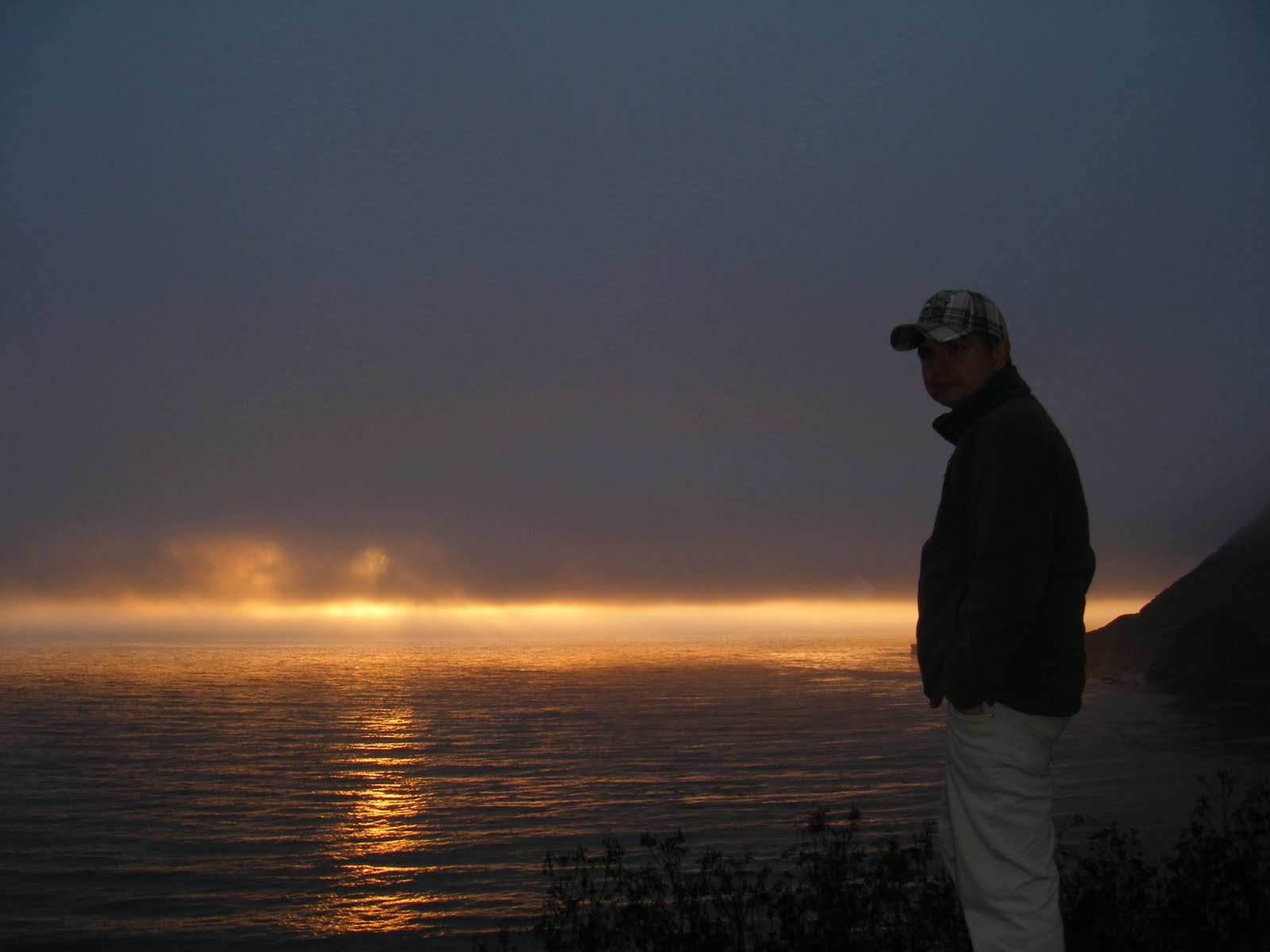
Sunset in San Simeon

Name two countries: one you’d like to visit, and one you’d like to visit again.

I would love to visit Iran. And Morocco. And India. I also would like to visit Oman and see sea turtles. Mexico too. I would like to go to Turkey and fly over Capadoccia. Ireland is in my list of countries to visit, so are Vietnam and Lebanon… oh, sorry – you said ONE! But there are so many other places I would like to experience…

A country I would revisit? To be honest, I am not ito revisiting places. Given the opportunity, I will always choose the one I have not been to. In saying that, I would like to take my teenage girls to Egypt and to Jordan, to share the beauty of these places with them, especially because we are so close and these destinations are so magic…
I would not consider going to these places again if it were not to show them to Anita and Lia.

Do you believe in God?

I sure do. I just feel very sad for all the atrocities men do in name of Him. I am sure it pisses him off too.

***

This interview is part of Inside the Bloggers Studio, an ongoing project of short interviews with bloggers I read and admire.  (Apologies to James Lipton.)  To view the archive, click here.

‘I felt that my life was going down an unusual path, and I wanted to share it’

Having sindoor put on forehead during wedding

Sharell Cook is the author of Diary of a White Indian Housewife, a blog about her life as a white (Australian) woman married to an Indian man in Mumbai. Her subjects can spring from anywhere in the maelstrom of activity that surrounds her – visits with her new family, learning Indian recipes, the ongoing frustrations one inevitably feels as an outsider in India, and many moments of introspection at the path she has followed in life, to name just a few regular sources of inspiration.

Though a good number of her posts are illustrated with photographs, particularly the often amusing Snapshots of India, the biggest draw is her focused, straightforward storytelling. She seems to understand (or perhaps not even consider) the strength of the tales she has to tell and just gets out of the way, letting the various characters, locations and feelings in her life shine. Not surprisingly, she has a book in the works, with release slated for mid-to-late 2011.

If you glance at the comments on Sharell’s blog you will notice that she has legions of adoring fans – including myself – with whom she cheerily interacts. As such, she was willing to answer a few questions. All photos used with permission.

***

Why did you start blogging?

I started blogging for a number of reasons. One of them was because I felt that my life was going down an unusual path, and I wanted to share it with people so that they could benefit. I’d been trawling the blogs of people who were in a similar situation as me, but they didn’t always contain the information and detail I was looking for. So, I thought I’d write from the heart about my life and the kinds of things I would be interested in reading. Plus, I did have a notion in my head that I wanted to write a book some day. I thought having a blog would be a good platform with which to establish a presence and market myself to publishers. But still, I got a surprise when a publisher actually got in touch with me after reading my blog.

You mention a journal in your writing. Do you see ‘Diary of a White Indian Housewife’ as an extension of that journal?

I do, because primarily I write for myself, and my blog is where I record my experiences and thoughts. I’ve actually given up writing in my journal now. My blog is it!

Arabic mehendi

What is your first memory of writing creatively?

I think my first memory defines why I was always supposed to be a writer! It was in my first year of school. The teacher told the class to narrate (obviously we couldn’t write properly at that young age, so the teacher had to write down what we were saying for us) and illustrate a story about something of our choice. Apparently, I was the only child who actually came up with a proper story. The rest of them just described situations and things.

Describe something that is beautiful to you.

Oh, there are so many things — but they’re always the small things. Usually, something to do with nature.  A butterfly, a sunset or sunrise, the ocean, the smell of the mountains. An unexpected smile is always beautiful too.

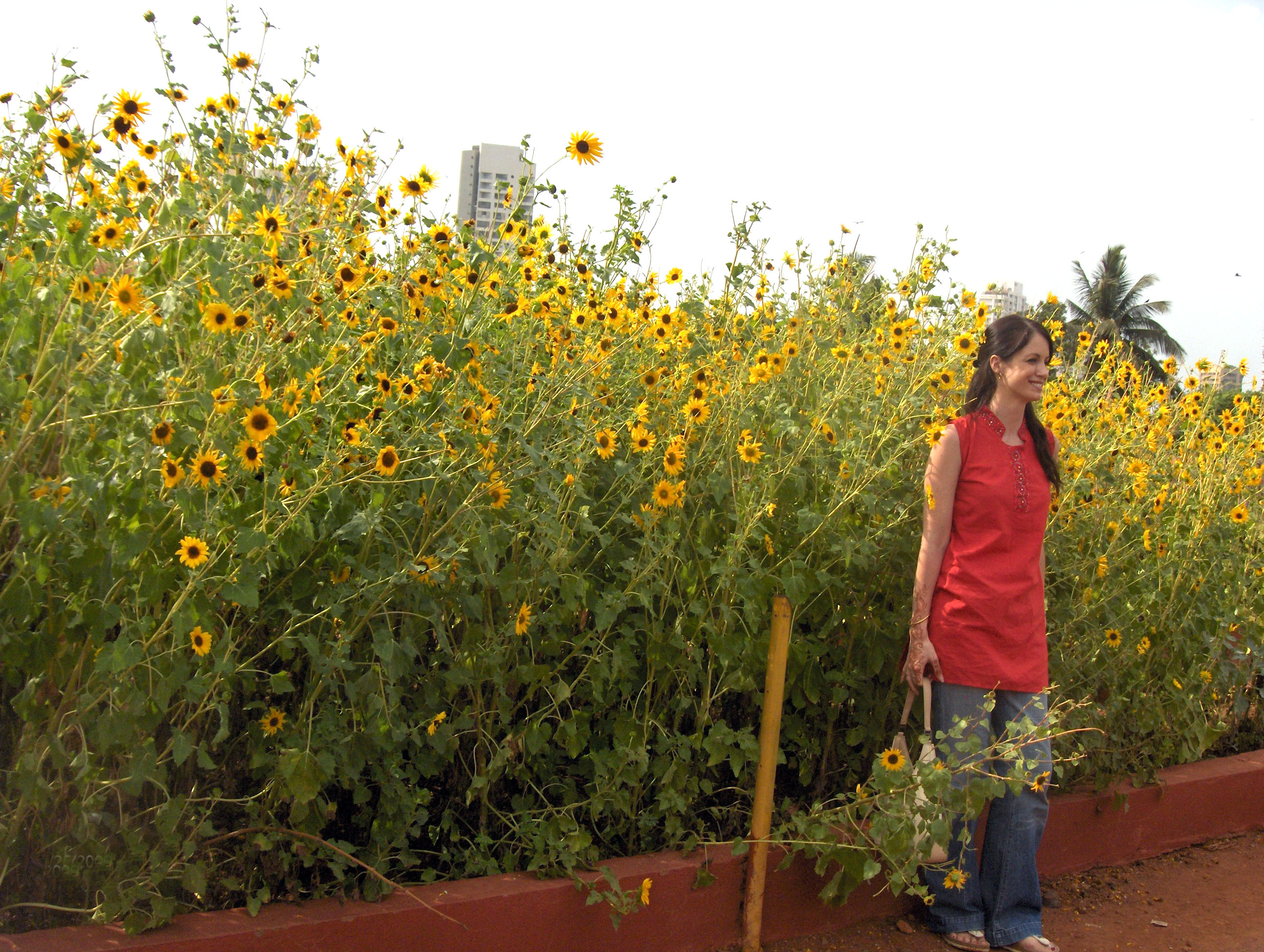
With sunflowers in Mumbai

Are you equal parts white, Indian, and a housewife, or does one of these labels apply to you more than the others?

This is such an interesting question.  Funnily enough, being constantly surrounded by lovely brown skinned people, these days I often forget I’m white until someone treats me as such. I don’t feel like I’m a foreigner living in India anymore, and I find that I have trouble relating to many foreigners living in India. Often, I actually feel like I’m Indian, but sometimes I get reminded that I’ll “never be Indian” so I have a bit of an identity crisis. I do feel like I’m a housewife though, despite the fact that I work. I don’t keep staff (only a maid who comes every second day to wash the floors) and I’m always at home since I work from home.

You live in Mumbai, one of the world’s most populated and varied cities. What is the first piece of advice you would give to another outsider coming to live there?

Just let go of any expectations about how you think things should be, and be prepared to adjust.  You can live as grandly or as simply as you want in Mumbai, but you can never escape the day to day frustrations that come from living in India. In Mumbai, we have world class bars and shopping malls, but a severe traffic problem, water shortage, and lack of space.  The problems are different to the ones you might find elsewhere in India, but they’re still there. You just have to accept it for what it is. And don’t try and replicate the life you had elsewhere.

Homemade fish curry

The phrase ‘the real India’ is one that foreigners tend to use, usually to make a distinction between how they used to perceive India and how they perceive it, or something about it, after going and spending time there. Of all the experiences you’ve had in India, which one, by your estimation, felt most like that so-called ‘real India’?

I actually see the “real India” more as the “dual India”.  Everything about India is real, from a luxury hotel to a vendor selling vegetables from his wooden cart.  However, an experience that I had that felt most like the so called “real India” was having to deal with corrupt customs officials at the customs office, when trying to retrieve 2 boxes of personal items that I had sent over. I don’t want to focus on something obviously so negative, but I’ve chosen this example from the point that corruption is everywhere in India, at all levels, and it affects the rich as well as the poor. There’s no escaping from it.

Is there a post on your blog that you are most proud of?

Not really, but if I had to pick one, it would be the one about how India helped me find my purpose in life. I’m really interested in people’s transformational stories.

Name two countries: one you’d like to visit, and one you’d like to visit again.

A country I’d like to visit: Brazil.  A country I’d like to visit again: Spain.

Guests dancing at wedding

Do you believe in God?

I believe that God is a name for the universal energy and consciousness that is present everywhere. All religions have the same aim, that is bringing people closer to the one entity labeled as “God”.

***

This interview is part of Inside the Bloggers Studio, an ongoing project of short interviews with bloggers I read and admire.  (Apologies to James Lipton.)  To view the archive, click the category tag in the ‘By Category’ section at the top right of this page.