3 Women (1977) (E)

IMDb / Ebert 1 / Ebert 2 / Cale
Written and Directed by Robert Altman

2006: the year I discovered Robert Altman. It’s not that I was unfamilar with his work – I knew of his high status, and had seen Short Cuts and Gosford Park, considering the former to be greatly impressive. I think I was just too young for any of it to really stick with me, or to motivate me to seek out more. Well, after Nashville, I really wanted more, and decided I might as well start with one I’d read virtually nothing about. 3 Women is an extraordinary film, one that washes over you and stuns you, lingering in the mind long after viewing it, daring you to forget it.

At first it seems more about two women than three: Shelley Duvall’s Millie, a woman so enveloped in her own trendiness that she doesn’t notice that everyone is laughing at her, and Sissy Spacek’s Pinky, so childlike as to appear utterly dependent on Millie’s guidance (at work, at home, and down the pub). Here, it’s extremely tempting to simply discuss the narrative of the film, because it so closely resembles a dream; there doesn’t seem to be anywhere else one can go when discussing it. Indeed, it came to Altman fully-formed in a dream, and that doesn’t surprise given that it progresses exactly as a dream would – strange, bewildering, sometimes completely illogical, but always feeling natural. You know how you only realise how strange that dream was after you wake up? That’s what it’s like after watching this movie.

I’m not going to do that, though. I came to it untainted by any kind of plot summary, so I’m going to avoid that from now on. Like in Nashville, the characters are defined mostly by their flaws. Millie is often painful to watch, walking just behind other pairs, talking constantly but never being listened to. She sincerely believes that all the men desire her, but before she is even up the steps they ridicule her. Pinky is the exact opposite, a blank slate who approaches every aspect of adult life as though it was for the first time. She believes Millie is helping her, educating her well, which is even more painful because her mentor couldn’t be more misguided. The third woman of the title, pregnant Willie, is usually seen painting disturbing, pained figures on the pool walls and floor. She seems alienated, or alien, out of step with her surroundings. We don’t follow her the way we follow Millie and Pinky, but we often feel her presence in the background, watching over proceedings like a… something.

The music is the first clue. To begin with, it doesn’t seem to fit at all, but it steadily becomes more and more appropriate until it goes perfectly with the images and tone. And it’s not just a case of becoming used to it – the film actually changes into something different, a clear but not incongruous shift. Just like a dream. Then there’s the impeccable film technique, timing every shot just right, and in a few notable cases surprising us with anomalies such as double reflections and a wavy fluid that sometimes partially obscures the image. It’s very strange, and dreamlike. You get it, I’m sure.

Again, Altman captures the potential of the form without resorting to lazy hoodwinks or clichés. The notions that could lead to disappointment are there, but they are executed perfectly. You don’t necessarily understand it – and quite likely, you shouldn’t – but it doesn’t feel wrong, or a cop-out. Don’t get me wrong, I do love Mulholland Dr., but I kind of feel like Lynch pulled the wool over our eyes. Nothing wrong with that per se, but with Altman there are no smoke and mirrors, and no pretensions. He shows us some stuff, and leaves the rest up to us. A genius and a giant of cinema.

Look Both Ways (2005) (C)

IMDb / Bond / Keller & Urban
Written and Directed by Sarah Watt

As I walked out into the street after seeing Look Both Ways, an overwhelming surge of reality hit me. I saw people walking fast, slow, with their heads down or looking straight ahead, engrossed in their lives so that they didn’t stop to consider other passers-by. I was struck by the banality of it all, the simplicity, when taken at face value. Needless to say, Look Both Ways replaces this seemingly dull real world with a cast of erratic characters and a series of contrivances, viewing this universe with a wide but limiting focus that puts to bed any chance of the story (or stories) having any lasting impact. Shame, really, because it started out with so much promise.

For a film that bundles in no less than 8 meaningful characters, Look Both Ways, at around 100 minutes in length, is about 45 minutes too short. I’ve said it a hundred times, and I’ll say it again: if you want to engage the audience, limit yourself to getting a few things right rather than trying to wow them with many things. This is Watt’s first feature, and I say she was too ambitious in her writing – shear it back, cut some characters, lose some scenes, make others longer, then you’ve got a good movie. As it is, most of the actors are at least once asked to step outside the confines of the character they’ve built in order to offer some kind of revelation, and this just doesn’t ring true. The story isn’t allowed to grow by itself; instead, Watt tries to force a grand conclusion, which ends up doing none of her characters justice.

While her abrupt changes in tone and lines out of place stick with me, so does her interesting directorial style. Most of the film is framed simply and effectively, but there are brief interludes using different media – hand-drawn animation and still photography – that offer insightful breaks in the narrative. They don’t always work in the context of the scene, and some of the epileptic flashing of images on the screen did my head in, but they are innovative techniques that deserve praise. Just tone them down a bit. Her use of music and non-incidental sound, though… well, to put it bluntly, it was derivative and didn’t fit. In most cases, the film would have played better over silence.

The acting is fine, with particularly good performances from the ever-excellent William McInnes and the heretofore unseen Justine Clarke in what one would call the central roles of Nick and Meryl. Of all the characters, they are the most involving – not surprising given that far more screen time is devoted to them than anyone else, but the quality of acting really shines through, particularly when they don’t have anything to say.

This has been billed as an Australian Magnolia or Crash, but I would veer from that and say it has more in common with Zach Braff’s Garden State. Both films, by first time directors, appear to be slight and whimsical but end up aiming for something loftier and more lasting, which remains just out of reach. It isn’t escapist cinema, but it’s miles from verité; while there is potential – big questions are asked about the fundamental element of humanity: mortality – it isn’t followed through, as attempts to answer such questions will inevitably fall on their face. I will be interested to see what Watt comes up with next, though. She’s confident, which can only be a good thing in a filmmaker. A better balance, and she might be onto something.

The Beat My Heart Skipped (2005) (H)

Original title: ‘De battre mon coeur s’est arrêté’
IMDb / Ebert
Based on ‘Fingers’ by James Toback
Written by Jacques Audiard and Tonino Benacquista
Directed by Jacques Audiard

When James Toback wrote and directed Fingers in 1978 with Harvey Keitel in the lead role, he probably didn’t expect that two and a half decades on it would be reworked by a French writer/director named Jacques Audiard. Those of you who are familiar with his earlier Sur mes lèvres (Read My Lips) already know what a good director he is; with De battre… he has shown himself to be one of the most exciting and confident filmmakers working today.

This is subjective filmmaking of a very high order. Immediately we are thrust into the world of Tom (Romain Duris), a small-time real estate crook who used to be a decent pianist. Everything that happens in the film, we see from his point of view – he’s in virtually every scene – so the film achieves a real sense of getting inside someone’s head. The plot turns on Tom’s decision to try and get back into playing the piano, with a view to getting out of derelict buildings and onto the stage. Whether he gets there or not depends on how well he can rein in his nerves, his constantly racing brain, and finally find calmness at the piano.

However, just as in La pianiste, piano-playing is shown not to be a pleasant creative outlet but a source of disappointment and infuriation. The scenes of him evicting tenants with rats and baseball bats have a similar nervous energy to those of him practising with his Chinese mentor (who provides some of the film’s best moments). He is always moving – his fingers, his feet, his eyes – he never stops for a moment to just relax. Duris’ tension-filled performance is instantly intriguing, and despite maybe a couple of slightly forced moments, he’s bang-on perfect, a mixture of good Ewan McGregor and (dare I say it) the incomparable Vincent Cassel. As well as the Chinese girl, the supporting characters include his real estate associates, their spouses, his dad, and a shady Russian man. They’re all mixed up in each other’s business some way or another, and they collide in different – some very powerful – ways.

Audiard’s direction is characteristically excellent. While this is not quite as complete a film as Sur mes lèvres, it enveloped me immediately and keep me solidly transfixed for its duration. Like Pawlikowski and Herzog, he has an uncanny sense of timing each scene perfectly so that it isn’t too short or long – each time we cut to a new scene, it feels like a perfectly natural progression, even if there may still have been more to say. The camerawork, almost entirely hand-held, fits the story well; he shoots in a freeform style with useful shifts in focus that is almost invisible. That is, you are never distracted by the nature of the images, but enthralled by what is contained within them.

I’d also like to make a special mention for the music. The best soundtrack I’ve heard in ages, this film mixes classical with French pop and house to extremely good effect. Scenes of Tom listening on the car stereo and Tom listening through headphones are interspersed among the scenes of him slaving away at the piano seemed to fit so very well. I can’t say why, it’s a metaphor for something maybe, or maybe it’s just a great way of showing how he’s in touch with the past and the present but slightly unhinged at the same time.

De battre… ends with an epilogue set two years after the main action that is alarming and brutal. At first it felt a bit sudden, maybe even out of place, but on reflection I think it fits perfectly and even sums up the film. We change, but we stay the same. Things grow in us, and are replaced by new things, but they don’t die out; they lie dormant, waiting for an opportunity to be brought to the surface. This is laid out in explicit detail in the epilogue, and we are left shocked and, in the case of this viewer, completely satisfied. This is the best film I’ve seen so far this year.

Hi, Mom! (1969) (R)

IMDb / Emerson
Written and Directed by Brian De Palma

Beginning with a point-of-view shot of the protagonist’s perspective and ending with that same protagonist waving directly into the camera, Hi, Mom! is a film that states a clear desire to involve and manipulate the audience. It wants to make you complicit in its senseless violence, its comedy, its voyeurism. It wants you to be aware that as you watch and judge, you are also being judged. A film like this wouldn’t even get made today in America, but if it were, it would be just as incendiary as I’m sure it was back at the beginning of the 70s.

Practically formless, Hi, Mom! is composed more of a string of related scenes rather than a straightforward narrative. There’s Jon Rubin, just back from Vietnam, who wants to film the people in the housing project across the road from him and sell the footage to discerning buyers. And in the windows of that housing project, we have: the family of four whose mother remarks that their housing project is much nicer than the others down the street (it’s exactly the same); the playboy who forcefully beds a different woman each night; the cute girl who Jon attempts to seduce; and the young actor staging a play called ‘Be Black, Baby!’ with some African-American friends, and the audience for that play. Through all of these characters, these ciphers who do not remotely represent real individuals but instead stand for collective groups of society, De Palma turns his gaze on the American public and says ‘Something ain’t right’. And he does it with a wink and a smile, daring you to distance yourself from it.

As I said, it’s a string of related scenes with not much tying them together narrative-wise; still, many of these scenes are excellent. The absurdly optmistic footage shot by the well-to-do family makes light of a situation most would be disappointed with; little is more depressing than someone trying to say they’re happy with their lot when really, they’re not. Jon’s routines with the cute girl are extremely manipulative, but I found myself laughing along with them because Jon was intended to be a source of amusement – wasn’t he?

Then there’s the performance of ‘Be Black, Baby!’, for which the film’s upbeat soundtrack stops and we descend into hell for several harrowing minutes. It’s the moment in the film where you realise how twisted it’s been all along, how you are just as involved in it as these audience members are in the play. It’s truly horrifying to watch, creating an incredible sense of dread that eventually does spill over into our deepest revulsions. And suddenly, Jon appears to play his part, and we’re back where we were – aware once again that it is just a film, just a performance, as if his presence on screen reassures us. The audience’s eager recommendation of the play at its end is, I suppose, akin to my little ‘R’ at the top of the post there – I felt angry and confused, but I’m damned if I didn’t enjoy it just a bit, or feel like I learned something.

After that, Jon loses it and… well, I don’t want to ruin it for you, but his actions are outrageously senseless, and they are coupled with that same upbeat music that keeps telling you everything’s going to be all right. A character called Joe King (say it out loud, fast) succinctly sums up the film’s agenda, but is listed in the credits as a real person. Then Jon interrupts to register his disgust because, among other things, Mr. King hasn’t been to war and seen what he’s seen. Finally, he says hello to his mother, and smiles and waves directly at us.

What to take from all this? Is he reminding us one last time that it’s all just a performance and we can go home and recommend it to our friends and family? Or is he saying that it is us, the audience, that spawned him and brought him to commit such heinous acts? This is the earliest film I’ve seen that really manipulates the audience and incorporates them into its agenda, and it does it very effectively; in a way, its lack of structure helps its impact. You won’t be able to sit through it and not have a reaction. Just quietly, this is a film that came out of nowhere, almost completely unheralded, and pretty well stunned me.

The Graduate (1967) (C)

IMDb / Ebert 1 / Ebert 2
Written by Calder Willingham
Based on the novel by Charles Webb
Directed by Mike Nichols

Inches away from being a grand Fail, The Graduate is the worst film I’ve seen since Doom, and the most annoying and insipid since Millions. There is so much praise out there for it – it almost always comes up in a list of great American films – but at film’s end my reaction was worse than feeling unmoved: I felt cheated. Cheated by a writer who set up an intriguing situation then pissed it away by descending into cheap fantasy, cheated by a director whose track record suggests he is incapable of producing an insufferable film, cheated by the legions of fans who led me to see what all the fuss was about.

The tagline reads: ‘This is Benjamin. He’s a little worried about his future.’ I assume that implies that the audience will be, too; I wasn’t. From the beginning I couldn’t care less, even when my current situation – (near) graduate looking for what to do next – mirrors his to a degree. Hoffman’s Benjamin Braddock is surely one of the most annoying characters in movies: his awkwardness, meant to be adorable, is frustrating. His attitude towards his parents is immature. The things he says are off-putting and often stupid; the things he does are flat-out ridiculous. This is mostly due to the scriptwriter’s (lack of) craft, but Hoffman needs to shoulder some of the blame – it could have been an interesting character, one we at first distance ourselves from but eventually come to associate with, but he did not pull that off.

What angered me most was the inconsistency. One moment Benjamin is a stuttering fool, wandering through a hotel lobby totally unsure of himself; the next he’s taking a girl to a strip club on their first date, sunglasses fixed on his face, cigarette hanging out his mouth, the supposed epitome of don’t-give-a-shit cool. Then he’s back to stuttering and awkward, then confident, and back and forth and so on for the rest of the movie. None of it makes any sense! Why would he do that, or that, or that? Why would he say such stupid things? Why wouldn’t he say such an obvious thing? I can’t understand it, or why it struck a chord with anyone.

Anne Bancroft did well in her challenging role – very well – and Katharine Ross is beautiful and wonderful right up until the inane closing minutes. Unfortunately, the story takes too many stupid turns to allow them to keep shining. And what was up with the music, man? Legendary Simon & Garfunkel score? Bullshit. It was three, or possibly four, songs repeated two or three times each, and only once – the opening credits – did they work well with the image. Next time The Sound of Silence comes on the radio, I’m going to break it, because I heard it enough times in this movie to last the rest of my life.

As for Nichols, I’m not familiar with much of his work – only Closer, which I enjoyed despite its theatricality – but I read that it almost always cuts into the deeper channels of modern society. Not this one. And his technique is particularly unsubtle – the slow zoom is used a couple of times too many, and the fast, clumsy zoom is used distractingly often. Some compositions are nice, the most obvious being the famous legs/Benjamin shot on the poster, but others beat you over the head (Benjamin sitting on a bench, alone, at Berkeley with Old Glory fluttering in the foreground sticks in the mind).

Yes, all that saves The Graduate from the lowest rating are some interesting, informing points of technique (I didn’t know Kubrick ripped it off for 2001) and some good support acting. Everything else is pointless, dated trash that may have been edgy and provocative in its time but is almost completely inconsequential now, not to mention utterly nonsensical. This is a rare film that makes me think today’s best films are better and more profoundly effective than those of previous decades – give me Eternal Sunshine, Lost In Translation or Before Sunset any day over tripe like this.

Capote (2005) (W)

IMDb / Ebert / Cale
Written by Dan Futterman
Based on a book by Gerald Clarke
Directed by Bennett Miller

I’ll make it immediately clear that Philip Seymour Hoffman deserves to win the Best Actor Academy Award for his role in Capote. His work here is the most impressive in an already distinguished career despite his comparative youth; usually offered supporting roles, here he grasps the opportunity to carry a film with both hands and really does walk off with it. His long overdue success comes in a film that, while impressive enough, lacks a certain something – it isn’t that it’s bad, it’s just less than it might have been.

I get the feeling most of the problems lie at the script level. Futterman is a first-time writer, and it shows; while the dialogue is economical and sparkling, the pacing is uneven – while years pass in the lives of the characters, it seems like very little to us watching. Also, a film which unfolds at a languid pace should offer considerable detail (of anything) to the viewer, but come the end I felt like I’d missed something.

That’s all the bad stuff, though. Hoffman is so good that it must be seen to be believed – note particularly how he uses props (cigarettes, glasses of alcohol) and gestures to convey the inner workings of the character, not to mention the mastery of Capote’s unusual voice. It’s a masterclass. The supporting parts are filled out by actors that are always worth watching – Clifton Collins Jr., Catherine Keener, Bruce Greenwood, Chris Cooper – but apart from Collins, we don’t see as much of them as we would like as they get written out of the action.

Miller, a first-time director (very much a freshman effort, this film), hints at a potentially glorious career. His compositions frequently reminded me of Brokeback Mountain, a comparison which he himself is not surprised by, because he has studied Ang Lee’s films. There are plenty of worse directors to imitate, that’s for sure. I’ll watch keenly to see what he does next.

I did quite enjoy Capote, but as the brevity of this review shows, it hasn’t really stayed with me. While a more focused and less forgettable portrait of a famous person than Walk the Line, it drifts at times, seeming a bit padded despite its relatively short running time. Many critics have lavished great praise on it, so on their opinion and the strength of the acting it is worth seeing, but for this particular viewer I don’t expect it to linger in the mind. I did, however, get to see the trailer for Caché, which threatens to be the greatest film of the year – I really cannot wait.

Walk the Line (2005) (C)

IMDb / Ebert / Cale
Written by Gill Dennis & James Mangold
Based on ‘The Man in Black’ and ‘Cash’ by Johnny Cash
Directed by James Mangold

Take last year’s Ray, change the central character from a black man to a white man, add a few more redemption clichés, and you have Walk the Line. It’s remarkable how similar these two films are. There’s the death of a sibling at a young age, the strained relationship with the father, the escape from down-home obscurity to stardom, the womanising, the drug addiction, the crawl back to normality on the back of that sweet gal. On this basis, one might also think that the lives of Ray Charles and Johnny Cash were also practically identical. They weren’t. It’s just that the similarities between their lives are what Hollywood biopics thrive on. I would imagine that a film about any famous person would be the same, if their stardom followed a parabola (a great start, followed by decline, and finally redemption).

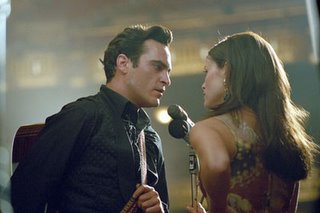
I knew this would be the case, though. So why did I go along? Well, because of the music, basically. I love Johnny Cash’s music. He’s one of my favourite recording artists. Thankfully, the moviemakers got that part absolutely right: the musical interludes are remarkably close to the original recordings, which is amazing given that Joaquin Phoenix and Reese Witherspoon sung and played their instruments for real. I was hoping for more than that, however. I wanted some kind of insight into Cash the man, something more than the standard biopic clichés that you can see in a hundred other films. Unfortunately, it just isn’t there; I suppose this means I should read more.

Not to say that Phoenix and Witherspoon aren’t very good. They pretty much nail their parts, the mannerisms and the emotions, all the while connected with the drama of each scene. Thing is, they’re making the best out of a pretty poor script. The dialogue is forgettable, and everything feels glossed over – pretty much the same problems I had with Ray, except that was longer and slightly better acted so it gets more points in my view. I’m on side with Matt Cale’s suggestion that a better film would’ve focused solely on the events surrounding the concert at Folsom Prison – more and more, I feel that if you narrow your focus and concentrate on getting everything right within that smaller focus, you’re more likely to hit the deeper truths present in the material. A thorough examination of one day in the life of an individual is always more compelling than a shallow overview of their entire life.

Seeing this on the same day as Brokeback Mountain brought home to me how good that film was. It was everything this film could’ve been: nuanced, meditative, involving, affecting. Walk the Line is a showcase for two actors offering their best work, and little more. Besides their performances, it offers nothing you couldn’t get from reading a few articles or the books written by the man himself. Having seen most of this year’s multiple Oscar nominees (only Capote and Memoirs of a Geisha to go), I would suggest that this is the one that is least worth your time.

Brokeback Mountain (2005) (R)

IMDb / Ebert / Cale
Written by Larry McMurtry & Diana Ossana
Based on the short story by E. Annie Proulx
Directed by Ang Lee

Ennis: “I figure we got a one-shot deal going here.”
Jack: “It’s nobody’s business but ours.”
Ennis: “You know I ain’t queer.”
Jack: “Neither am I.”

I want to say these are two simple, uncomplicated men, with simple lives and simple desires, but it just isn’t true. To say that would confound us all as being simple. We reach for simplicity, for plain happiness and peace of mind, but the reality is never quite like that, and the case of Ennis and Jack is no different. Love isn’t ever straightforward, and it can become so complex that it rips you apart. You will have heard Brokeback Mountain described as ‘that gay cowboy movie’, but to be honest, sex/gender is irrelevant to a large extent. It’s about two people who long for and love each other, and how no matter how strongly their love is tested, it will not die.

This is a film remarkably free of pretension or obviousness. The direction is careful and restrained, as one expects from Ang Lee; working in tandem with one of my favourite cinematographers, Rodrigo Prieto, he crafts stunning compositions that are truly beautiful to behold. From a wide shot of sheep being herded through a valley, to a tight closeup of an actor’s pained performance, to one of the best final shots I’ve seen in a film, he uses the full frame superbly to extract the most out of every scene. Everything is placed perfectly: the actors, a campfire, a pack of cigarettes, a bottle of beer. It all adds up to some of the most impressive images in recent memory, particularly as most of the subjects are everyday things that one wouldn’t normally give any thought to.

In the steady hands of an assured director, all the actors shine. Michelle Williams and Anne Hathaway are good as the wives of Ennis and Jack, and Linda Cardellini and Anna Faris offer good support in brief roles. However, the movie is about the characters played by Heath Ledger and Jake Gyllenhaal, and they absolutely nail their roles. Ledger is garnering most of the praise in the press for his subdued, grunting performance, and I can understand that as it is some distance away from his real-life persona. For me, though, Gyllenhaal’s turn is marginally more impressive. He shows sensitivity, fragility, strength, and a deep sadness and regret; I’d be quite happy to see him take him the Best Supporting Actor Oscar. They both are really very good, though. Their scenes together, right from the film’s opening, are compellingly well-acted and affecting.

I wonder how people are reacting to this film. I’ve read about religious zealots condemning the film (and in a couple of cases refusing to screen it), but I’m not interested in them. I want to know what the average male cinemagoer feels when a movie gets him to care strongly about – and love – two male characters. Has it provoked angry reactions, or maybe rethinks of personal philosophies? Personally, a heterosexual, I welcomed the opportunity to empathise with gay men in a film, as it challenges me and forces me to consider things I would otherwise avoid. Anyway, as stated earlier, gender was pretty much stripped away by the sensitivity of the portrayal. That’s the way it should be. It’s love, just as we know it – intoxicating, difficult, impossible to predict or prevent. There are significant elements in the plot concerning homophobia and the concealing of the relationship, but they are an aside, rather than the crux of the story. The focus is on the struggle of two people, and the effect their struggle has on the people close to them.

Overall, it loses a couple of points for covering a long period of time in too short a time-frame and for being a little episodic. Brokeback Mountain isn’t a great film, but it is a very good one – a serious, thoughtful, mostly subtle exploration of the Greatest of All Things. It deals with homosexuality in a very mature manner: while it plays an integral role in the characters’ lives, it isn’t what defines them. Their love for each other is what defines them, and ultimately, what destroys them.

Farewell My Concubine (1993) (R)

Original title: ‘Ba wang bie ji’
IMDb / Ebert
Written by Lillian Lee, Bik-Wa Lei & Wei Lu
Based on the novel by Lillian Lee
Directed by Kaige Chen

This is the second film I’ve seen recently that relates to opera and China, the other being the disappointing M. Butterfly. Thankfully, Ba wang bie ji is not a confused adaptation of a confused stage play; rather, it is a quality adaptation of a popular novel. Unfocused and abrupt in some sections, but expertly orchestrated in others, it tells an involving and epic story with often stunning visuals and confident direction.

While I was watching, I was struck by how much more substance was present than in Yimou Zhang’s recent epics, Ying xiong and Shi mian mai fu. Those films are stunningly beautiful and extremely entertaining, but they just don’t have the depth of Ba wang bie ji. Very basically, it’s a love story – two characters and their loves for the opera stage, a woman, and most of all each other – but their detailed exploration makes it more than that. These are complex characters, full of hope, sadness, regret, and great love that spills all over the screen; I remember someone referring to those Zhang films as ‘China discovering Shakespeare’, but to me this is more Shakespearean because it deals in important themes while telling a good story.

Because Mandarin is so different from English, I usually find Chinese acting stilted and awkward and lacking in emotion. Not so here. The three leads (Leslie Cheung, Fengyi Zhang and Gong Li) are compelling and offer affecting portrayals of tragic characters; the child acting in the earlier Full Metal Jacket-esque scenes is also very good. In particular, Cheung is superb as the confused Dieyi; he has too much love to give, and it is heartbreaking to watch as it slowly destroys him. It is particularly sad to watch now, as he committed suicide three years ago.

I’m particularly unfocused with this review; perhaps that’s because the last half hour covered too much ground too quickly. A film of nearly three hours should feel complete and satisfying, and such feelings are nearly impossible when it crams a lot of plot development into the final reel. By that stage the themes are well established and we are just waiting for them to be rounded out, but the introduction of these plot elements is distracting. It’s not enough to derail the film, but I would like to think they could’ve spent a bit less time further back in time in order to give the later periods better coverage.

Overall it’s worth seeing, at the very least for a few scenes which were so good they sent shivers down my spine. It’s the best film I’ve seen from the Republic, and probably better than any Hong Kong film I’ve seen, too. Kaige Chen shows that he is an extremely capable director (I couldn’t believe this was the same guy who made Killing Me Softly), and the actors offer impressive characterisations. I guess my lack of focus with this review shows that I wasn’t completely struck by greatness, but then again, maybe I shouldn’t have watched it in two goes. Another viewing, a complete viewing, would probably make my opinion more solid. It doesn’t matter; it’s good cinema.

Munich (2005) (R)

IMDb / Ebert / Cale
Written by Tony Kushner and Eric Roth
Based on ‘Vengeance’ by George Jonas
Directed by Steven Spielberg

I hate it when movies are lumped with political agendas. Nothing distracts more from a good story than obvious political content, and it is equally frustrating when that content is forced upon the film by statements in media. Munich suffers from the latter, but tellingly, not the former. (Here and here are two very insightful pieces of comment by Spielberg himself, defending his film.) Words have been spoken at length in the press about its supposed defamation of Palestinians, or of Jews, etc etc etc. I was aware of all this going in, and to my delight, these statements were proved to be totally reactionary. This film sides with no group or individual; it sides with humanity, our collective desire, and shows how misguided we can become in our pursuit of the fulfilment of that desire. It’s a film made by people who care about people, not a piece of propaganda designed to convert minds to a different way of thinking.

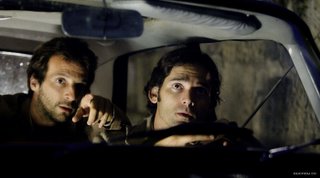
Munich is based on true events – the series of hits carried out in the wake of the killing of 11 Israeli athletes at the 1972 Munich Olympic Games. However, its focus is not so much political, but more on the implications of these incidents on one man. And, in keeping with my own philosophy for filmmaking, this refined focus offers a more inclusive and substantial view of the human condition than a wider scope could have. We watch as Avner (Eric Bana) leads his team through several hits, his life becoming more and more complicated; we don’t condone his actions, and neither does the film, but we sympathise with him because he has real concerns that we can relate to. Family, morality, legacy. The big issues, the ones that really matter.

The screenplay drives the film forward nicely, becoming more focused as it progresses (which I like); it also has room for brief moments that do nothing to advance the plot, but flesh out the characters infinitely better. The acting is decent; Bana is not a great actor, but he is a good one, and he carries the film well – we want to know what happens to his character, and we understand what’s going on through his eyes. It’s every inch Spielberg’s film, though. Many shots are masterfully composed, shifting our focus from one character to another with considerable skill and a great deal of style. It moves at a swift and even pace, making the long running time fly past. And, as I have stated many times already, it is very well focused for a film tackling such grand issues. My hat is off to the guy; he’s hardened a lot since E. T., that’s for sure. Of particular note are the assassinations: they are brilliantly executed, exhilirating set pieces that linger long in the memory.

A few overly dramatic choices bring it down a bit. The sex scenes that bookend the film are gratuitous, especially in that they are integral to the overall message; there had to have been a more toned down way to get the point across. Some of the accents were not very convincing, especially Daniel Craig’s – a minor quibble, but it is distracting. And occasionally, the violence is a little bit too brutal. It’s horrifying and realistic, but too much of it can be numbing, and Munich comes close to reaching that stage.

Some of us may have a collective goal, but are we justified in doing everything in our power – including killing other people – to obtain that goal? And how does it compare to watching our children grow up, or looking into the eyes of a friend and knowing that there is mutual trust and respect? Munich raises many questions, none of which have simple answers. Like The Constant Gardener, it promotes an awareness of what atrocities are being committed in the world, and it promotes a better attitude towards each other and ourselves. Everything isn’t just going to be all right if we carry on like this, so let’s all do something about it. Classic Spielberg themes, in a way, but rarely have they been better handled.