Opening My Eyes Further: Graphic Novels, Comics, and Me

Upon Ed’s recommendation, I’ve been reading a lot of graphic novels lately – or comics, I’m not sure which. They’ve all been non-fiction, so are they still graphic novels? I’m gonna go with graphic novels because of their long-form nature – when I see the word ‘comic’, I think first of strips in the newspaper, like Peanuts and Garfield.

They’ve been quite a revelation, these graphic novels. My reading hasn’t just been changed by the addition of this bright new medium; it’s been broadened and given new life. I hope you’ll bear with me while I cast my eye back a little to illustrate how this new enthusiasm fits into the context of my life.

L-R: Sad, Unfunny

It’s funny that I should associate Peanuts and Garfield with the newspaper, because when I was a kid, I borrowed and read all the Peanuts and Garfield books in Tokoroa Public Library several times over. I never read them in the newspaper. I even bought a few cheap Peanuts collections with my allowance, books that are now long gone. (I never bought any Garfield, and I’m glad now that I didn’t because reading Garfield as an adult has been one of the most jarring revisitations to childhood I’ve had. Like, did I really used to laugh at this?)

More than Peanuts and Garfield, I read Tintin and Asterix. I think Tintin was my first exposure to comics. On about my seventh or eighth birthday, a compendium of the three Tintin books – Tintin in America, Cigars of the Pharaoh, and The Blue Lotus – was given to me by parents, and I was soon reading each of the stories over and over. I already loved reading, and read voraciously, but Tintin allowed me to escape into a world I could literally see, not just imagine.

The following year, I was given another compendium containing The Calculus Affair, The Red Sea Sharks, and Tintin in Tibet. I remember being moved by Tintin’s relationship with Chang, the Chinese boy he saves from the river in The Blue Lotus, and their tearful reunion in Tintin in Tibet. Because I read them all so many times – possibly into the hundreds – I can also a remember a number of specific images, like Haddock’s curled-up beard when Calculus lights his microfilms on Haddock’s pipe, or the final ‘shot’ of Tintin in Tibet, in which the yeti looks longingly across the plain at the departing travellers.
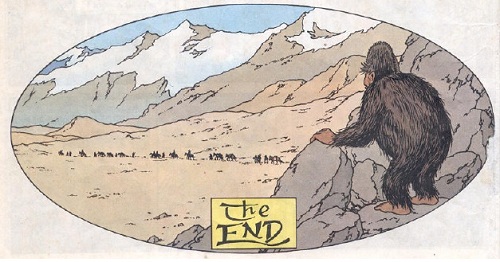
Tintin in Tibet | Tintin au Tibet | Yeti | Himalayas

Tintin is like a series of shots, a storyboard for a film. I still haven’t seen anyone convey movement in a static image as well as Hergé could. The stories are often as full of plot holes as the dumbest Hollywood blockbusters, but the drawings themselves are so memorable. Pretty good cast of characters, too.

As a kid, when talking with friends, I was adamant that Tintin was not a ‘comic’ but a ‘cartoon’, which to me implied its status as serious art. There began my prejudice against comics in general, or what I narrowmindedly thought of as comics.

Asterix, meanwhile, has followed me into adult life more than anything else I read in childhood. I liked Asterix in those days but preferred the fast-paced action and earnestness of the Tintin books. When I read through the entire Asterix series as an adult, however, I marvelled constantly at all the wordplay that had flown way over my head years before. What’s more, all this wordplay was developed twice – once in French by Goscinny, and again in English by those translation wizards Anthea Bell and Derek Hockridge. I’ve never read the French editions of Asterix but someday, if my French ever gets good enough, I’d love to do so.

Obelix speeds up the works | Asterix in SwitzerlandI do remember the images of Asterix well, too, especially Uderzo’s broadly demonstrative facial expressions. The bit where the major-domo tastes Asterix and Obelix’s stew in Asterix and the Laurel Wreath ALWAYS cracks me up, as does the bit in Asterix in Switzerland where Obelix tries to ‘speed up the works, by Toutatis’ and immediately gets wasted drunk. No doubt there are others out there who can recall it in an instant too.

After going through Asterix again – this was about five years ago – I didn’t seek out any more comics. The term ‘graphic novel’, which came up with relative frequency in conversation with various friends and family members, was still off-putting to me: it conjured visions of dark sci-fi drawings with lots of blood and exclamation marks. No real reason for that, of course. It was my way of closing my mind off to them, perhaps so I could keep the world a little more manageable. It’s bad enough thinking of all the films you want to someday see, let alone all the books you want to read.

I also saw the film version of Watchmen and hated it. After hearing so much about the supposed genius of the graphic novel, the terribleness of the film seemed to validate my preconceptions.

120 Days of Simon | Simon GardenforsThen, a few months ago, Ed got The 120 Days of Simon out from the library. It was really quite vacuous: a man I would hate in real life travels around Sweden having lots of sex and taking lots of drugs, then tells his story through cartoonish illustrations and unexceptional (though relatable) dialogue. To my surprise, I raced through it in an hour, thoroughly entertained. I guess I’m as voyeuristic as the next guy.

Afterwards, the sense of satisfaction at reading a 400-plus-page book in such a short space of time was something I hadn’t felt before. It was a minor epiphany: graphic novels are a way of reading many books without using up all my waking hours! I decided to seek out more.

Next, Ed recommended the work of Guy Delisle, a Canadian animator who has written graphic novel travelogues about his time in various unusual locations around the world. I started with Shenzhen, which was very good, and then went on to Pyongyang, which was not as good but fascinating just for the fact that it was about the everyday life of a foreigner in North Korea.
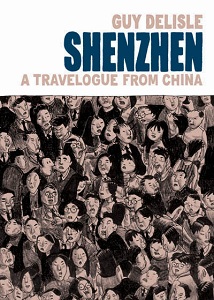
Shenzhen | Guy Delisle | Comics | Graphic Novel from China

When I look back on reading those two Delisle books, I can’t remember many of the images. My brain is wired for language, it seems, so I focused on the dialogue and narration much more than the pictures. Not surprisingly, the drawings I remember most clearly are the ones that were unaccompanied by English words, such as a hilarious scene in which a Chinese man gets into a lift with Delisle and bellows into his ringing phone before realising he hasn’t pressed the button to answer it. I wonder if this means my brain can only properly process one form of input at a time, in this case either pictures or words. I’ll bet it’s possible to train your brain to do both.

Delisle has done quite a bit more than those two books, including some well-reviewed work on Burma and Jerusalem, but I wanted to get into some classics of the genre first. A little research brought two titles quickly to the surface: Persepolis by Marjane Satrapi and Maus by Art Spiegelman. Persepolis is the story of the artist – an Iranian woman – growing up in her post-revolution homeland, while Maus is the story of the artist’s father surviving the Holocaust in Poland and Germany. Both are widely hailed as exceptional works of art in any genre – Maus won a Pulitzer – and as essential reading for any graphic novel enthusiast.

I decided to start with Persepolis because I’ve been very interested in Iran lately. I want to get a broader picture of Iran than what we get from most news reports, which show virtually nothing beyond a tyrannical government and a faceless, obedient proletariat. Persepolis was perfect because Satrapi was a woman (i.e. not a man with a beard) from a well-off but somewhat dissident family, which couldn’t be much further from the fundamentalist Islamists I had previously pictured when I thought of Iran.
Persepolis | Marjane Satrapi

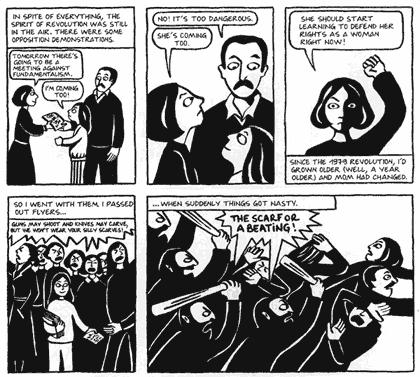
It was a brilliant memoir, full of internal conflict as Satrapi wrestled with her love for a homeland that felt less and less like home. She illustrated the dynamics in her family clearly, and with admirable and honest empathy for all the times she drove her parents crazy. She also didn’t shy away from her passionate views on human rights, the veil, censorship – the kinds of things that artists in Iran have been jailed for. I was entertained by her sense of humour and enlightened by her bitter insights. Persepolis enriched me as a person. It also got me the email address of a PhD architecture candidate from Iran, who was handing out questionnaires in Civic Square one afternoon and saw me reading it. A golden coincidence.

As it was with Delisle, I don’t remember many of Satrapi’s images. Most of the time I would skim across the top of each frame, where the majority of the dialogue and narration was placed, and more or less ignore the illustrations. Perhaps the skill of taking both text and images in at once will develop with experience – or perhaps it’s just that those details you missed can be revealed on subsequent readings, just like with any other book.

The Complete Maus cover | Art Speigelman | Maus CD-ROM

Then came Maus, which is the reason for writing all this. Maus is purely extraordinary. Schindler’s List used to be the work of art I would immediately think of when moved to consider the Holocaust for one reason or another; henceforth, it shall be Maus. Here are some of the reasons why:

  • The central character is compelling. He’s racist, cantankerous, and miserly, as well as being chivalrous, resourceful, and very intelligent. He speaks in a grammatically imperfect English – “one of the boys what we were in the attic together, talked over to the guard” – which builds up a distinctive voice in your head as you read it. He loves and loses almost everything.
  • Spiegelman doesn’t shy away from the most horrendous aspects of the Holocaust. He illustrates so many ways to die in just the level of detail that you won’t be put off reading any further but won’t forget any of it, either.
  • With Maus, I DID remember a lot of the images afterwards. In fact, I’d seen some of them before: in a third form social studies exam, more than half of my life ago, we were asked to read a page from Maus and then answer questions about it. (I had no idea what it was at the time, of course.) When I came to that page in the book, I recognised it immediately. I think this is a testament to Spiegelman’s straightforward approach to detail in his drawings, which aims to tell the story without too many lines getting in the way. He also employs the simple visual metaphor of drawing each race as a different animal – Jews as mice, Poles as pigs, Germans as cats – to help embed those images.
  • The story is fundamentally about one man’s experience, but that narrower focus allows for a richness in detail that broader works wouldn’t have time for. In sticking to his dad’s story in this way, Spiegelman ends up speaking directly to people’s individual experience of the Holocaust, which is much easier to relate to than a history lesson. The fact that his dad’s life intersected with so many others helps, too, as they move in and out of the narrative. You get a sense of the staggering numbers of lives involved – on all sides.

On the back cover of this edition of Maus, there was a quote from the Washington Post: “impossible to describe accurately, and impossible to achieve in any medium but comics”. The latter part seems very true to me: it’s a perfect marriage of illustration and language, both of which are essential to the way the story is told. The narration allows you into the characters’ heads so you can see the illustrations on the page from their perspective as well as your own. And because it’s a printed page, rather than a moving image on a screen for example, you can linger on a particularly compelling image for as long as you wish.
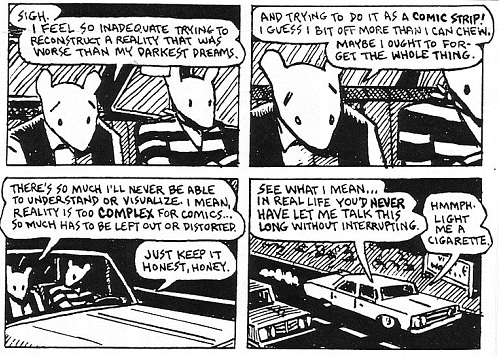
Maus | Reality vs Comics | Art Spiegelman

As for the ‘impossible to describe accurately’ part, that’s obviously an exaggeration, but I think the point is that it’s considerably more valuable to read Maus in its entirety than it is to skim over its Wikipedia page. It was, for me, an incredibly moving and inspiring experience, and I cried a little as I read the last page. It’s good to know I’m not so caught up in my own scattered thoughts that I can’t be moved to tears any more.

I notice that something common to all the graphic novels I’ve read so far is that they are memoirs, so maybe my enthusiasm is just as much for the confessional nature of memoir writing as it is for the fact that they’re in illustrated form. Perhaps it’s related to the fact that I’ve long felt a deeper affinity with film than with words on the page, and I hardly watch films nowadays compared to the amount I read, and the graphic novel is a happy middle ground between the two that I find doubly satisfying. Maybe graphic novels remind me of the exhilaration I once felt reading Tintin, how I could blast through a book and be entertained for half an hour – a kind of Freudian link to some of the most purely content moments of my childhood.

Or, maybe I’ve just lucked into beginning the genre with its most broadly appealing work. Whatever the case, graphic novels – comics – cartoons – whatever – are a legitimate art form and I am thrilled to have finally discovered them.

As mentioned before, graphic novels are not eating into any of my other reading. They’ve simply added more time and more discernment to my reading habits. I’ve learned that my brain can switch from one printed story to another, just as it can switch from longform journalism article to another, or from one music album to another, or from one internal monologue to another. What graphic novels are eating into is my time spent watching Youtube videos and liking things on Facebook, and I’m not complaining about that.
Marjane Satrapi on Facebook

Next will be the work of Joe Sacco, who was once featured in The Caravan and has been widely acclaimed for graphic novels about turmoil-stricken places like Palestine and Bosnia. After that, maybe I’ll try and break down another the wall to another consciously overlooked writing genre. Poetry, probably.
In praise of Roger Ebert

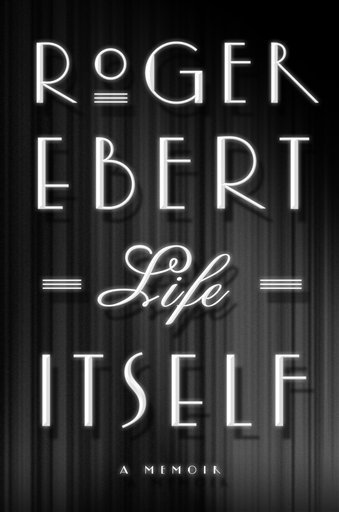
'Life Itself' by Roger Ebert, on release this week

“But now it’s getting late, which means he has his own work to do. Chaz heads off to bed. Millie, for the moment, hasn’t been seized by night terrors, and the brownstone is quiet and nearly dark. Just the lamp is lit beside his chair. He leans back. He streams Radio Caroline — the formerly pirate radio station — and he begins to write. Everything fades out but the words. They appear quickly. Perfect sentences, artful sentences, illuminating sentences come out of him at a ridiculous, enviable pace, his fingers sometimes struggling to keep up.”
-‘Roger Ebert: The Essential Man’, by Chris Jones, Esquire, March 2010

Roger Ebert, more than anyone else, is the reason why I wanted to be a writer. I think most of us have an initial reference point from whence our passions arose, like a car enthusiast’s formative obsession with the 1961 Lincoln Continental convertible or a young swimmer watching Michael Phelps sweep eight golds at the Olympics. I write because I have always written, since I was a small child, but I take my inspiration from Ebert above all others. His writing is honest, principled, informative and articulate, always entertaining, never boring.

When I first started this blog on Blogspot back in 2004, it was to practise writing film reviews, and I said in the first entry (since deleted, time wasn’t kind to those words) that I hoped I would one day be Ebert. I hadn’t actually been reading him for very long at that point – maybe a year or so at most – but he’d already become the standard to which I aspired, for reasons I’ll attempt to put into words further down the page. It was my plan to write reviews of most of the films I saw in an effort to get better at watching them, but my bigger hope was that I would at least become a better writer, if not a successful one.

Over time I’ve written less and less about film, and taken on a wide range of other writing influences. To my great surprise, it is India that has given me the inspiration, impetus and support to be a bit more successful as a writer, and not film. However, I’ve continued to read Ebert – who in fact has also written less and less about film, proportionally at least. In addition to the weekly film reviews he’s been filing regularly for over 40 years, and the other writing he’s compiled in the form of interviews, features and books, Ebert now has a blog, too. He writes on many subjects besides film, most of them aspects of his colourful life Every entry is a joy to savour. The blog was the main reason behind his winning the 2010 Webby Award for Person of the Year – not only for the quality of the blog entries he posts but also for the quality and depth in the comments he receives, which are sometimes even more fascinating than the entries themselves.

The definition of a good writer is elusive, and likely subjective. The standard of one’s readers, like the myriad folks who comment on Ebert’s blog, might be a pretty good one. But a definition that appeals to me is this: a good writer articulates thoughts in ways the reader might not have arrived at on their own. Even if they are thoughts with which the reader strongly disagrees, the writing itself can still be compelling in the hands of a vivid wordsmith. Take, for example, Arundhati Roy’s work in recent years, which can be as misguided as it is literary. On the other hand, saying what a lot of people are thinking can be even harder; one has to work the words on the page into a form that somehow impacts on a reader who agrees with them before he or she even reads them.

With Ebert, whether I completely disagree with him, completely agree or am ambivalent (I usually agree), there is always something new to discover in his words. Perhaps some film fact I never knew, or the name of a new actor to watch; most often, it is the sentences themselves that offer the greatest delight. They frequently surprise me, flicking a ‘how did he do that?’ switch in my head.

I find Ebert’s words returning to me at unexpected moments as a way of articulating what I see before me, or to offer something of value to a conversation with someone else. Ebert’s words are often so tightly formed that they sometimes seem to have always existed, like he plucked them from the sky and set them before me. And his words become part of me even as I read them.

After decades of getting those words in small chunks (though nowadays, with his blog and Twitter and Facebook etc, those chunks arrive more frequently), now we have Roger Ebert’s memoir ‘Life Itself’. Thousands upon thousands of those words, all arriving at once, and I am certain they will be just as much a joy. Thank you, Mr Ebert, for being such an inspiration.

Book Review: ‘Henna for the Broken-Hearted’ by Sharell Cook

'Henna for the Broken-Hearted' by Sharell Cook, 2011 (Pan Macmillan)

One of my first Inside the Bloggers Studio interviewees was Sharell Cook of ‘Diary of a White Indian Housewife’. Since then, I’ve been lucky enough to meet Sharell and her husband in Mumbai and even more lucky to count them both as friends.

It’s as a friend that I write this post full of pride for Sharell, because she is finally a published author. ‘Henna for the Broken-Hearted’ hit the shelves in Australia a week or so ago, and it’s great to see Sharell’s straightforwardly elegant prose gracing the pages of a real live book, not just on the computer screen. And while I’ll refer to her in the first person throughout this review (we are on first name terms, after all), I won’t be biased. Well, not too biased. I hope.

The book is closely tied to the blog Sharell has written for the past few years. ‘Henna for the Broken-Hearted’ tells her story of making an unexpected transition from Australia to India, finding love and a chief purpose in life – writing – along the way. It all sounds very ‘Eat Pray Love’, especially with a title like ‘Henna for the Broken-Hearted’, but this book is much better written, more informative and more resonant than Elizabeth Gilbert’s me-me-me-memoir. The title even makes sense once you read the introduction, linking the slow reveal of henna designs as they are painted to the unfurling of meaning in one’s own life.

The book follows Sharell through heartbreak in Australia, volunteer work in Kolkata, falling in love with an Indian man and – after some eye-opening experiences in the beach town of Varkala and Himalayan village Manali – eventually settling in Mumbai as an Indian housewife. If you’ve been following Sharell’s blog for a long time, a lot of this will sound quite familiar, but the facts are presented in ‘Henna for the Broken-Hearted’ in a longer and more cohesive form. Rather than coming across as a series of connected vignettes, the book actually feels a book, as in a single story that we follow from the first page to the last.

However, an interesting sense I get from the book is that rather than having a traditional ‘ending’, ‘Henna for the Broken-Hearted’ gives a clear sense that Sharell’s life went on beyond the confines of its pages. We’re dropped into Sharell’s life for a few years, privy to a period of incredible upheaval, but we know that the end is not actually The End. Sharell makes no claim to understand everything about India, married life, or even about herself, and we can feel that the learning continues after the last page. I, for one, will be clamouring for a sequel.

What ‘Henna for the Broken-Hearted’ really offers, though, is an honest new voice. I’ve always found Sharell to write on just about any subject with fundamental truth and honesty, but without compromising on elegance. I think that’s what sets the book apart from most transitional stories. There are no attempts to trick the reader by writing floridly around a point; instead, Sharell tells it exactly like it happened, warts and all, and she does so in a way that illuminates the deeper truths behind her experiences – truths many of us will be able to relate to. In her honesty, Sharell transcends simply narrating her own experience and speaks to all of us.

Probably the strongest section of the book is when Sharell is slowly getting to grips with Kolkata and falling in love with her husband-to-be. Their courtship is incredibly sweet and romantic, a real-life fairytale, but tempered with the reality of Sharell’s freshly broken heart and the more immediate challenge of dealing with daily life in India. She gives a good sense of what it feels like to drop yourself in such a foreign environment, and what the adaptation process is like. It’s slow, and there’s no single ‘eureka’ moment of understanding. If you put your mind to it, though, there are many small understandings along the way, each adding to a slowly growing knowledge and understanding of one’s surroundings. This is what happens to Sharell the longer she spends in India, and it’s what happened to me too.

On the other hand, I do have a criticism: the book is too short. Yes, I know it sounds like I’m pandering, but there were often moments where I wanted more detail about a particular event, like some of her experiences in Varkala and Manali. Still, the book is about a transformative process over a number of years, not so much the small details. Cramming those years into 300 pages without losing all sense of perspective is an admirable feat, and anyway, there are plenty of small details to flesh out the story and make it more real.

I recommend ‘Henna for the Broken-Hearted’. It certainly isn’t for everyone, particularly folks who have no interest in India or in alternative healing therapies (which also feature at certain points of the book). However, those with an interest in transitional stories, cross-cultural experiences and the essence of true love – and figuring what that means – will find it fascinating.

Congratulations, Sharell. Here’s to many more!

Film Review: ‘Never Let Me Go’ (2010)

IMDb / Ebert / Hoberman
Starring Andrew Garfield, Keira Knightley and Carey Mulligan
Written by Alex Garland
Based on the novel by Kazuo Ishiguro
Directed by Mark Romanek


Rating: C (Careful)

Book-to-film adaptations are always a challenge. They’re a challenge for filmmakers trying to translate the feel of the written word for the screen, and they’re a challenge for audiences already enraptured with the book to accept with open minds.

Here’s a case in point. I love Kazuo Ishiguro’s Never Let Me Go. I read it in 2007, a couple of months into my stay in Japan, and it completely blew me away. It was a brilliant idea, crafted into a grand and brilliant story, and written in an endearing matter-of-fact style through the voice of a devastatingly sweet and immature narrator. For all its superficial coldness, the depth of feeling and heart contained in its simple language gave rise to such massive potential for an emotional response, and that response would take you down as many rabbit holes as you let it. I felt like I understood people, and our potential as humans, better after reading this novel.

Of course it was always going to be made into a film. How could it not? All of the elements were there: a high-concept idea, a love triangle, Oscar-baiting pathos and (most importantly) a recognisable and well-established brand name. Surely the film would write itself?

Well, it didn’t. In Alex Garland, he of novels The Beach and Tesseract as well as the script for Danny Boyle’s beautifully misguided Sunshine, the production pulled in a very savvy and thoughtful writer – and I’m sorry to say that he went the wrong route. That matter-of-fact prose I mentioned earlier could never directly manifest on the screen, but Garland, bless him, tries his damnedest. What came across as innocence in the book translates to coldness and a kind of dull, grey superficiality on the screen.

As a result, some very well-intentioned and capable performers flounder before our eyes. Save Mulligan’s near-constant sad, tilted smirk and Knightley’s frequently insane toothy grin, all three are surprisingly affecting. Or at least they would be if they weren’t lumbered with overly direct dialogue, a pace that never flows, and some of the most ridiculous wigs and outfits this side of Mamma Mia! Mulligan in particular is becoming one of the most enigmatic presences on cinema screens, with her pixie face concealing a gravelly, Shakespearean voice. But her Kathy isn’t the limited childlike wonder of the book.

To be fair, any sort of comparison with Ishiguro’s prose is unreasonable. I can only think of a few films which have affected me so deeply. Still, I’m a firm believer that the best book-to-film adaptations leave the feeling of the book behind and concentrate on telling a story on screen well – even if it’s a story that differs considerably from that of the book, if only in the telling. Examples: Jeunet’s A Very Long Engagement; Anderson’s There Will Be Blood; Pawlikowski’s My Summer Of Love. Romanek’s proved himself to be quite a talent with his earlier One Hour Photo, but he and Garland would’ve done themselves a favour by watching those three films as a kind of Adaptations 101.

I am, of course, biased, and would love to hear from anyone who hasn’t read the book. A follower on Twitter, @PapushiSun, hasn’t: “I haven’t watched another film that made me so angry in a long time. People don’t behave like that, I kept thinking.” It didn’t stir the same frustration in me, but I have to agree that the motivation for much of the characters’ behaviour was unclear, or – worse – when it was revealed, I just didn’t really care.

The Land of Open Expression

Over in the central Palace Hall, there seemed to be more of a calm that befitted such a princely and tradition-filled room. I remained there for the rest of the weekend as part of an extraordinarily varied audience. There were: distinguished local retirees with a passion for language; twentysomething Malayali men asking me for my mobile number within minutes of meeting; young tourists in summer dresses and sunglasses; local professionals, well groomed and dressed; adolescent children sitting unusually still; fellow resident foreigners of all backgrounds; and many of the authors themselves, catching another speaker’s session.

…read more at The NRI…

Writing a NOVEL now, wahey

I just realised that I self-promoted my National Novel Writing Month all over Facebook, Twitter and the NaNoWriMo forums, but didn’t make it obvious on my own site… so in case you didn’t know about it, and are interested in how my NOVEL is progressing – with all the searing insights gleaned thus far – click on ‘NANOWRIMO’ in the buttons at the top of the page.

If you can’t be bothered scrolling all the way up to the top of the page, or are sneakily reading this via Google Reader or similar, click here.

Not just anybody

My day job involves a lot of sitting at a computer, wearing headphones and performing monotonous tasks. In fact, it involves nothing but these things.

When I just can’t take it any more, I like to go for a quick walk to Technomall’s small bookstore. There, I can awaken a few different areas of my brain as I process the new books that interest me, relish the prose of good writers and laugh inwardly at the cheap tack by the crap ones (until I feel guilty, because while I might think ill of these writers, it’s a certainty that someone out there who reads this will mock me mercilessly for it).

Usually I stick to the fiction section, with its stock of prizewinners and the cream of Indian literature in English. Today, however, I stumbled upon a section I’ve always avoided in bookshops: the self-help (or ‘personality development’) section. I mean, I read David Cain because he is actually kind of inspiring and not force-fed down your throat, but I’ve never felt a need to consume chicken soup for the soul, or to read one guy tell all about the differences between rich dads and poor dads like it’s some big secret. Speaking of which, I’ve sure as hell never been interested in The Secret.

But there are so many of these books.

I looked closer at the bookcase, but became steadily more uncomfortable as I contemplated this particular book’s title.

One minute had been enough. Those monotonous tasks weren’t so bad after all. I returned to the office, inspired back to work in a new and unsettling way.

(For the record, Viktor Frankl’s ‘Man’s Search for Meaning’ gives value and meaning to this entire genre. Have you been inspired or helped to see things in a different way by a self-help book?)