WHEN I WOKE UP THIS MORNING COULDA SWORN IT WAS JUDGEMENT DAY

Today is a holiday in Japan. Marine Day. What that means is that I and most of Japan’s employed population have the day off work, so I did what any sensible person would do: I went on a bender.

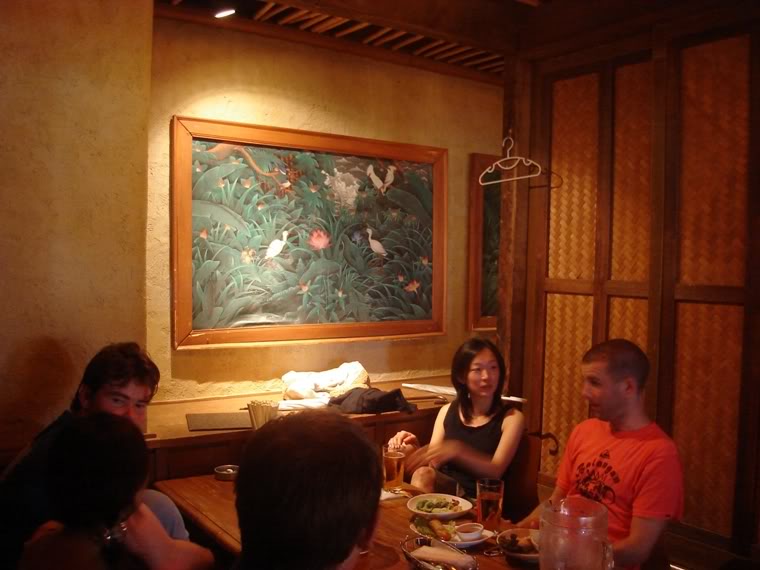
It wasn’t really my intention to do so. I mean, I wanted to celebrate – my first pay, my first paid day off work EVER, a rare chance to go out with other trainees – but I didn’t really have a plan. Sometimes, as in this case, that is best. You let yourself be led from place to place, and soak up as much of the atmosphere (and alcohol) as you can. We woke up on Sunday morning still a bit drunk from the night before, and in a moment of inspiration realized that we didn’t have to work tomorrow! We could do it all over again! And so we did.

The beer and shochu fuelled spirited conversation. I learnt a new word: majime, which can be roughly translated as ‘proper’, relating to behaving sincerely in the way you ought to be according to traditional social mores. What is its value? If sincerity is derived from obligation, doesn’t that make it insincere? Then again, if such a thing is part of the foundation of a culture, it shouldn’t be criticized just because it’s there, should it? It is important, and it’s impossible to imagine Japan without it, but for Westerners it can’t be completely understood. It’s just another thing that prevents us from truly joining this big club.

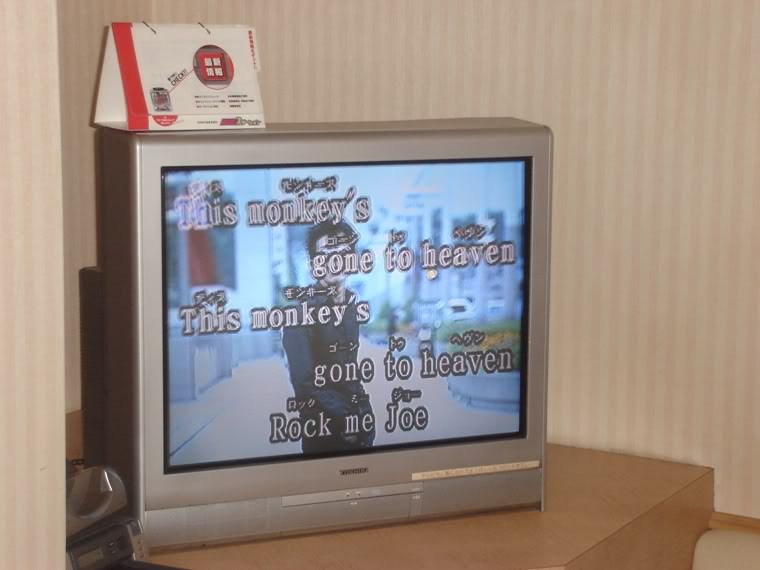
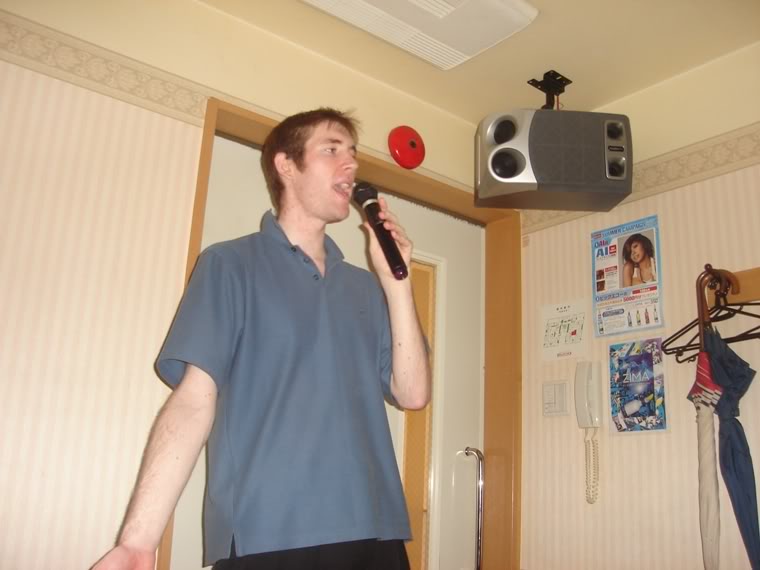
Many places have nomihoudai, all you can drink for a two hour period, which is just a wonderful way to promote sensibly paced drinking. They even have this at karaoke bars, so there’s this effect of feeling like your singing is getting better when you actually sound like the Jenkins’ greyhounds next door. Consequently I hit the wall at about 9pm on Sunday in some izakaya somewhere (they all blur together eventually) and, in no state to catch three trains home, stayed a second night at Tim and Shoko’s (thanks, guys).

Now I’m home, I have that odd feeling of knowing I had a pretty good weekend but without much that lasts. It’s a very immediate thing, getting drunk and talking shit – it entertains for a time, then it’s gone. I met some new people, so I guess that’s what I take away from it. The opportunity for more of the same at a later date. People might say I’m too serious all the time, but they… well, they’d be right. In the words of Oscar Yesenin: I’m not care.

Half Nelson (2006) (E)

IMDb / Cale / Sragow
Written by Ryan Fleck & Anna Boden
Directed by Ryan Fleck
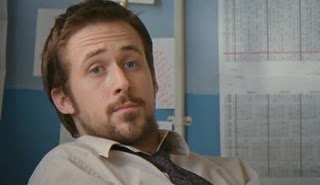
Traditionally, drug addicts in the movies are dealers or unemployed: figures on the margins of society physically and intellectually. They are certainly not people in positions of authority or importance. The protagonist of Half Nelson is Daniel Dunne, an inner-city high school teacher who smokes crack in the bathroom after coaching his basketball team after school. As such, this film offers the most mature depiction of drug addiction I’ve seen in movies. Dan is a real person, with real strengths and failings. He knows how his drug problem limits him, but he can’t be bothered to do something about it – or perhaps he doesn’t know how.

The film focuses on Dan’s relationship with Drey, a girl in his class who catches him slumped inside a toilet cubicle one afternoon at school. Drey lives with her single mother, a paramedic who works long hours, so Drey spends a lot of time hanging out with Frank, a drug dealer who consequently is wealthier than most of the community they live in. Frank has sold to Dan, and when Dan sees how Frank is taking Drey under his wing, he moves to intervene despite being in no real position to tell someone to stay away from drugs. It gives nothing away to say that she does eventually spurn Frank’s enterprise, and that this is a direct result of Dan’s actions, but certainly not in the way you’d expect.

This is typical of a film that doesn’t reach for anything beyond telling simple truths about normal people. Lofty ideas such as the current state of drug abuse in America, the battle between teachers and high school students of different races, or the problems of middle American families are avoided, but in the course of telling its story the film touches on all of these in some way or another. Instead of delving in and searching for answers, it succinctly shows what’s going on and leaves you to think about it. What I’d give to be offered such rich opportunities for thought every time I watch a movie, to have spoonfeeding struck from Hollywood conventions… some hope.

For example, we do get to kind of see where Dan’s problem stems from in a five minute sequence covering a night back home having dinner with his family. It only hints at the difficult familial relationships Dan has, and the escape drugs will have given him, but most of it is given over to contemplation on the viewer’s part. The movie is about the impact of his problem, not its origin. Fleck has said he was influenced by Altman, and it shows in these scenes in which people may be talking, but what they say isn’t really important: it’s the way the move, the way they sit, the looks on their faces that tell you everything. There’s no proselytizing – it leaves all the thinking up to you.

And you will think. Throughout the film, there are several of these wonderful periods of silence during which there’s so much going on even though nothing of consequence is said or done. It takes great skill to make scenes like these work. You have to make the audience forget they’re watching a movie and get them to live in the characters’ minds for the duration, and Fleck does it like he’s made a hundred movies (this is in fact his first). He achieves this not just through a great script, but by shooting the right thing in each scene to make sure its dramatic intent is understood. Like when Drey is having burgers with Frank, and Frank gets up and does the chicken walk, but the camera stays with Drey and her reaction. It’s another small moment that just works because we understand that Drey is what matters here.

Frank is the antagonist, I suppose, but he isn’t a bully or a thief, which is yet another of the film’s pleasant surprises. He’s a bad influence on Drey, but only in terms of the path he’s leading her down, not really in attitude. It’s a socially unacceptable path that could lead to hurt, and Dan feels that he must do something about it because he’s probably the only one who can, but how do you do that when your weekly budget includes $50 for crack & coke? There’s an incredible scene in which Dan confronts Frank without any real plan of attack, and what ensues will surprise any viewer.

Ryan Gosling plays Dan. He was nominated for an Oscar, and he probably should’ve won (though haven’t yet seen Whitaker in The Last King of Scotland). His is a performance of outstanding skill: subtle, understated, deeply felt and understood. He spends a lot of time brooding, but offers several moments of delight in his interactions with the kids. Then there’s newcomer Shareeka Epps as Drey, who is stunning in a role that calls for her to seem strongly independent yet vulnerable at the same time. Special mention should go to Anthony Mackie as Frank, who avoids caricature and gives us one of the most convincing opposing forces in recent history. Yeah, the whole cast is great, from these lead players to the smallest, single-line role. The set must have been a relaxed place of much laughter and creativity.

I’ve run out of steam. Just see it. I’ve watched it three times in a week, and I’ll probably watch it a couple more times before moving on to something else. It has everything I ask for from a film. (Except explosions. I’ll hopefully get those from Transformers and The Bourne Ultimatum.)
WE BUILT THIS CITY ON ROCK AND ROLL

I have Fridays off, so usually that’s my day for exploration – sometimes with a companion, sometimes not. This week, I went into Ginza to meet someone for yakitori. I arrived there with two and a half hours to spare, so through thick humidity and heat, I wandered down to Hama-rikyu, known in English as the Detached Palace Gardens. That’s a reference, I believe, to the Imperial Palace twenty minutes to the north; Hama-rikyu was the emperor’s duck-hunting and tea-sipping retreat.

Begun in 1654 by the Tokugawa family and finished over a time period encompassing about 6 Shogun, then sequestered by the Emperor after the Meiji Restoration, the whole thing was destroyed last century: first by the Great Kanto Earthquake, second (and most completely) by bombing during World War II. The City of Tokyo was then given the garden by the Emperor (that strikes me as rather hollow: “Okay, everybody, we’ve enjoyed this beautiful park for hundreds of years and kept you out of it, but now that it’s decimated… here you go!”), which restored it – within about a year – to its former glory.

So, as I ambled through grassy meadows, sat contemplatively in rest houses, and admired the view from the Nakajima tea-house, the historical significance of it all was more a product of my imagination than actual, tangible evidence. However, the Japanese are exceptionally good at rebuilding things to look exactly as they would have. Some shrines were built to symbolize regeneration, so they are torn down and rebuilt brick-for-brick, board-for-board every 20 or 50 years or something. And of course, the war left a trail of destruction right across the country, so a good number of the country’s important sites are in fact copies of the real, vaporized thing. This garden, then, looked authentic enough, but the knowledge that it basically wasn’t couldn’t be pushed from my mind.

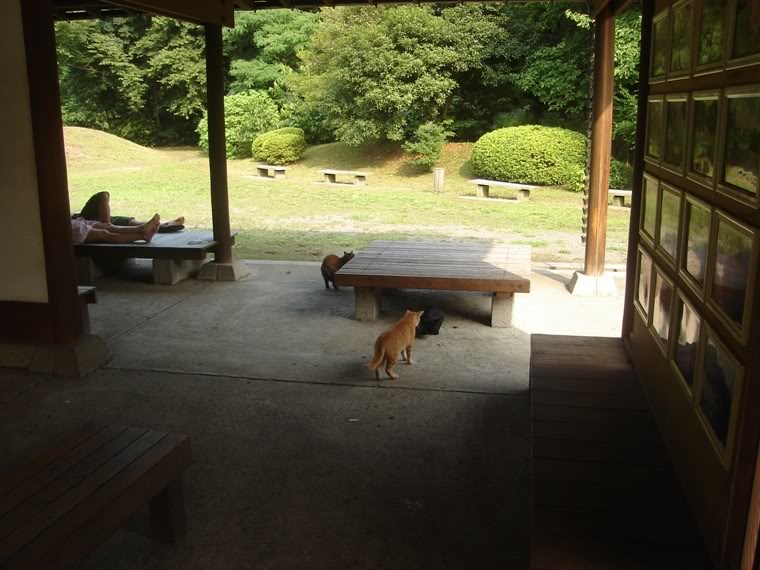
While the noise of the city and the shadows cast by its buildings cannot be completely escaped, its filthy air can. I’d almost forgotten what it feels like to inhale a lungful of fresh air, so entering this tree and grass-filled delight was like stepping out of my new life and back into my old one. I breathed deeply and felt… well, regenerated and energized afterwards. Plus there were resident cats, which always delights me (though the enormous flying insects don’t). Tokyo needs more places like this.

I also cannot escape New Zealand. I had a bit of free time at Yokohama the other day, so I was chilling out in the teachers’ room reading my handy guidebook (thanks again, Nic and Mami). Suddenly, I was forced to look up from the book and listen intently to the music coming from the lobby PA. Normally I would avoid doing this at all costs, as it is invariably pumping out swill like The Black Eyed Talentless Pricks or Destiny’s Satan-Child, but not this time. No, it was the dulcet tones of Bic Runga. Turns out it belonged to one of the staff members, who spent three years at high school in New Zealand, and actually lived just down the road from me in Riccarton. We probably saw each other at some point or another. This, combined with seeing my old flatmate’s picture on hundreds of Fujifilm photo-printing machines in Shinjuku, makes me think I know everyone in the known universe. Even if they don’t know me. Or prefer not to know me, since the spaghetti incident. Look, I said I was sorry and I meant it, okay?

SAY IT’S A GAME AND I’LL COME TO NO HARM

Most of the time, I try as hard as possible to block advertising out of my brain. It’s dull and ever more aggravating. It’s always the same. Then I see something I haven’t seen before, and I think ‘wow! That deserves my attention!’ But after I’ve seen it about ten times, it’s exactly the same as everything else. With the exception of the Freshup ad.

For the first three weeks of being here, I was constantly in that ‘wow’ phase. On billboards, trains, massive TV screens – seemingly everywhere – I could see advertising images I had never seen before, and it was like being in a foreign country, as Ian Rush might say. It struck me that perhaps wherever I go, I will experience this initial fascination with advertising. Like, it’s so pervasive everywhere in the industrialized/developed world, and the products are so different everywhere, that it’ll always be the first thing I notice.

Now, I’ve stopped staring intrigued at DoCoMo posters on the train. I’ve almost reached the same stage I was at back home, an attitude of ignorance to the extent possible. It probably helps that it’s mostly in written language I don’t understand (with a few exceptions, like http://www.jti.co.jp’s intriguing campaign), but I get the feeling it would be the same in America or the UK or anywhere else. Advertising’s really, really interesting until you realise it’s the same thing as everywhere else you’ve been: companies selling things.

My kids classes went well this week. I prepared the shit out of them, so that when we got in there I knew what I was going to do, when I was going to do it, plus I set stronger rules and reward schemes so they didn’t run about the place. We played a lot of Spiderman, which is exactly the same as Hangman except with a spider instead of a person – more politically correct, I s’pose. Images of a crudely drawn stick figure being hung by the neck from a decidedly unsound structure never perturbed me as a child, but hey, I’m just following the book. Needless to say, the adults classes went fine, and people have actually started signing up for my lessons because I am teaching them. Apparently. This is what staff members have told me, anyway – it could just be a confidence-boosting thing. Whatever, I’ll take it.

After my last kids class on Wednesday, I was looking out the window, and I got my best smog indicator yet. Back in NZ, if you look directly at the sun for longer than half a second, you’ll destroy your eyes. (I did this often as a child, actually: I would stare at it until it went a kind of shimmery blue colour which wouldn’t get out of my vision for about two minutes. True story, and probably the reason for my rapidly diminishing quality of eyesight.) Here, the sun appears to be smaller and more orange in colour, filtered as it is through thick clouds of smog that hang over the city. I reckon you could get away with two or three seconds of staring at it before it burnt out your vision. It probably also means I might finally be able to get a tan and not just go bright red within five minutes of taking my shirt off. That’d be nice.

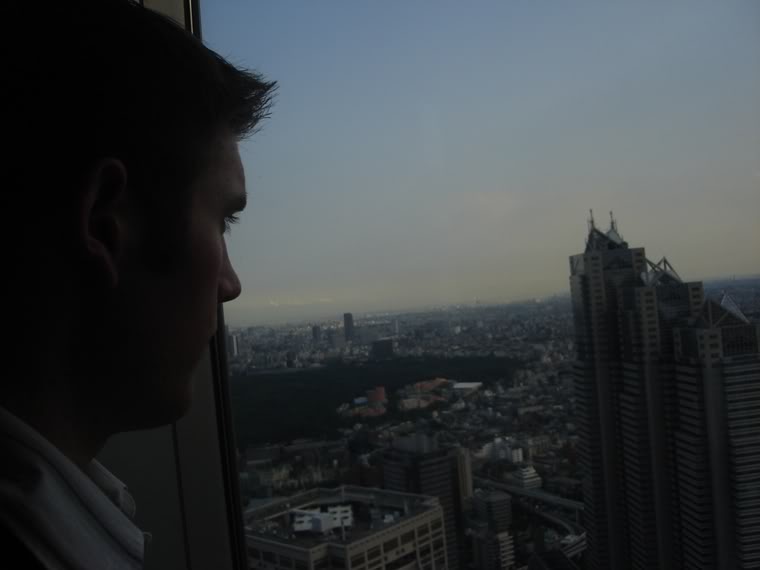
Finally, I went back to Shinjuku on Friday and had dinner on the 29th floor of the NS building, looking out over the night skyline with the Park Hyatt in the foreground. Unfortunately I forgot my camera, but you can trust me when I say it was quite stunning. The food wasn’t bad, either. I’ll have to go back and take some pictures.

DANGER STRIKES, THE IDIOT SLIPS

I’ve finished my first week of teaching. All together now: ready? THANK CHRIST THAT’S OVER. No, hang on, it wasn’t really that difficult – the basic adult lessons are a cinch, and make up about 90% of my schedule, so most of the time I’m not all that bothered. I turn up, tell a story and field some questions to get them thinking in English, go through what’s in the book, then just keep them talking until the lesson’s over. My students have pretty much all been friendly and eager to talk, which makes my job a whole lot easier.

There’s that other 10%, though: kids classes. I’ve hung out with kids before, and I used to bloody be one, so I thought I could control five at a time and actually help them speak in another language. Not to be. To employ an overused but no less appropriate phrase: they ran amok. I didn’t prepare enough, I didn’t set ground rules, and I didn’t get into a confident frame of mind, thus ensued a clusterfuck. Hopefully next week it’ll be like one of those stupid substitute teacher movies where, with everything having gone wrong on the first day, teacher goes home and undergoes a training montage – cut to the next day, and teacher waits in the classroom, ready to face those bastard kids… then they run roughshod over them once more. Except I’ll win in the end, and everyone will love me.

After that somewhat traumatic kids class, I was further humbled as I failed to observe an important Japanese custom: wearing footwear in the appropriate places. I don’t want this whole thing to turn into a discussion of things everybody already says about Japan (They work ridiculously hard! They sleep on the train, but always wake up in time for their stop! They have tiny feet! Etc.), but on this point I’ll concede bafflement. Why couldn’t I remain in socks as I escorted the kids and their parents down to the lobby? With some of the looks and comments I received upon stepping onto carpet without first entering my lace-ups, you’d swear I’d just been instructing those kids in the finer arts of bomb-making and shooting pornographic films, not English. I made a similar mistake at home in walking out the front door with shoes in hand and putting them on outside, rather than slipping into them at the genkan and lacing them up before facing the world. It’s just something I’ll have to get used to, I guess.

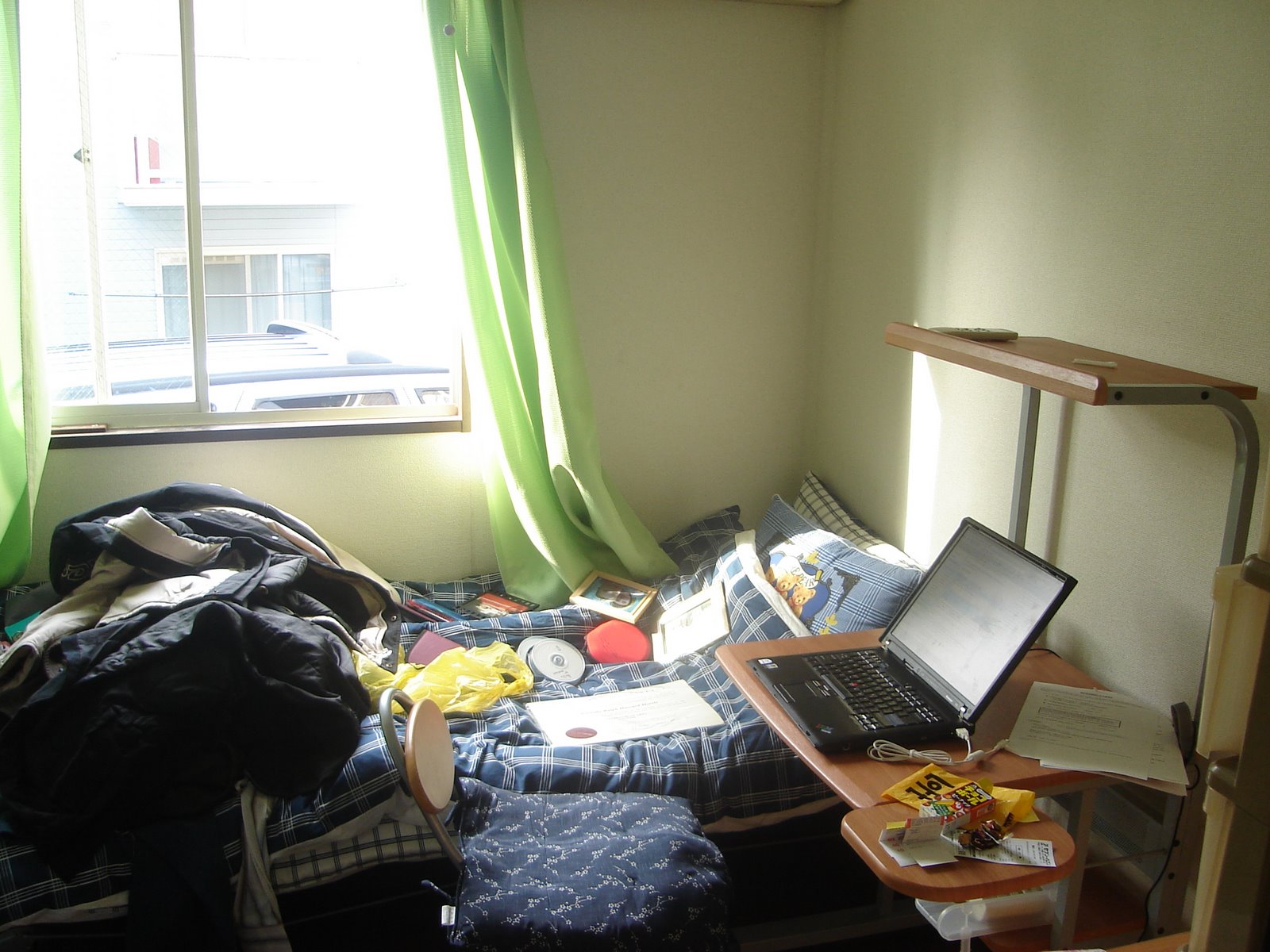
I’ll also have to get used to being spoken to in Japanese. On Friday I went to the hopelessly bland local government office to apply for my Alien Registration Card, or gaijin card as they are commonly known, and for the national health insurance. Nobody spoke passable English, so we baby-stepped through all the forms until they seemed to be saying everything was finished. Something will be delivered to my house around the 15th of July, and then I have to go to a bank or convenience store and do something… but I didn’t understand what. Fortunately, I live with other teachers who have both been here for over a year, so I’m not exactly adrift at sea – just mining this experience for content.

That building, though – probably the dullest, most depressing working environment I can imagine. The floor tiles, these tiny little off-white rectangles, were horribly ugly and obnoxious; even the paintings on the wall (presumably there for decoration) were nothing more than a slathering of brown with some words carved into them. It must have been a metaphor for the bureaucracy surrounding it: there’s some meaning here, but you’ll have to stand here looking for hours before you find any part of it. Naturally, I put my headphones in, put on Justice’s excellent and incredibly vibrant new album, and waited my turn.

Tracks I never tire of: ‘Boyd’s Journey’

‘Boyd’s Journey’, by Michael Nyman & Damon Albarn, from the album Ravenous: Original Motion Picture Soundtrack

Film scores rarely hold much interest for me as stand-alone works of art. Generally, they’re either boring compilations designed to cash in on (or bolster) the movie’s success or the same cue repeated 20 times with little variation and a few bits of dialogue thrown in for distraction. There are exceptions, of course. Great compilation or part-compilation soundtracks include GoodFellas, Boogie Nights or Lost In Translation (among others), all of which work wonderfully as albums; of excellent original score soundtrack albums, however, I’ve only come across one – Ravenous.

Without its score, Ravenous would be a decent, enjoyable, but somewhat muddled film. With its Albarn/Nyman score, the muddlement remains, but it seems to fit perfectly alongside the schizophrenic music and the film is elevated to something I have been happy to watch about six or seven times. For me, no other film score is as important to its film than this one. Other scores may be greater – 2001, On Her Majesty’s Secret Service, name something of your own – but here it’s absolutely vital to the film’s success. It is its star, its guiding force, the thing you remember about the film years later.

Though it’s full of fantastic individual tracks, it’s easy to pick one as the standout. ‘Boyd’s Journey’ is essentially the film’s main theme, appearing three times in the film and acting each time as a cue to our hero’s rebirth. As it begins it sounds like a child with ADD plucking at banjo strings, then other elements such as harmonica, squeeze-box and brass are brought in. It’s almost heroic, but the overwhelming impression one gets is of bitterness, melancholy, and tragedy. Like, it’s really beautiful, and seems to signal new beginnings, but I don’t think there’s any real joy intended – yes, things are changing, but probably not for the better.

The first time and (I think) second time through, it’s played on actual instruments, but on the third time – for the conclusion and end titles – Nyman & Albarn switch just about everything over to keyboards and synthesizers. With the strings, it adds a deeper level of sadness, its preciseness somehow cutting deeper than the roughness of the former version. Both are phenomenal pieces of music, regardless of whether they’re listened to in context (of the film or the album) or not. My vote for the Best Film-Related Music Ever, and as stated above, something I never get sick of hearing.

I MADE A BATCH OF SCONES

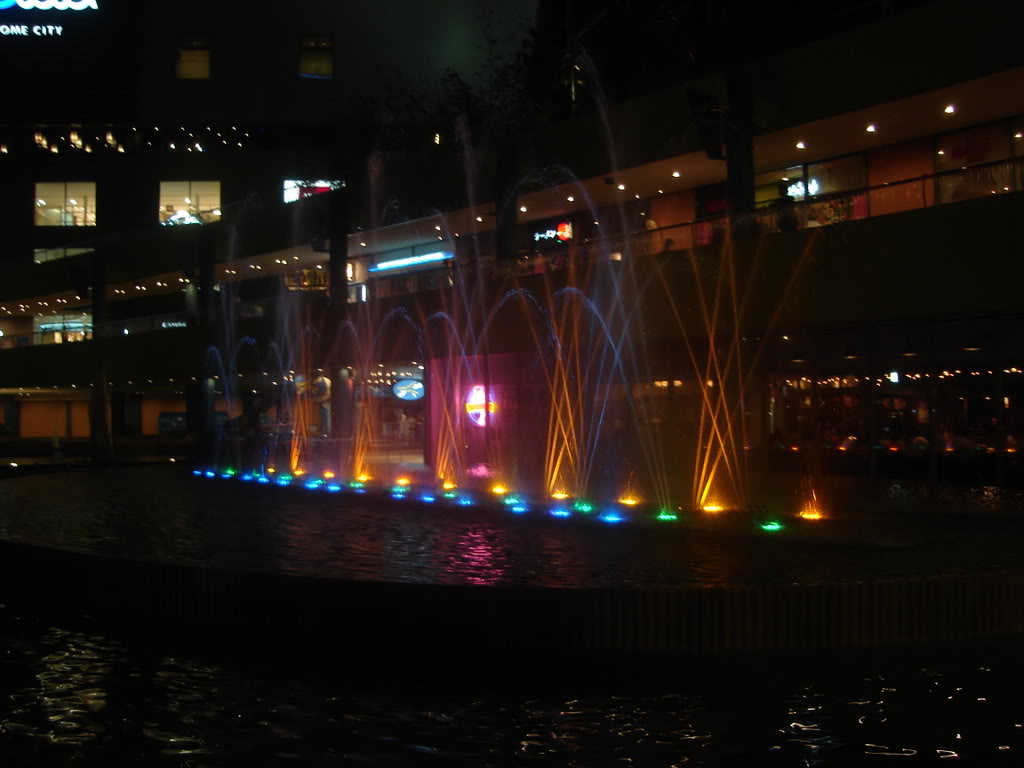
Just as I am not built for air travel, I am not built for amusement parks. With yuenchi, the Japanese variety, my height becomes an even bigger issue. I know it’s old hat, possibly even racist, but most things in Japan really are a bit smaller. I bang my head ALL THE TIME in this apartment, on trains, at the office, et cetera. So, it was with some trepidation that I ventured forth with my fellow trainees to the Tokyo Dome City Attractions last Wednesday. Rainbow’s End couldn’t prepare me for this shit.

It’s home to the Thunder Dolphin, a one-and-a-half kilometre collection of Thrills and Spills including an 80-degree drop and a top speed of 130km/h. You know how most rollercoasters have those big securing pads that come down over your shoulders? Not this one – just a seatbelt and a bar across your torso. I wasn’t really that nervous, because I didn’t know what to expect, but as we went up the first incline and looked out over the city whilst screaming ‘Holy shit!’, the visions of all the safety precautions failing and me falling hundreds of metres began to swirl.

It was fine, of course. I would make fun of one of our number for closing her eyes throughout, but she (and all the others) actually went back twice while I wandered around on the ground like a dog waiting for its master to come home. What? I had a headache! Largely because of another rollercoaster we subsequently went on, Geo-Panic (indoors, dark, very very cramped), but a headache nonetheless. I’d go in Thunder Dolphin again, but not twice in the same day. Even if it does have a ridiculous name.

Speaking of faithful dogs, I met Eiko-san by the statue of Hachiko on Thursday. She took me to an izakaya for dinner, where we had some good stuff (I forgot to take photos this time, sorry), then to an English pub. She kept feeding me Long Island Iced Teas until we had to leave to catch the last train, so of course I felt like death for the last day of kids training. Worth it though, totally. I’m very lucky that I know people who are already here – I think it’s a bit difficult for some of the other trainees who really are starting a whole new life in Japan.

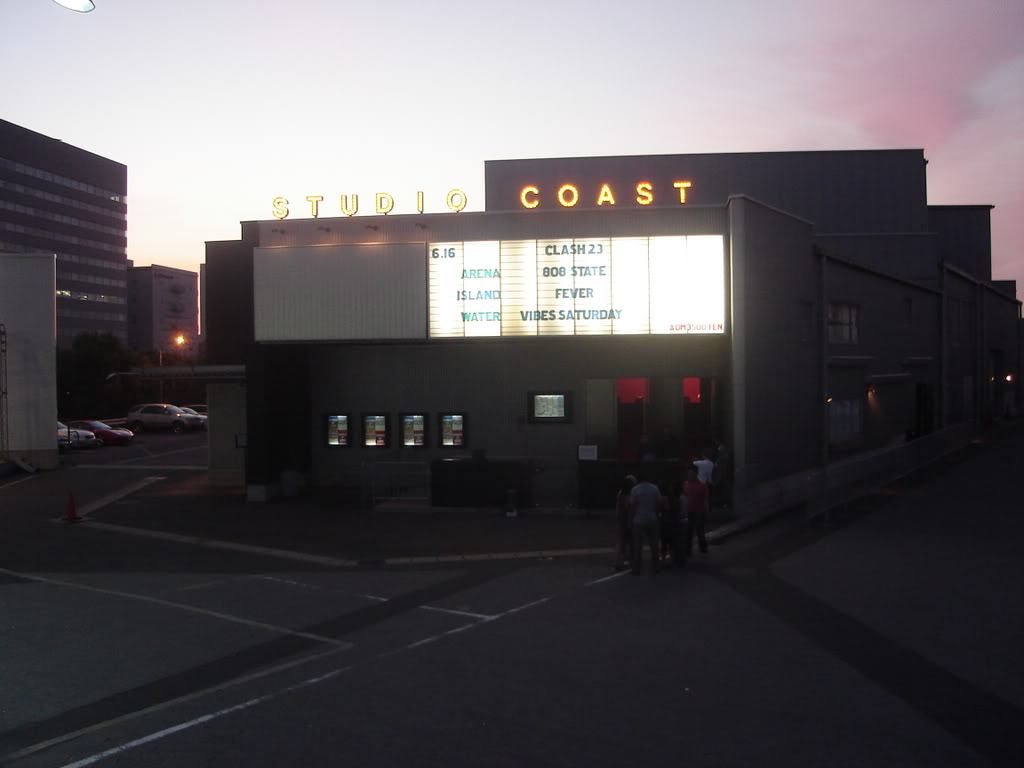
Last night I went clubbing by accident. I was supposed to just have a couple of drinks then come home on the last train so I would have some energy for study today, but of course I was dazzled by my new colleagues’ conversation, so I missed that train and had to stay out all night. Jimmy paired up with a girl at the first bar so we left him behind and went out to Chiba-ken to a club called Studio Coast. Almost as impressive as the cavernous interior and the pumping beats was the 3500 yen cover charge (about $40 back in NZ).

It was fun and all, but I hit the wall pretty early and it took two hours to get home. I wondered how one-night stands work at a place like that. You meet someone, you decide to leave together, and then… you spend hours in buses and trains just getting back to the flat. Maybe I’ll find out soon LOL!!!!1! The other thing I’m struggling to adjust to is people smoking inside – it’s illegal in workplaces and public establishments back in NZ, but not here. People always go on about how bad passive smoking is, and yeah that sucks, but the worst is how all your clothes smell like they’ve been washed with tobacco. You think you’re getting away from the smoke when you leave, only to find you can’t escape until your shirt and pants are in the washing machine.

Couple of other things: check it out Johnny’s weblog, he can tell you about host bars and how he should try to get work in one. Finally, the other day I finally saw something I’d been looking for ever since coming to Japan: ganguro fashion. It’s basically fake tan, peroxide blonde hair and white around the eyes and mouth. Perilously close to blackface, and horribly unattractive if you ask me. Supposedly, it’s a way for unpretty girls to mask their looks, but like… I struggle to believe that most ganguro girls wouldn’t look better without it. If I were making a ‘Bizarre Japan’ list, it would currently rest at #1.

This is why I should make regular posting days: so my entries aren’t so all over the place, or so long. I’ll probably make it Fridays and Sundays from now on, seeing as those are my days off. Work proper starts tomorrow by the way. Not worried about it.

BLOCK OUT THE SUN OVER ME

On Thursday I met my friend Yutaka after training. (I was so excited I forgot to punch out my timecard.) He’s a tour guide in Christchurch, but has been back in Japan until tomorrow, so he offered to show me some things in Shinjuku. First, some skyscrapers.

West Shinjuku is known in Tokyo as ‘the skyscraper district’. There must be somewhere between 10 and 20 buildings that are 35 stories or more. Pretty much all of them are about 80-90% offices, with supermarkets on the ground/basement floors and restaurants on the highest floors. Some of course, have observation areas, so we checked a couple out. The most impressive was the tallest building in the city, the Tokyo Metropolitan Government Buildings, with its twin towers and modern interiors.

Generally I would say a view’s a view and there’s no point explaining it, but this was special enough to warrant more than just a photo or two. In every direction, buildings cover the land (apart from the parks, like Yoyogi), all the way out past your field of vision. This means there is an obscene amount of pollution, so you can’t really see that far – like, if it was NZ, you’d probably be able to see Mount Fuji, but here you can only see it about twenty days a year. The point, though, is that one has to marvel that a lot of this sprung up in the wake of World War Two. That’s 50 years to get from near-decimation to arguably the most impressive, advanced and certainly largest metropolitan area in the world.

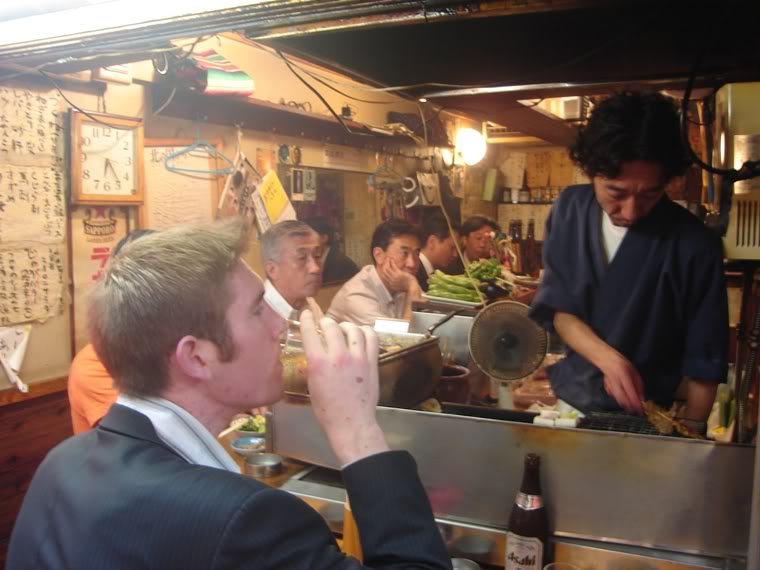
From there we went to an alley crammed full of very traditional yakitori bars: tiny establishments serving mostly barbecued meat on sticks to salarymen. The ‘men’ there is key, because while we there, I would’ve only seen about four or five women out of the hundreds of people dining in the alley. Every time a pair or group of young girls walked past, Yutaka would say they were probably from out of town, because local women would always go somewhere else and leave the blokes here to drink, smoke and banter.

I quickly realised the art of choosing which establishment to enter. First, you want one that’s full (or nearly full) of people. If there’s nobody there, that’s usually for a good reason: the food’s inferior. Better to have to keep your elbows tucked in tight and enjoy incredible food than be able to spread out and not want to finish what’s been put in front of you. Second, the chef shouldn’t be too vocal. The vast majority will be calling out ‘Douzo’ (please), ‘Irrashaimase’ (formal welcome) and ‘Oishii desu yo’ (It’s delicious), loudly and almost desperately. The good chefs a) are too busy cooking to yell at potential patrons walking by; b) know their stuff is so good that people will come anyway.

Which brings me to the food. I… words fail me. Certainly one of the best meals I have ever had, and a dream experience. We had mung bean sprout/chicken liver salad, seasoned pork/spring onion skewers, macaroni/tuna/ham salad, tofu/pork/radish stew, seasoned chicken mince skewers (a house specialty), and seared bonito slices (just amazing), accompanied by several Asahi beers. I’ll post a photo soon, but seriously, every last thing was incredible. And we were sat right in front of the charcoal broiler, so we could watch the chef work. Everybody was friendly, too – obviously quite surprised to see a foreigner in a place like this, but keen to communicate.

We then met an Aussie guy and a couple of American girls, so we had a few drinks with them, which was cool. I found myself talking like a teacher: smoothly and very demonstratively. Perhaps not a good thing, but I’ve resigned myself to it, because these procedures and philosophies I’m being trained in won’t allow themselves to be put to one side. Actually, maybe it is a good thing. I’ve never been very good at verbal communication, so if if the only downside of changing that is sounding like I’m in an infomercial, I guess I should embrace the trade-off. Either way, it hasn’t been that difficult thus far. Kids training next week! Singing and dancing! Woohoo!

HOLD YOUR HEAD UP HIGH ON THE OTHER SIDE

QUESTION from Marty: How long does the train ride from Chigasaki to Shinjuku take? – Well, if I take the Rapid service (which I usually do), it’s 52 minutes. Yes, train times are that exact. In physical measurement, it’s just over 60 kilometres. Including walking times, my daily commute is about 70 minutes each way. Bear in mind that the whole way, the conurbation never stops – it’s buildings from beginning to end with no parks, forests or hilly domains. Thanks for the question, Marty – keep ’em coming, people!

This morning I slept through my alarm. That’s to say, it went off, I grabbed it and pressed ‘Stop’, then settled back into bed – all without actually waking up. I opened my eyes to find the sun higher in the sky than it should be and my phone/alarm clock nowhere in sight. Panicking, I threw my bedsheets around trying to find it. What if I only had 5 minutes to get to the train station? What if training had already started? Very soon I found my phone, and it said 8 o’clock. Training started at 10:30. Not the nightmare I was preparing for, but still quite pressing.

I made it, though. No problem. And I remembered my pen today, which I’m sure you’ll agree was sensible.

After training I found myself in Shibuya, so I met up with the gentleman who writes (or used to write) this website. He’s a Kiwi who’s been over here for a year now. Pretty crazy, hanging out with someone I’ve only previously talked to on the internet. I must say, it was very nice to hear a familiar accent again, even though I’ve been here less than a week. We had a good yarn over a couple of beers; he introduced me to some new terms, like ‘friendsick’ and ‘familysick’ in place of ‘homesick’, as they are very much distinct from each other.

Generally, talking to this guy was massively reassuring – like, now I feel like I’m really here and it’s exciting and my horizons can be expanded, because until now I’ve been wary of exploring too far, or challenging myself too much. His words made me think about why I’m here, and how I’m here, which made me eager to get into things a bit more instead of sitting back, saying as little as possible and keeping to the streets I need. The easing-in period can finish; the grabbing life anew period can begin (as ridiculous as that sounds).

PEOPLE WON’T BE PEOPLE

I made my way to Shinjuku this morning for the first day of training. As is customary, I missed the turnoff and walked about three times as far as I should have, before realising my mistake and turning back. I found the building, sweaty and harried, with 5 minutes to spare. Wahey.

(By the way, the weather is different between Chigasaki and Shinjuku. In Shinjuku, it is sticky and energy-sapping. I think it’s all the tall buildings reflecting heat into the street, or something. Down here in Chigasaki, it is comfortable – warm but not too hot, not humid, occasionally with a pleasant breeze. But you didn’t come here to talk about the weather, and anyway, it’s all going to change very soon – the Rainy Season is almost upon us…)

Once inside the training room, with four fellow trainees (all Australians), I realised I hadn’t brought a pen. Good start. Our trainer looked and spoke a bit like Simon Amstell, so when he noticed me looking around uncomfortably at form-filling-in time, he graciously offered me his pen for the session… and took the piss out of me at the same time. What he couldn’t possibly have expected was that I would BREAK HIS PEN just five minutes later! What a ridiculous thing to do! I felt like a prize idiot, but he didn’t mind too much… he just took the piss out of me again.

The second trainer who took over at about 4 was a Yorkshireman who was into, among other things, avant garde hardcore and noisescapes such as the music of John Zorn. So far, not too challenging.

After the training finished, I went for a wander around Shinjuku, just to look at all the blinking lights and swiftly moving people. It was illuminating, to say the least. So many shops, bars, restaurants… all with staff outside shoving menus in your face and loudly chorusing for you to come inside. I didn’t buy anything – somehow. I also counted about four noisy buses circling the neighbourhood, obnoxiously but delightfully advertising various wares. Then I caught the train home, and the mass of people on the train network illustrated again how vast Japan’s (and especially Tokyo’s) population. People just don’t stop coming.

Now I’m back here, writing this, and thanks to Google I know that there’s a guy who did exactly the same. Here‘s his webpage, which I discovered some time ago, but only read through in the past couple of days. A lot of it is rather familiar. That’s my house! That’s my room! That’s my local bar! His writing is (I think) a lot more earnest than mine, but it’s pretty good, and worth a look. It makes me wonder whether I shouldn’t lighten up once in a while and just be stunned by my life at the moment, similar to how he was… but that wouldn’t be me, would it? I come at everything – even a completely new environment, with the hundreds of challenges that poses – with ruthless pragmatism and even a healthy dose of cynicism. It’s just the way it is. How would you react in my situation? Or how did you react? Am I doing it wrong?