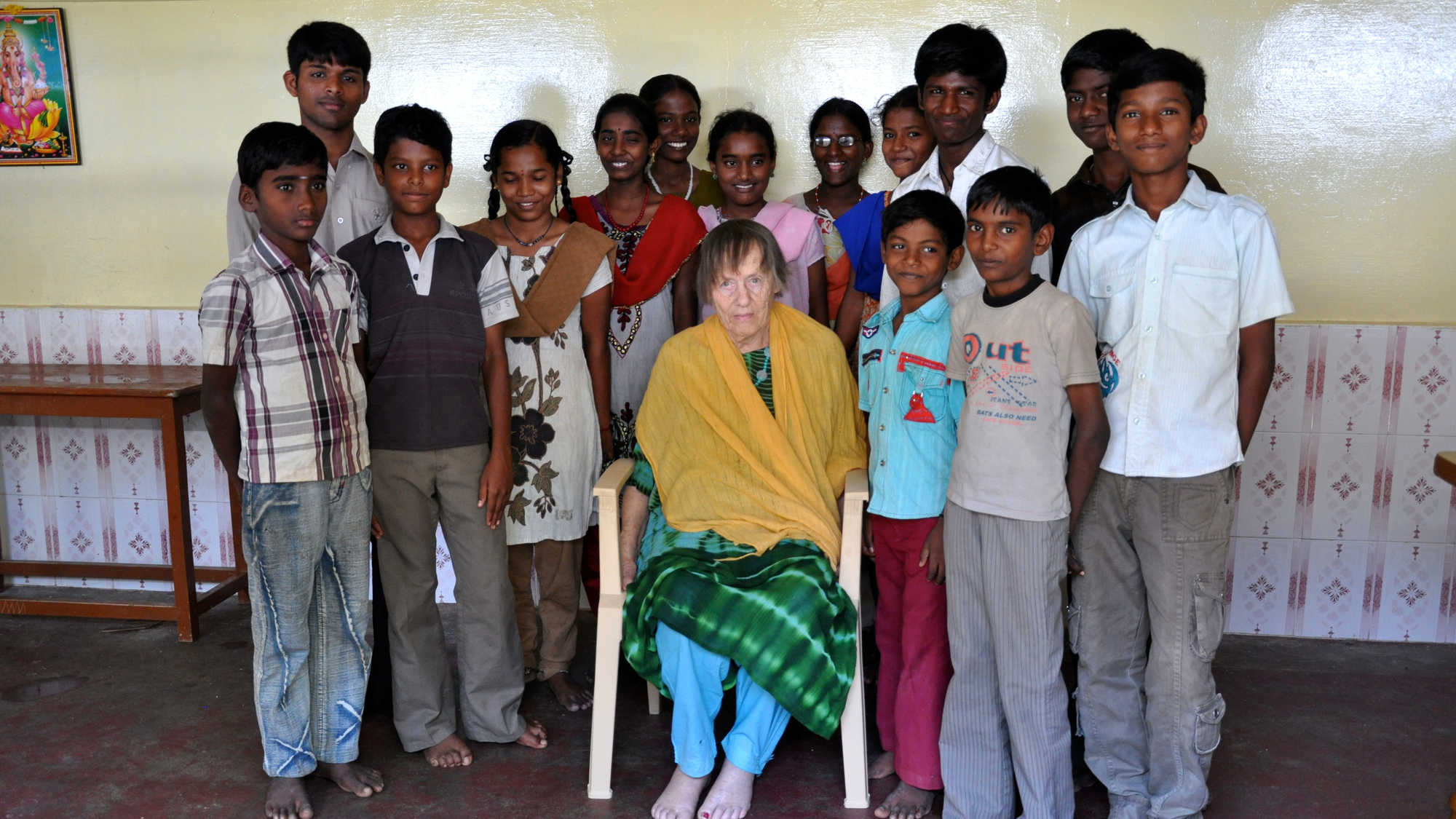
The film opens with Jean Watson, eighty, her face creased with river-like wrinkles, wandering around the streets of Kanyakumari and lowering herself into the ocean as dozens of young Indian boys (and a camera) look on. My first thought — I couldn’t help myself — was ‘I’ve swum in that ocean!’ And I had, a strange trip in 2009 during which my then-girlfriend was groped repeatedly and I lacerated my feet on sharp underwater rocks. It’s a beautiful location, revered by many as the point where three seas meet, but my memories of it aren’t entirely positive. No such problems for Jean Aunty, though, who wanders through it all with the same inscrutable expression on her face, and who emerges from the water cleansed and energised, ready for the next challenge.
I hadn’t heard of Jean Watson before seeing AUNTY AND THE STAR PEOPLE, and I expect many New Zealanders won’t have heard of her either, despite her many published novels, her long romance with Barry Crump, and her considerable humanitarian work in India. Watson is one of life’s observers, regularly found at the extreme right or left of group photographs, peering into the camera with the same watchful eye she casts over her surroundings. She is an intrepid, self-effacing realist, moving through life without fanfare; even in a South Indian village, where any foreigner is met with prolonged stares and chatter, she seems capable of blending into the background. Her decades of involvement in improving young boys’ and girls’ lives in India prove that you don’t need to be romantic to be idealistic; she sees the world as it is, not for what it could be, and tries to make it better.
Watson is the chief benefactor of Karunai Illam, which was set up in the late 1980s and which offers orphaned children the value of routine. Rather than being left to scratch around the streets on their own, or bounced from orphanage to orphanage, Karunai Illam gets them out of bed and brushing their teeth at the same time every day before filling them up with a hot meal and sending them off to school. These are children for whom deceased parents are merely a fact of life. But they look healthy, and happy, and show an abundance of curiosity about the world.
In fact, given their aspirations to become doctors and engineers, it’s slightly frustrating that so many of director Gerard Smyth’s questions to the girls revolve around marriage. This feels like a missed opportunity to gain more insight into their deeper thoughts. But marriage and reproduction are also a huge factor in the kids’ lives, an inevitability for many, and probably at a young age; it’s understandable that it might be at the forefront of their minds. And apart from this, Smyth does a fine job of taking us inside Watson’s two worlds: her anonymous writer’s life in Wellington and her status as life-changer for hundreds of children in Nilakkottai.
Apart from Watson and the kids, the other person seen most often in AUNTY AND THE STAR PEOPLE is Joy Cowley, an old friend of Watson’s and — through her innumerable and widely popular children’s books — a friend to almost every New Zealander. Where Watson’s insights are plain-spoken and straightforward, Cowley’s are effortlessly elegant and warm. She has a gift for language and, apparently, great reserves of empathy and generosity. She is a joy to spend a little time with. I can’t wait for the film about her.
The quirks of nziff.com’s online seat allocation mean that nerdy early bookers like me are almost always put in the middle of a full row, regardless of the overall house size. When I staggered into VOICES OF THE LAND, heaving after me a plastic bag filled with hardcover library books, I stared down that ancient social experiment: shuffle past two already-seated patrons and hope they don’t hate you forever. Fortunately for me, the two women — I’d guess they were in their seventies — stood with a smile. I still apologised for existing, as one must.
The plastic bag crashed into the second woman’s leg as I sat down next to her. “You’re quite the reader, aren’t you?” she said. I admitted the books had been borrowed by my girlfriend and that I hadn’t read a word of them. The woman segued seamlessly into a discussion of a book she recently read and was fascinated by. It went in one ear and out the other, but I nodded an acknowledgement and proceeded to tell her what I was reading: Netherland by Joseph O’Neill, which concerns a Dutch man living in New York when the planes hit the World Trade Center. His marriage steadily disintegrates thereafter, and the rest of his life devolves into meaninglessness. The man’s only solace is cricket, which he played often as a boy and is surprised to find in baseball-mad NYC.
The woman nodded back, then said her son was in New York on September 11 as well. She noted that his marriage had also fallen apart over the ensuing couple of years, and that he and his then-wife ultimately divorced. My brief description of Netherland must have sounded uneasily familiar, and I was struck by the reminder of how directly fiction can echo reality. But if the eerieness of the coincidence bothered her, she didn’t show it. In any case, it didn’t seem like the time or place to delve deeper, and I felt embarrassed at having unwittingly called to mind her son’s past trials, so I simply said “That’s no good” and asked what else she was seeing in the film festival. We went on to talk about our expectations of VOICES OF THE LAND and its subject, the brilliant Richard Nunns, a Pākehā who learned how to play Taonga pūoro (traditional Māori instruments) in dreams. Then the film started.
Nunns has Parkinson’s disease, and as you watch him shuffle with a stooped gait along forest paths and stony beaches with protégé Horomona Horo, it’s as if the Earth is slowly pulling him back down to it. His connection with the land is greater than most, comparable to almost any Māori. Over his seven decades, he has accumulated an unequalled volume of experience and knowledge regarding Taonga pūoro, and that flows into a wealth of other insights: about divine inspiration, about why Pākehā often fail to connect with Māori, about the nature of sound and its value to us, and about his own influence. He shares these insights in his own inimitable, rhythmic language: “these are the ways in which our sonic environment is subsumed.” As much as the land may be calling him back, Richard Nunns’ abundance of knowledge — and his awareness that it is held by remarkably few — may be weighing him down.
So he’s passing it on to Horo, an affable and deferent man with a hulking figure and a long ponytail. Through this film collaboration with Paul Wolffram, he’s also passing some of it on to us. Ninety minutes in Nunns’ company could never compare to the lifetime of looking and listening it’s taken to get him to this level of understanding, and Horo is clearly the next master of Taonga pūoro, but there is so much for an audience — especially in New Zealand — to take away from VOICES OF THE LAND. Take the headphones out of your ears next time you go for a walk. Allow yourself to experience the sound waves moving through you. Pay attention to where those sounds are coming from. Respect their sources, and remember that the river or the forest have been around a lot longer than you have. A lot of Nunns’ work with Horo, and previously with the late, great Hirini Melbourne, involves playing to the land: taking their instruments out to some barely touched forest or foreshore scene, usually by request, and following their sonic inspiration. Their mastery is not so much of the instruments but of their connection with them, and by extension the land itself.
Throughout VOICES OF THE LAND, I couldn’t help being reminded of my dad, who I sometimes feel I am slowly becoming. Like Nunns, he has an array of artifacts displayed around his house, including several creaking bookshelves bearing cherished works; like Nunns, he has a story for each of them, and for pretty much everything else in his sphere of orbit. Among the artifacts are some instruments, some of which bear some resemblance to Taonga pūoro. My dad was once in the Scratch Orchestra, a collective led by Phil Dadson that performed a combination of music and sonic experimentation. The one I always remember is the repeated scrunching up of a page of newspaper into a ball then reopening it, maybe fifteen or twenty times. Try this, if you have a newspaper handy, and notice how the sound and feel of the newsprint changes. It’s this kind of mindfulness towards the objects and sounds in one’s environment that Nunns has spent his whole life promoting.
I was lucky enough to see Melbourne and Nunns perform once, at WOMAD in Auckland in 1999. They took over the Auckland Town Hall for an hour and held everyone in their thrall as they moved between various instruments that had been placed on the stage. This music was like nothing I’d heard before: sparse, not particularly tuneful, but possessed of a seemingly inherent gravity that captivated me. (By the way, you probably already know this sound if you’ve seen any New Zealand film since ONCE WERE WARRIORS, but if you’re drawing a blank, have a listen here.) My dad was sitting beside me that day; he’d bought my ticket. Later, I was too embarrassed — too fourteen and pimply — to dance to Pacific Island fusion group Te Vaka out in Aotea Square, but my dad was shuffling away with a smile on his face in his huge black-and-blue jandals. At one point he gently admonished me for folding my arms and refusing to give in. “Can’t you just let it take you over eventually, just let it move your feet for you?” I remained coiled, and he carried on dancing.
VOICES OF THE LAND closes with one of the best final shots I’ve seen: a moment of dazzling, patient, inevitable simplicity, a reminder of the wonder in something that happens perpetually. It left me feeling inspired and moved. The woman asked me what I thought as we stood up and left the cinema, and I told her that I loved the film but felt embarrassed that I’d seen (and heard) so little of New Zealand. “Oh, you must,” she said. “Why haven’t you seen much? Are you not from here?”
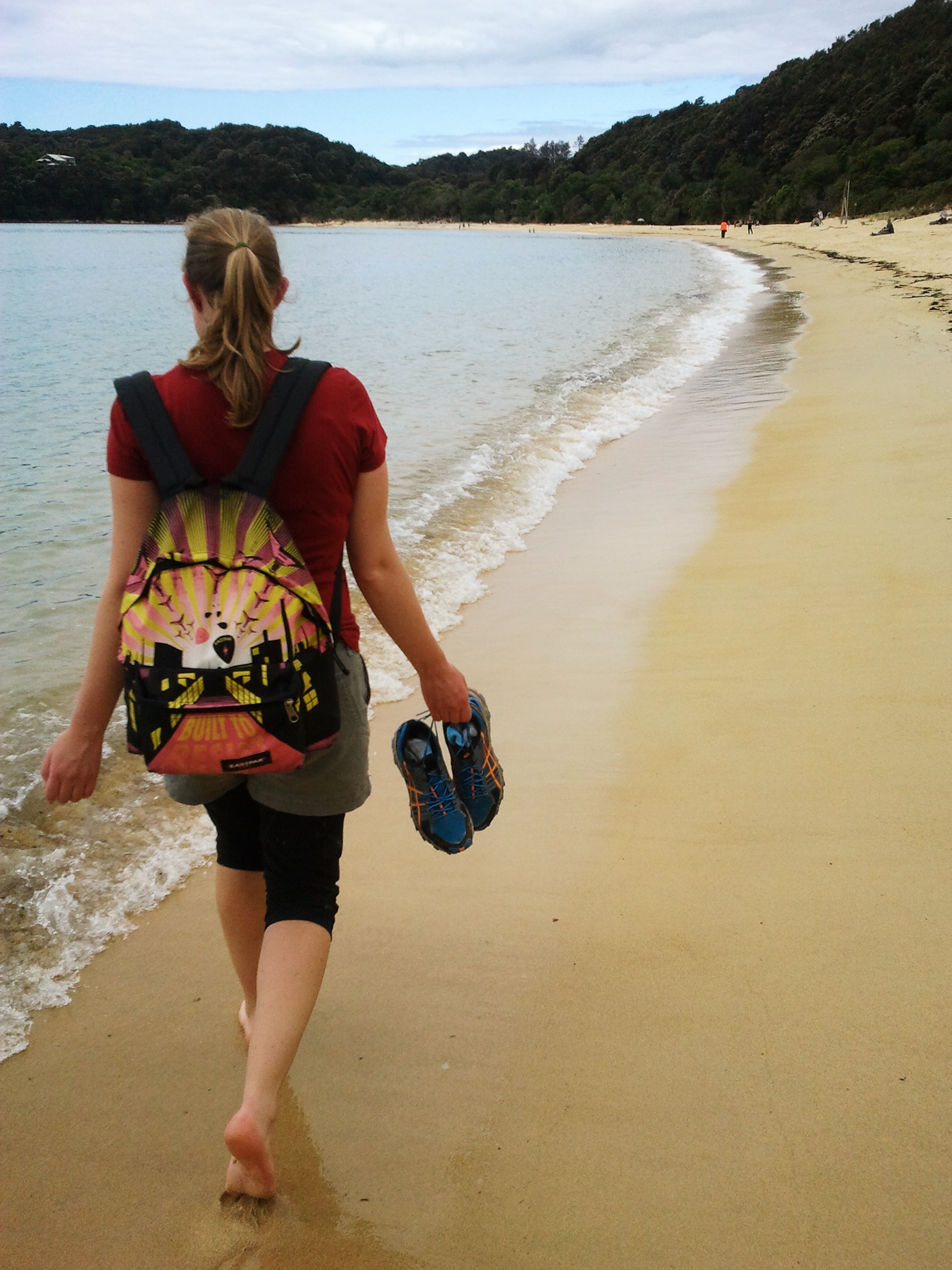
I replied that I grew up in the Waikato and have since lived in Auckland, Christchurch, and Wellington; that I’d visited beautiful locations such as Cape Reinga, Mahia, the Tararuas, Abel Tasman National Park, and Castle Basin in the Southern Alps. And as I spoke, I realised that I have seen quite a lot of New Zealand. I’ve only seen the Tararuas and Abel Tasman thanks to my girlfriend, who is as filled with fascination in nature as anyone I’ve met. But I owe the rest — and many others — to my parents, especially my dad. We had so many week-long driving holidays when I was a kid, sleeping in tents and living on Rice Risotto as we took in the many sights of the North Island. My dad was obsessed with taking the back roads instead of the state highways, carsickness be damned, just to see something different. He lived for some years on the edge of bush in the Waitakere Range, west of Auckland, and he still feels its pull. Whatever connection I have to the land, I owe a huge part of it to him.
I’m now 29 and I have no kids. No property or other investments, either. I would like all of those things at some point in the future, but they aren’t my priority at the moment. I’m more interested in travel and pursuing new opportunities in my career. Round up a few other 29-year-old New Zealanders and see how many say the same thing.
Most of what follows is about me.
Music
The best twenty seconds of a song I heard this year were 3:10 to 3:30 of ‘The Red Wing’ by Fuck Buttons, from the album Slow Focus.
My music listening habits never really developed past the age of 16, when I got my first computer. I come across a new album and listen to it once or for months on repeat. Slow Focus was my favourite album of the ten or so new ones I heard this year. James Blake’s Overgrown would be next, and I also really liked Nothing Was The Same by Drake.
The steady accumulation of layers and abrasions on ‘The Red Wing’ reaches a glorious, spine-tingling apex about halfway through. My second favourite twenty seconds of a song are also from ‘The Red Wing’ as it starts to devolve from 6:10 to 6:30. The album as a whole is relentlessly dark, loud, and repetitive; it calls to mind the twisted sensations of being off your face in a dark nightclub, or the sick emotion that accompanies losing something important you can never get back. It drags me through a 45-minute catharsis. My kind of music.
Oh, the best New Zealand album I heard this year was Anniversary Day by JP Young. It would be my favourite album of the year but it came out in 2012. I recommend you go and listen to (and maybe buy) it now, especially if you have any connection to Wellington. It is a genuinely great album, poetic and easy to get along with.
Politics
In my dictionary (the excellent WordWeb), the first definition of ‘politics’ is Social relations involving intrigue to gain authority or power. No wonder it fills so many pages in the newspaper and minutes on the airwaves. Not here, though.
Sport
From in front of that massive, stunted goal in Shed 1 – about waist-high and about a third of the width of the pitch – James rolled the ball out to me. I was just on our team’s side of the halfway line, the opposition goal about fifteen metres behind me. We were ahead, but we’d just conceded a goal and needed to regain control of the run of play.
I leaned back slightly as the ball reached me and tapped it with the outside of my right foot to MHS, who was over by the left sideline. As he put his foot on the ball and drew a defender, I spun round and sauntered into space a few metres downfield. Just as I was nearing the penalty spot, with no defender near me, MHS took a couple more touches and tapped the ball past his marker, into my path. In my peripheral vision, I sensed two things: one, the opposition goalkeeper was positioned slightly to the left of the centre of the goal, back near his line; two, an opposition defender was rushing at me from my right.
As the ball ran in front of me, I controlled it with one touch from my right foot and – judging that I had less than a second in which to act before I would be tackled – snapped a left-footed shot along the ground, past the oncoming defender, and into the bottom right corner of the opposition goal.
The exact same sequence of events could have happened a hundred years ago, albeit on grass rather than turf and with a plain leather ball rather than a bright yellow plastic one. I will remember it for decades, just as I remember my chipped goal from near halfway in a second XI match at high school and a perfectly timed flick off my pads for four from the first ball I faced in house cricket. Such moments in our sporting lives are timeless.
Film
I seem to be getting more bored with the movies. I went dozens of times this year, more than I have since about 2006, and I always enjoyed myself from start to finish, whether it was any good or whether the dude behind me provided a running commentary throughout (as happened in The Hunt and at least one other film I can’t remember). But I rarely left feeling inspired to talk about what I’d just seen, or to think about it a week later. The prime example of this was Hyde Park on Hudson, a film so bland I barely remember seeing it.
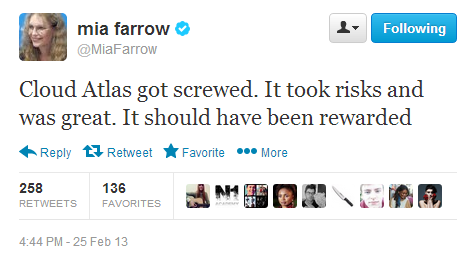
Casting a wide shadow over all my cinematic joys this year was the disappointment that Cloud Atlas was not released in cinemas in New Zealand. The distributor must have gotten cold feet at the prospect of selling Kiwi audiences on a three-hour epic with six ongoing storylines painted in broad archetypes, which seems like a fair decision when I look at that sentence, but Cloud Atlas somehow fulfils its extraordinary ambitions and offers a new kind of multi-layered spectacle in film. I watched it at home, alone on the couch wearing headphones, oblivious to a storm raging outside. It was the best new film I saw this year, and when a stranger says they also loved it, I feel like the film is recommending that person to me.
Tech
A couple of months ago, someone did a memorably recognisable impression of me. They held a smartphone close to their face, jabbed it with their index finger, and muttered, “Just… fucking… work!”
The way I treat the technology in my life has become a good indicator of my mood. The more accepting I am of my phone becoming unresponsive or my laptop shutting down unexpectedly, the better my overall frame of mind. If I’m already frustrated, I swear and click the mouse harder and bang my foot on the floor. I apologise to my colleagues for this.
The fact that my use of electronics can be seen as a barometer of my psychological state suggests how deeply I’ve involved these objects in my daily life. When you spend more than half of your waking hours with someone, or something, some irritation is inevitable. But if I lost them, it’d be like losing one of my senses.
Books
In August I went to the launch of Eleanor Catton’s The Luminaries, putting one foot in the world that knows her as ‘Ellie’. She complimented me on my yellow shoes, and I asked her how she was feeling. “A bit overwhelmed, to be honest,” she replied, looking around at the faces and wine glasses packed tighter than ever into Unity Books. This was a couple of months before she won the Booker.
After the launch, Nik and Ant and I discussed what a positive occasion it was. A good person being celebrated for an amazing feat of creativity. I still haven’t finished reading the bloody thing because I am so terrible at reading books, but it really is great, and I will get there.
Travel
In September I went to Brisbane, and in December I went to Nelson. First holiday was alone, second was with a companion. The weather was great for both.
People
I think it has to be Tara, four months in, as wonderful as my colleagues, friends, and family are. She plucks snails off the footpath and places them safely in the bushes. She attempts to identify each bird she sees: “Thrush? Female blackbird?” She is comfortable speaking to strangers on the phone. She writes good emails. She gives excellent gifts. Our conversations flow easily, weaving from meaning to silly madness and back. Perhaps I am overly observant, but she means a lot to me.
Also, the Internet has a slightly diminished role in my life right now but I was lucky enough to get to meet Charles, Dan, Kathleen, Isabel, Martyn, Naomi, Neha, Reena, and Sarah this year – all people I came to know about through Twitter, and who have all been teachers in some way or another. Each year brings more new connections, and some old ones rekindled. Many bleed happily from one medium into another: Twitter, then Facebook, then a coffee shop or a pub. There will no doubt be more new people in 2014 – more good people, and more effort not to spread myself so thinly.
*
Thanks for coming and looking at this. The years are all arbitrary but regardless of what has happened in 2013, I hope 2014 is all right for you.
In the last month or so, British comedian and writer Russell Brand has called for a revolution against a political establishment that, in his view, serves the wants of corporations and those who wield political power while casting aside the needs of a majority of the general public. Brand has been speaking and writing passionately and eloquently around this topic for some time, particularly in The Guardian, and he’s gained plenty of notice on social media for it, but his interview with the famously hard-hitting political journalist Jeremy Paxman on BBC Newsnight brought him into a new realm of Facebook and Twitter shares:
If you don’t see yourself as part of the powerful establishment in Westminster-based society – and very few do – then it’s easy to climb aboard Brand’s revolutionary bandwagon. We live in a world in which legislation is passed with a purported mandate from a slim majority of the population, whether or not they all understood what they were voting for; if you are part of the 40-something percent that didn’t vote for the mob in power, your opinion is discarded. Then there are cases such as the GCSB Bill in New Zealand, which allows the government to spy on its own citizens, and which was not part of any political agenda at the 2011 election but is now law by governmental decree, whether the electorate wants it or not. A lot of the political process appears to me, looking in from the outside, to be tied up with balancing the desires of powerful lobby groups that often represent large corporations. Meantime, poor folks in UK council estates or state housing in South Auckland struggle from paycheck to paycheck without anything approaching an equal voice in the democracy.
Brand followed up his rant on Paxman with an editorial in The New Statesman titled ‘We no longer have the luxury of tradition’. As far as I can tell, Brand’s revolution starts in the mind but veers off disconcertingly into whatever you care to make of it:
“To genuinely make a difference, we must become different; make the tiny, longitudinal shift. Meditate, direct our love indiscriminately and our condemnation exclusively at those with power. Revolt in whatever way we want, with the spontaneity of the London rioters, with the certainty and willingness to die of religious fundamentalists or with the twinkling mischief of the trickster. We should include everyone, judging no one, without harming anyone.”
Notice that he condones the London rioters – who destroyed hundreds of small businesses and made life hell for the people living in the streets they pillaged – on account of their spontaneity, then pleads vaguely for a lack of judgment or harm. The rest of the editorial is similarly rambling, unfocused, and inconsistent; certainly eloquent, brilliant in places, but amounting to what? Is Brand’s voice that of the disenfranchised, venting a scream of raw frustration? It can’t be: in the same piece, Brand relates a story about attending a Reclaim the Streets march while working for MTV and getting called out by someone clearly lower on the ladder of wealth and entitlement than he was. How can he speak for the disenfranchised when he is such a prominent citizen? And he is even helping?
Robert Webb, best known for his collaborations with David Mitchell on Peep Show and That Mitchell and Webb Look and a contemporary of Brand in British comedy, responded in The New Statesman with a rebuttal to Brand’s apparent cry from the heart. Webb reminded Brand that effective democracy demands engagement, with particular condemnation of Brand’s call to abstain from voting:
“I do think that when you end a piece about politics with the injunction “I will never vote and I don’t think you should either”, then you’re actively telling a lot of people that engagement with our democracy is a bad idea. That just gives politicians the green light to neglect the concerns of young people because they’ve been relieved of the responsibility of courting their vote.”
Webb went on to strongly criticise Brand’s call for revolution, reminding him of the death and destruction wrought by revolution in the past. Indeed, for a recent example, Brand need only look back as far as those ‘spontaneous’ London riots. Webb’s practical response was to rejoin the Labour Party and helping the UK’s main opposition party fight a Conservative government he believes “scapegoats and punishes unlucky people”; to actively engage with politics in an effort to further legitimise it by adding his voice as a paid-up member; to literally buy into democracy. In response to Webb’s response, Brand invited Webb to check his privilege: “If you went to Oxbridge, if you went to a private school, no one is coming for your kids. They’re not coming for you if you’re from Oxbridge. That’s my open letter to Robert.”
It was about this time that Russell Brand offered up, for me at least, the final straw:
When it spills from the pages of The New Statesman and The Guardian into the town square, Brand’s revolution looks the same as every other impractical anti-establishment protest of the last few years: a V for Vendetta mask and a smartphone, both manufactured on production lines in East Asia by workers paid a pittance. Brand was presumably tweeting to his ~7.3m Twitter followers about the power and collective energy of the occasion, rather than scrolling idly through BuzzFeed listicles, but it hardly looks inspiring after all the promise of his language.
I posted the above photo on Facebook with the sarcastic and cynical caption ‘This is what revolution looks like’, which many seemed to take in earnest. It led to a debate with a friend, who wrote the following:
Brand’s response to Webb is better than Webb’s response to Brand. It’s about disillusionment with a system that repeatedly fails a group of people and repeatedly serves another, with some minor variation for those in a privileged position (such as Webb).
To which I replied:
I think Webb’s view is considerably more coherent and practical than Brand’s. The Westminster system of democracy, which seems to inevitably lead to two parties exchanging power, seems far from ideal but I can’t think of anything better; certainly not revolution, whether through violence or apathy. Brand may articulate the views of the disenfranchised eloquently and compellingly, but as this photo shows, his cries (so far at least) don’t add up to anything more than V masks and smartphones for all.
After some more back-and-forth, my friend later came back with this, with which I agree:
I think Brand’s disillusionment with the results of the current system is pretty much spot-on, but beyond that it’s hard to see what kind of system would produce better results while still being morally acceptable. It’s a dilemma. Disillusionment is easier than the search for a solution, but it doesn’t change the fact that disillusionment may well be justified. Some form of democracy obviously remains the ideal, but presumably Brand wishes rednecks didn’t vote (we’ve all been there). My dissatisfaction comes from how certain groups have power to distort the system (i.e. media influences voters, corporates have access to lobby politicians well beyond the influence of poorer people etc.), and I think it’s entirely reasonable to pursue reform in that direction. Just a thought.
For that reform to be pursued, Webb’s Labour partisanship still seems more effective and meaningful to me than Brand’s outright dismissal of the establishment. Brand’s great trick is to paint all politicians with the same grubby brush: a self-obsessed, money-hungry, cronyish lot with zero interest in the lives of those who struggle. This is true in some cases, but it is not the whole truth; many politicians enter public life with the express goal of making a positive difference and helping people to have their voices heard, and they work hard for decades to pursue those goals. And just so you know, I went to an expensive private school as well. Does this mean that like Paxman and Webb before me, Brand can cast my opinion aside in a single line?
Genuine democratic change, which remains the best option available to us, demands an electorate that is well-read and politically engaged enough to understand what is wrong, vigilant enough to call out those who do wrong, and optimistic enough to see a future that is more right. Then you have to keep reading, and stay politically engaged, and stay vigilant, and stay optimistic – in as much of your life as possible and for as long as possible – to promote what you consider a better society.
You also have to be realistic enough to acknowledge that not everyone will agree with you. Here’s what another friend said in the same Facebook thread about Brand:
But he has at least started a debate. And a smartphone gives him an audience. Can’t just stand in the town square and ring a bell anymore. And you can’t send pictures via Milo tins and a piece of string. I’m sure when they develop a vegan, biodegradable, solar powered, decaf phone made under good working conditions, he’ll be into it. Or not. Maybe he doesn’t give a shit about a bit of hypocrisy to get his point across.
If one thing’s for sure, we’re all hypocrites in some way or another. I’m no exception. Neither is Robert Webb, and neither is Russell Brand. And my friend is right: Brand has started a debate that has helped clarify some of my ideas about democracy, and mobilised me to engage more in effecting social and political change. I’ll just be moving in a different direction, away from the messiah.
I have never gotten so prepared for a film festival as I have for the 2013 New Zealand International Film Festival in Wellington. Man, I don’t think I was this prepared before moving overseas for four years. I’ve booked leave from work, prepared a backpack of essentials (including water, fruit leather, and a range of medicaments to treat these bastard cold symptoms), and bought a hardcover notebook to jot down thoughts on a jittering knee.
That last point is a first for me. I’ve been attempting to write about film on here for years, but only after I get home and try to piece it all back together in my mind. Today’s initial trials indicate that I am less able to let go and be immersed in a film if I’m taking notes, but I remember a lot more and have a much more coherent understanding of it as I watch it. Seems like a reasonable trade-off: if I really like the film, as I did in both cases today, I can watch it again without the distraction of pen and paper in future.
My first two outings of NZFF 2013 both followed the same titling format: THE [x] OF [y]. Not a trend I’m particularly fond of, but here were two excellent, very different films that bore some surprising similarities. In the first instance, the title was entirely metaphorical and had nothing to do with the literal content of the film; in the second, it was an unvarnished description of the uniquely presented hell on earth it depicted.
The Weight of Elephants was a perfect way to start my festival. It’s a serious film, but very beautiful and filled with room for interpretation. It’s also very much a New Zealand story, and in the Q&A afterwards, director Daniel Borgman stated his intentions to be true to small town NZ (Invercargill in this case). I think he succeeded admirably in telling a story set in a world I could easily link back to my own childhood in Tokoroa, as well as crafting another worthwhile feature in NZ’s small town canon: Whale Rider, In My Father’s Den, Out of the Blue(which also stars Matthew Sunderland) to name three. The toetoe I’d noticed in Aro Valley on my walk to the cinema showed up on screen, too, as a key symbol in a very beautiful opening sequence. “A Kiwi film,” I thought. Naturally, Tim Tams also made an appearance later on and were appropriately fussed over.
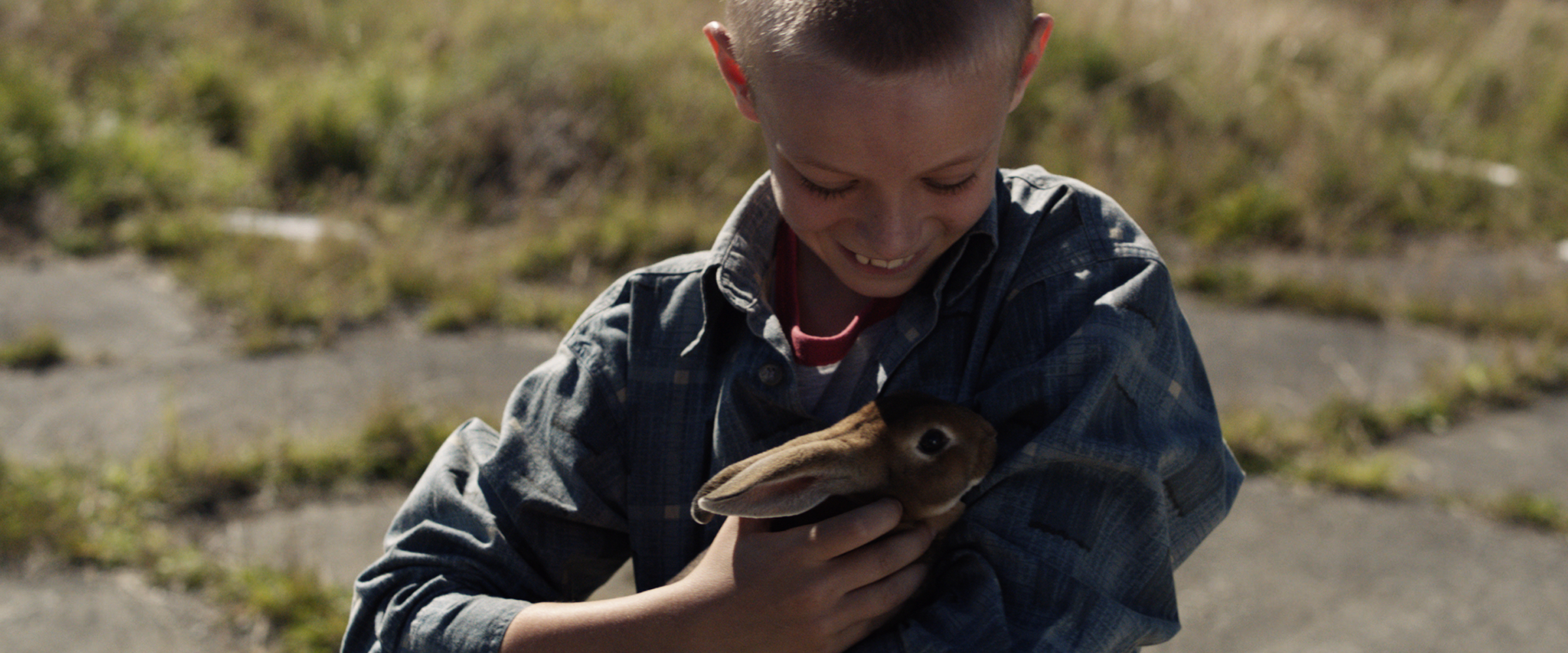
We meet 11-year-old Adrian as his lice-riddled hair is shorn off by a grandmother who really only expresses her (very genuine) love with a ‘get over it’ attitude. Adrian has no say in the matter, and this appears to be his life in a nutshell: a powerless young boy trying to figure out where he fits, virtually always dictated to unless he’s on his own. His friendships are more like ongoing negotiations as he tests others out and — more often — they test him. He’s willing to kick a rugby ball at someone he cares about if it gets him kudos with the playground bullies, but could he kill a rabbit for the same reason? We really see the world through his eyes, and as Adrian’s concept of loyalty is constantly recalibrated with each personal challenge, it all rings dauntingly true.
Borgman shows a strong hand throughout The Weight of Elephants, keeping a consistent tone of uncertainty through a mix of straightforward cinematography and glorious slow motion. His decision not to rely too much on music — indeed, much of the film carries only incidental sound — also bears fruit when the score quietly builds in the final scene, adding to its emotional payoff. He’s pleasingly comfortable with silence, rarely the hallmark of a commercially sought-after director, but skilled enough to hopefully bring his talents to mainstream success.
He would no doubt be quick to acknowledge that this film would be nothing without its child performers, who are both naturalistic and captivating. As Adrian, Demos Murphy has few memorable lines but says it all with his wide eyes and smile, and he does well to cry so much without ever seeming forced. Of his three aimless neighbours, who are his age or younger but whose worldliness makes them seem like adults, I was particularly taken with Hannah Jones as Joely. The character is only six, and Jones can’t be much older, but in her small amount of screen time she is totally captivating — a playful cherub with an unspoken darkness. If you see it (and you should), watch for the moment when she’s asked, “What’s your name?” The look on her face is perfectly enigmatic.
Just as the development and display of power is a key theme in The Weight of Elephants, it’s central to The Act of Killing, which offers regular reminders of who has it and who doesn’t. Joshua Oppenheimer’s documentary, which is unlike any other film I’ve ever seen, is as much an exploration of how power corrupts as of the long-term effects of mass murder.
Today, there are three million members in the Indonesian paramilitary organisation Pancasila Youth, which is headed by one of the most repellent people I’ve ever seen in a movie: a perpetually lewd, offensively charming bastard who doesn’t replace his divots at the golf course. Pancasila is as closely tied to governmental power now as it was in 1965-66, when it played a key role in Suharto’s military coup and helped kill somewhere between 500,000 and 3,000,000 alleged Communists and Chinese Indonesians. It’s an organisation synonymous with extortionist gangsters, who (according to this film) are seen as an integral element of Indonesian society and politics. They even find repeated justification for themselves in the original meaning for the Indonesian word for gangster, preman, which was ‘free man’; this seems a particular point of pride, with the unofficial theme song ‘Born Free’ providing one of the film’s most memorably off-putting scenes.
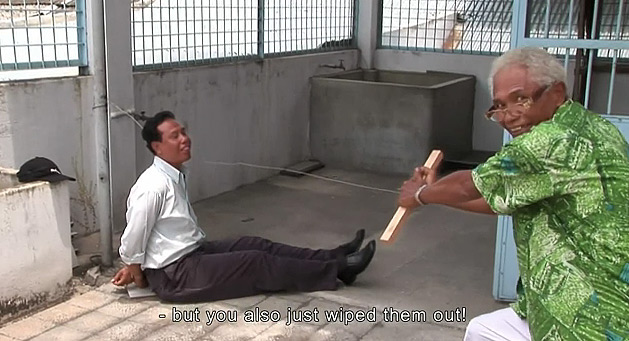
The main preman in The Act of Killing is Anwar Congo, who is estimated to have killed around 1000 people during the purge and appears to have been trying to justify it ever since. Either that, or he was getting drunk or high: “I’ve tried to forget all this,” he says as he details his preferred method of strangulation. This is the conceit of the film: Congo, and a few of his Pancasila contemporaries, are invited to re-enact their killings in a fictional film bearing the styles of the Hollywood favourites they used to exhibit in shady halls. He dresses as Pacino, Eastwood, and Gene Kelly; in his idle moments, he looks like a thinner, more drug-fucked Nelson Mandela. “There are many ghosts here,” he says as he gestures to a nondescript terrace floor, but it becomes ever more clear that the ghosts inhabit his mind. He certainly can’t escape them when he sleeps.
Act of Killing. Not really ok
I experienced a new kind of desensitisation to violence while watching The Act of Killing. Congo and the others described killing so often, and in such detail, even before any filmic re-enactments were shown, that I found myself nodding more and recoiling less. The killing seems mostly incidental to them in light of the far more important achievement of overthrowing Communism; indeed, most of the paramilitary guys, and ALL of the politicians, are obsessed with appearing powerful and successful. “For massacres, I usually wore jeans,” says Congo, focusing on how he ought to be attired for a particular shot. Herman, a big man who is both lovable and terrifying, blunders into politics as a means to gaining greater wealth and status. Congo’s compadre Adi sees a bigger picture — how Oppenheimer’s film could reflect badly on all of them — but even in full awareness of his own past atrocities, he’s happy to argue at length the negligible difference between cruelty and sadism.
“It’s not about fear. It’s about image,” says Adi. “The legacy.” He’s happy to go on trial for war crimes in The Hague if it brings him fame, and he says all this not as a naive pawn in a grander scheme but as a clear-eyed believer who has thought all of this through and justified his horrific actions as an absolute necessity.
It isn’t so easy for Congo, whose mind and body are slowly failing him. Confronted with what he has done, and invited to act out both parts, he sees how hollow his “relative morality” is. In a key scene, he invites his grandchildren to bear witness to his on-screen suffering, and in the same moment gains piercing insight into his victims’ plight. Here is a man who, upon reaching the twilight of his life, is literally given pause as he looks back over his deeds.
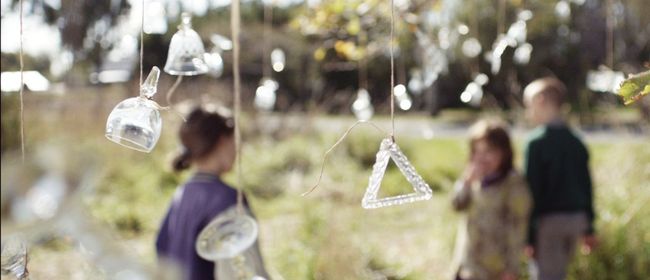
In The Act of Killing, expensive crystal sits behind locked glass as a grotesque monument to power and ego. In the more humble Invercargill homes of The Weight of Elephants, a wet finger run along the rim of a crystal glass sings — until it’s smashed. Here are two films that pick the crystal shards off the floor of human experience and place them before us as uncut diamonds.
I have no qualifications for writing about Swan Lake performed by The Royal New Zealand Ballet with the New Zealand Symphony Orchestra, other than that I saw it and was wearing this t-shirt:
(File Photo)
Like many others, perhaps including a majority of men about Natalie Portman’s age, I became interested in ballet — particularly Swan Lake — after seeing Black Swan. As much as I love that epically unhinged film, Tchaikovsky’s music is what has sustained my interest in the years since. I must’ve listened to the whole score a hundred times; in particular, it provided a surreal soundtrack to my daily train commute in South India, clarinet and strings waving in sync with the branches of coconut palms.
From our seats, we were lucky enough to be able to see into the orchestra pit.
St James Theatre, Wellington
And when the lights dimmed, and that familiar musical phrase opened the performance, I already had my money’s worth.
Up went the curtain, and the best dancers in the country moved their perfectly toned, muscular bodies with transcendent grace. Between the music and the movement, I wasn’t really sure where to look. My tendency in describing art to others, especially visual art, is to focus on a particularly memorable aspect or moment and let that speak for my overall impression. This is very hard to do with a consummate performance featuring the life’s work of two dozen dancers, world-class choreographers, designers of three-storey sets and 20kg costumes, and an entire orchestra. How can I omit the flautist’s precise notes, the ornate headdress at stage left, the way liquid nitrogen ripples beneath Qi Huan’s feet? If I don’t mention that heartbreaking key change in the final scene, or Odile’s 32 fouettes, can I even say I’ve seen Swan Lake?
One dancer stood out. My companion later told me that she’d earned 100% on a Royal Academy of Dance exam when they were in the same teenage class in Tauranga. Her name is Katherine Grange and she danced in such a way that I could imagine her succeeding in any chosen passion; she just happened to choose dance. As much as anyone else on stage, her performance showed me something I hadn’t previously realised: ballet is a genuine feat of acting, and facial expression is a key element. The feet and arms need to be technically exceptional, but it’s the emotion in the way they move that carries the audience along.
Some of my favourite films, like 2001: A Space Odyssey and Lost In Translation, make a point of telling the story (or long stretches of it, at least) with images and music rather than words. In ballet, I think I’ve found an art which is based entirely on this principle. “Would you like to go to the ballet again?” asked my friend as we debriefed over a beer. My eyes widened. “Absolutely.” If the human species had three hours to demonstrate our capabilities to visiting alien dignitaries, a full performance of Swan Lake would do the trick.
We were in the car, golf clubs rattling around in the back, on our way north to the driving range at Silverstream. Bella was behind the wheel. I turned to her with a stupid grin and said, “So, when was the last time you went driving?” I then laughed for a while, and I seem to remember that she laughed too but memory has a funny way of serving ego before truth.
Her last time hitting golf balls was in February. My last time was in January with my brother Rua, and the time before that was the previous January, also with Rua. Both of those times were at Chisholm Park Golf Club in Dunedin, which has world-class views over the cliffs and down to the Pacific Ocean, and both times I was surprised to learn I could still swing that shaft of metal over my head and whack the ball far enough to lose it. Used to play golf when I was kid, you know. Procedural knowledge is an extraordinary thing, especially when the procedures are embedded at a young age: hitting a golf ball 200 yards, kicking a soccer ball with power and accuracy, riding a bike. Do it enough times and something clicks in your brain so that years down the line, the knowledge can be called back in an instant.
‘Tomahawk’ at Chisholm Park Golf Club
I remember going to the driving range in Hamilton for my 11th birthday (or thereabouts) with brothers and mother. At one point, they stood behind me and watched as I played a few shots and said, “Barns is quite good, isn’t he?” I was the mocked ‘sporto’ of the family, forever bowling a tennis ball against the fence and shooting hoops while my brothers got quite good at the guitar and went off to university. Nothing ever really came of golf — I essentially stopped playing when I was about 14 — but that moment of approval is enough for it to have been a worthwhile part of my life.
The ping of the ball off the tee, though. For all the madness golf can bring, that ping makes it worthwhile, too. I stepped up at Silverstream with my bucket of 118 balls, a six-iron, and a driver with a clubhead the size of my fist. First ball, I swung without really thinking, just hoping to connect. Ping. It flew off into the distance, straight as an arrow. I was sure it had sailed past the 250-metre mark and away over the back fence into Tiger Woods territory. ‘Still got it,’ I thought to myself.
Of course I hadn’t hit the ball that far, as the next 117 shots proved. Still, I was amazed at how forgiving the driver was, how it didn’t seem to demand you make it go ping instead of clunk to allow the ball to fly straight for a fairly long way.
The driving range at Silverstream
After a while, I started using the six-iron to try and hit the ball into a derelict car at the 50-metre mark, which appears to be an obligatory feature at many driving ranges. Got it on about ball 103, I believe. Bella missed the moment but I insist it really happened: one bounce and in through the smashed back left window. She was probably focusing on ironing out her own technique at the time, which I suppose is fair enough.
(By the way, her name isn’t Bella. It’s Isabel. Two things led to my foisting this nickname upon her: 1) her distaste for the Twilight series, of which Bella Swan (played by a dead-eyed Kristen Stewart in the films) is the main character; and 2) her admission that once, after learning her name was Isabel, a guy asked if he could call her Bella. “No you may not, sir.”
Presumably I have enough other qualities for her to tolerate my being ridiculous all the time.)
Isabel with an iron
“How’d you go?” asked David, the silver-haired, craggy-faced man at reception. His blue (it may have been red) pullover said ‘Manor Park Golf Club Centenary’, and I guessed he would’ve been around for about three-quarters of that. He gave a tentative smile as I handed him that absurd driver, commenting on my surprise at the powers it had afforded me. “Yes, you’ll find that the modern clubs are a lot more forgiving than the old ones.” He seemed like a man who knew a thing or two about a thing or two, so, having given him an opportunity to talk, we simply stood and listened.
David’s life story is easily structured around his golf handicap. He said he got down to scratch after a couple of weeks as a young fella, which seems impossible to me given how long it takes — and how many balls you have to hit perfectly — for the finer points of technique to be proceduralised. Maybe he was a superhuman, or still is one. Or maybe his memory had embellished things somewhat. He then took a long break to build a house, which he might well have designed and built himself. Then back into it for a few years, lowering the handicap once more, a notable figure on his club’s fairways. He didn’t say how he became a tetraplegic — though I think he alluded to some time in the military — but the long recovery process put him out “for a couple of decades”. It only showed in the odd halting movement.
Finally, a few years ago, David got back amongst it for presumably his last golfing stretch. “I struggle to hit the ball now, but playing with those young fellas, I’m still keeping up with them—” he raised his thick eyebrows and opened his eyes wide “—and even out-driving them sometimes.
“But anyway, you’re always playing against yourself, and trying to beat the course. There’s always something to overcome. You know? It’s all in your head.”
Bella drove us back to Wellington in the dark. We listened to a selection of 90s hits on Classic Hits FM, delighted to find we are finally old enough to hear formative childhood favourites on a radio station that always looks backwards. Accompanying them in my head were David’s simple but far-reaching words, and the lifetime of experience and imagination behind them. I wonder what else he has yet to overcome.
It occurs to me that for most people, being sick is not a totally solitary experience. Someone is there to bring you a hot water bottle, or a bowl of soup, or a face to look at and talk to. If you’re a kid, they’ll stay home with you, or they’ll leave you with someone familiar. If you’re old enough to be at home by yourself – fifteen, twenty-five, fifty – you might spend most of the daylight hours alone feeling sorry for yourself, but even if they do have to go to work during the day, they’ll be back again in the evening. Some noise in the house helps you feel a little less crazy and forces you to remember that as inwardly focused as you are right now, other people are continuing to live their lives.
For quite a long time — except for a two-and-a-half-year relationship in which I was more often carer than cared for — I have been sick on my own. I have lived alone, as I do now, for long stretches of my short adult life. Perhaps it’s a product of being the youngest child of three by some distance. However social an animal I have become, I seem to seek out solitude as a default setting.
I lived alone during the time I was the sickest I have ever been: a week in February 2007 when, after scoring an equaliser from halfway in the dying seconds of a game of futsal at Christchurch’s now non-existent QEII Indoor Sports Stadium, I promptly went home and collapsed on the couch. The next day I met a group of Japanese girls at the art gallery and took them across the road to show them the spare room of my flat, apologising constantly for my sniffles and dishevelled appearance. The day after that, I spent many feverish hours in a leather La-Z-Boy hallucinating hundreds of people into my flat, all of whom angrily admonished me for thinking about going to the doctor.
On the fourth day of the illness, I called Blue Star Taxis to take me to the after hours clinic on Bealey Ave. Alternating between shivers and hot sweats, I sat by the window and looked down at the street for an hour before calling them up again, at which point they laughed and said, “Sorry, there was a mistake.” A taxi arrived soon after, I went to the doctor and got medicine, and about a week later I was back at work.
Went to the doctor and guess what he told me? Guess what he told me? He said take Augmentin thrice daily and come back if you don't improve
The previous year, when visiting my mother during a semester break in my final year of university, I said I wasn’t going to get a flu vaccination. Didn’t think they helped. “If you get sick, there won’t be anyone to look after you,” she snapped. I can appreciate the love behind those words now, but at the time, the thought of having to lie around in bed with only a laptop and books for company didn’t exactly give me pause. I thought to myself: So what? That’d be kind of nice. I was younger, more selfish, and more socially awkward than I am now (believe it or not) and an opportunity to spend days on end without worrying about anyone else sounded all right.
I’ve been sick again this past week or so, alone in my perfect Brooklyn flat, and it has mostly sucked. The Internet, so often my redeemer during past illnesses, has provided distraction but little solace. Intermittent and occasionally severe pain has rendered meaningless the view of Wellington City and Harbour from my deck. Given that the sickness has been a new one, not previously experienced — a gingival infection spreading to wring out my throat and head — I have been able to confront the absurd possibility that my body is already failing me, à la Synecdoche, New York. Most of all, I have missed my friends and all the rituals of our weekly Wellington lives: the silly email banter at work, the walk home through Aro Valley, the Friday happy hour beers.
It’s funny, because I’d started to hate the sound of my own voice a bit lately. I’d come home after some event and say to myself, “you could always just shut up for a change.” (I am the type that remembers every conversation of the night, no matter how many standard drinks are consumed, and involuntarily picks back over every spoken sentence before falling asleep.) My body promptly gave me the opportunity to shut up for several days, and it wasn’t as immediately cleansing as I’d hoped; more deconstructive, as if a piece of my life had been removed.
Contrary to my perverse, self-centred hopes, the usual Friday and Saturday fun went ahead just fine without me. In my head, this particular Friday and Saturday fun was the most fun anyone has ever had. One friend graciously brought round a bag of groceries on Saturday and left it by the door, and I felt like I’d betrayed both of us by sleeping through his visit. Still, what would we have talked about? I was feeling very sorry for myself, and he had been uploading photos of fun to Facebook. This was a complex and very indulgent bitterness.
Later that day, I shaved off my beard, perhaps as a means of having a conversation with myself. Or to give myself a new face to look at. In any case, it got plenty of likes and comments.
A few texts rolled in about events I was missing. “Don’t mean to FOMO you but [x] is dancing like a gazelle on the serengheti” read one message on Saturday night. To my surprise, pangs of envy were quickly replaced by smiles at a) the image described, and b) the kindness of my friend to let me know what was going on. I got a few other texts from people, mostly just checking to see how I was, and they helped cast off my acrimony blanket. People are enjoying themselves, or even just going about their day, and want to include me somehow. Why should I be such a curmudgeon? Coincidentally, this is also about when the swelling in my gums started to go down.
I suppose those texts, and some nice words from nice people on social media, were my noise in the house. All that bitterness seems rather silly now. Might get a flu vaccination next year, though, just in case.
On the brick steps out the back of Meow, someone had trusted Aaron with a lighter. Alpro and Amy held their jackets up so the Wellington wind wouldn’t extinguish the candles before I could get to them. When they pulled them away, revealing the chocolate cake I’d been looking at all day, I leaned forward and waited a moment as everyone mumbled the ‘Happy Birthday’ song at high speed. We’re all in our twenties and thirties now, too old and not yet drunk enough to sing without self-consciousness.
Simon had just been talking about how gross it is that people blow out candles on birthday cakes. “I think the cake should be cut first, and all the candles put on one piece of cake. Then you could blow them out, and that could be your piece. I’m not saying that you should do that now, though.” I blew out all the candles.
All? No! One small candle held out against my invading breath. Like the others, it was rainbow-coloured – ‘pride candles’, as Jen had called them earlier. I blew again, leaving nine wavy columns of thin, waxy smoke.
“Congratulations,” Shelley said.
“Thank you,” I replied. “I’m proud to have made it this far.”
“Yeah!” said Aaron, laughing. “Well done for being born!”
“Right!” said Dave. “We didn’t think the Earth would get round the Sun again this year! But it showed us all! The little planet that could!”
Cake was cut and eaten. We all praised Julia’s baking skills and talked about Christmas party costumes. Some requisite bitching about Wellington summer was done. (Was that a raindrop?) I only checked Facebook and Twitter messages once, resolving to reply to them when I got home, however intoxicated I might be.
I also only once considered my good fortune at the fine people I’ve met since moving here. It was a mercifully brief thought, one which if dwelt upon could give rise to many more thoughts – of fraudulent unworthiness, of panicked fear of loss, of overthinking introspection, of teary gratitude. In musical terms, my brain played a few seconds of Radiohead before defaulting back to a selection of 90s hits.
And then it did start raining, and we ran for cover under a crudely functional awning further up the steps. Everyone tried not to stand in the pile of pigeon shit. Joe ran and got his backpack from the wet, noting upon his return that the cake plate was still out there – and so it was, deserted on the table, the raindrops belting into it from above, filling it slowly with chocolate-coloured water.
Today The Hobbit: An Unexpected Journey has its world premiere in Wellington – or Wellywood, as Peter Jackson, Richard Taylor, and former Wellington Mayor Kerry Prendergast wanted us to be known. (I hope you’ll indulge me saying ‘us’ even though I’ve only lived in Wellington for a year. I’ve developed quite an attachment to the city and its people.)
This premiere is quite a big deal, mainly because it is a world premiere and will be attended by the film’s stars. They held the world premiere of The Lord of the Rings: The Return of the King in Wellington as well, and it was quite an occasion – the culmination of “the single biggest phenomenon ever to hit our humble little shores”, according to one TV news reporter in this clip. That was kind of how I felt at the time, too. The Return of the King premiere seemed like a celebration of our capacity as a small country to do big things in a humble way. A couple of weeks later, I was watching ROTK in Auckland’s Lido cinema and marvelling at what they could put on the screen nowadays, let alone the fact that the visual limits of cinema were being extended right here in little old New Zealand, and by New Zealanders.
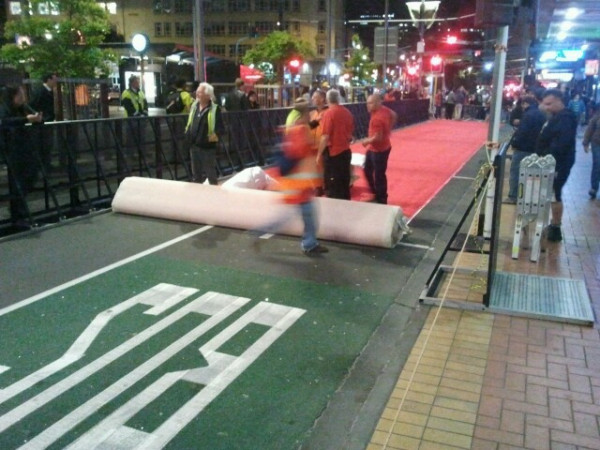
So now, almost ten years later, we have another world premiere in Wellington as Jackson returns to the wizards and elves he knows best. After I came out of Killing Them Softly last night, I found Courtenay Place closed and the red carpet being rolled out:
Exciting, huh?
No, not really. To be honest with you, I’ve written The Hobbit: An Unexpected Journey off and almost certainly won’t see it in the cinema. The humility and pride of 2003 has been replaced with the political chest-beating and cynicism of 2012. But I’ll get to that in a minute.
At bottom, Peter Jackson’s The Hobbit ought to be evaluated as a Peter Jackson film – because that’s what it is, much more than it is a cultural phenomenon or a Key Government policy. On these grounds, to say that I almost certainly won’t see it is kind of crazy. As much as the Lord of the Rings films were glorified time-pass, I actually quite enjoyed them while I was in the cinema. I forgot them all pretty quickly within days and definitely didn’t watch any of the extended editions, but for those 3+ hours each December, I was entertained and got my money’s worth. That’s all you can really ask for at the movies.
I also expected King Kong to be an awful, bombastic double-rehash of a past classic and the excess of the LOTR, but I actually enjoyed it a great deal. It was as big and loud as suspected but contained unexpected emotional depths. (It also contained a scene in which a giant gorilla pile-drives a dinosaur’s jaw into the ground. I mean, come on. Awesome.) Then there was The Adventures of Tintin, officially directed by Steven Spielberg but unofficially co-directed with producer Jackson, which I loved. Very entertaining and true to the spirit of the books. They even managed to improve the storyline – as I’ve written before, Tintin books are surprisingly full of plot holes.
Going back a bit further, I will also happily watch and re-watch The Frighteners, which I think pulls off the comedy-horror tone far better than a lot of people give it credit for. Heavenly Creatures, meanwhile, is an unforgettable piece of work. I saw it with my mother in Te Awamutu and remember that we hardly said a word to each other for about twenty minutes afterwards. It was probably the first time I was stunned into silence by a film, shocked and moved to a degree that I didn’t know what to say. Jackson’s splatter films aren’t really my thing, but they are certainly admirable for their ingenuity. However, Forgotten Silver, a brilliant one-hour TV film from 1995, is Jackson’s finest hour as a filmmaker and one of my all-time favourites.
So, given Jackson’s pedigree – just don’t mention The Lovely Bones – I should be queuing up for a ticket to The Hobbit with the rest of the country. Why, then, am I casting it aside?
For a start, the manner in which the production was kept here by the Key Government seems very morally suspect. New Zealand now has separate union laws regarding film industry employees, and Warner Bros got a tailor-made tax break not offered to other studios. It was a remarkably political play, led not by our Minister for the Arts, Culture and Heritage but by our Prime Minister (who is also our Minister for Tourism), to keep the production here in New Zealand, rather than see it escape to Eastern Europe or wherever.
And with that, the Key Government was all in. Having made some very specific tax concessions, and having rewritten labour laws for the production’s benefit, they needed The Hobbit to reap some tangible rewards for the country so that the people of New Zealand would accept it. As part of the deal with Warner Bros, NZ was given the right to use The Hobbit as a Middle-earth marketing crutch for the NZ tourism industry – but naturally, the Hollywood studio wore the pants in the relationship, not the small country in the South Pacific. Tourism NZ reportedly had to go to Warner Bros to ask about pretty much anything they wanted to do in their Middle-earth campaign.
This is where things start to get a bit messy, and my head starts to hurt. Tourism NZ has been using a similarly morally suspect marketing strategy for some time, based around the inaccurate slogan ‘100% Pure’. For the release of The Hobbit, particularly the period of months either side of its Wellington world premiere and subsequent global release, that slogan has been transmuted to ‘100% Middle-earth’ (also untrue). In turn, our humility has been buried under the language of advertising, pasted on in slick, shallow layers. (Giovanni Tiso has an excellent post up about all this on his blog Bat, Bean, Beam called Leaving Middle-earth, which I highly recommend reading.)
More than anything else, though, I’m just so tired of the endless Middle-earth advertising. It’s everywhere: on lampposts in the streets, in internet banner ads, on TV, and all over Wellington’s buildings. The film, the city, and the country are all being sold in the same way, an unavoidable triple threat birthed from the one fantastic seed that is The Hobbit. Here I thought The Lord of the Rings was in-your-face with its advertising campaign but I swear it wasn’t as pervasive as The Hobbit has been. Worse still, it’ll happen all over again for the next two Decembers as Jackson stretches a 300-page book into three movies.
It’s like a formerly decent TV show has been renewed for another three seasons after jumping the shark – except as Wellingtonians, the Hobbit show is our lives, and there’s nothing we can do to keep the cameras away.
In the film The Corporation, commodities broker Carlton Brown commented that in our world today, only that which is commodified gains meaning. He said this is in relation to environmental conditions, which are not yet capable of being traded on the open market and therefore of little importance to the richest and most powerful people on the planet. This speaks to the overwhelmingly consumer-driven nature of the society we have constructed: anything and everything can be a product, as long as you can get people to buy it.
I’m no less susceptible to commodifying my surroundings than anyone else, but where that commodification is so excessive as to become blatantly intrusive, I instinctively recoil. And The Hobbit, it seems, is very much a commodity in the eyes of the New Zealand Government, to be bought and sold for as long as it is profitable. When the hype dies down and Tourism NZ/the Key Government move on and The Hobbit stops being a commodity, probably several years from now, maybe I’ll be able to enjoy it.
 AUNTY AND THE STAR PEOPLE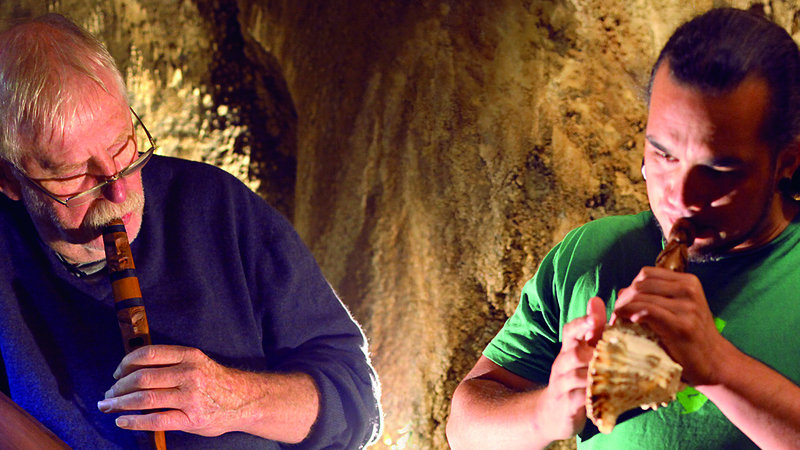









 Jdanspsa Wyksui