Books and movies of March to mid-June 2025

Hi friend,

New job and sleep regressions — first the kids, now also me — have pushed these little arts appreciation notes into the background. So here’s an omni-update to cover the last three and a half months.

First, really quickly, I made a couple of YouTube homages as a birthday present for Tara. The first apes Japan Eat, who uploads one-minute shorts every day about eating food in Japan at restaurants, convenience stores and food alleys. His speedy, mostly monotonous delivery masks a genuine desire to like the food that’s put in front of him and the knowledge to place it in some kind of context. He particularly focuses on smaller, out-of-the-way places, as evidenced by his constant references to ‘mom and pop restaurants’, and he’s way harder on the bigger or more popular establishments. Anyway, I pretended he came to Paraparaumu and ate a piece of cheesecake at Hudson’s in Coastlands Mall:

The second pays tribute to Fairbairn Films, two Aussie brothers offering commentary on 21st Century life by shouting at each other. Jeff and I didn’t get the sight lines anywhere near right for this, and I’m obviously reading, but still, I’m pleased with the writing and it was great fun to make.

Have you made anything lately? Now to the books and movies.

*

BOOKS

Faves

Alice’s Adventures in Wonderland
by Lewis Carroll, 1865

Finally got to the source. I don’t think it’s hyperbole to say this book goes beyond centrality to the Western literary canon; it’s fundamental to the Western idea of childhood as a place of fancies and nonsense and constant threat. I suppose Carroll follows the Brothers Grimm in that tradition, though his fey landscape is less grim and more absurd. His writing is very readable considering it’s 160 years old, and I suppose it’s that accessibility, along with the many fascinating images and characters conjured, that helps the myth persist. I found it interesting that I couldn’t get a read on Alice, who blunders from one peril to the next, munches almost constantly on snacks, and stroppily refuses to accept this strange world on its terms, all while characterised by Carroll as gentle and courteous to all and rendered in Tenniel’s illustrations as soft and long-lashed, but severe, a kind of porcelain doll with oddly adult features. I wonder what the real Alice made of her.

Gentlemen Prefer Blondes
by Anita Loos, 1925

It’s not often you read a hundred-year-old book and feel like it could have been written yesterday. I guess Lorelei Lee would’ve been on her phone an awful lot if so. I mean on the page she seems fully formed and recognisable as a contemporary figure. Contemptible, untrustworthy, still somehow innocent, perhaps because of the quirks of prose and misspellings, and because a parade of probably even worse men keep dropping everything to pursue her. I was darkly fascinated and will have to reread Gatsby to see if this was the actual great American novel of that year.

The Great Gatsby
by F. Scott Fitzgerald, 1925

For me, ‘The Great Gatsby’ invokes stuffiness and school classrooms, even though I’ve read it before, not at school, and know exactly how incisive and cynical it is about high society and America itself. It’s the title, which sounds lofty enough in itself and isn’t helped by its association in the hundred years since with essay structure: introduction, point 1, point 2, point 3, conclusion. Reading it again, there could be no other title. We all know Gatsby isn’t great, though in his polite and straightforward pursuit of an honourable but misguided goal, he is greater than pretty much everyone else in the book. And of course, he isn’t even Gatsby either. I’m pretty well fed up with the idea of the great American novel written by a white man that skewers the American Dream and leaves you disenchanted — but, truly, here is that great American novel.

Of Walking in Ice: Munich – Paris: 23 November – 14 December, 1974
by Werner Herzog, 1978

This review pretty much nails it for me, especially the last line:

“This is Herzog in the maelstrom of transformation into myth while remaining a man with hungers and pains and compassion.”

The man is so closely attuned and devoted to his own legend that the reason for his long walk — mentor Lotte Eisner’s ill health — becomes secondary to the walk and the man walking it, most of all the liminal spaces expanding inside his head in the pouring rain and snow. (He is thoroughly soaked throughout.) To be fair, it’s a journal scrawled out in real time, not intended for publication, but he still went ahead and published it anyway. A flight of fancy somehow still recognisable and rooted to the real world, much like his films.

New releases

Theft
by Abdulrazak Gurnah, 2025

Loved Gurnah’s talent for drawing you into a story here. This is a sharp focus novel of rooms and subtle looks, and I smashed through it. I’m not sure where that ending came from, though. That one guy’s ambition was always there, true, but it went unexpectedly off the charts in the final third. And I’m not sure I buy the other two, seems a bit contrived romance to me. But so what? Solid, a pleasure to read. My first novel by a Tanzanian.

Dream Count
by Chimamanda Ngozi Adichie, 2025

This book took me some time to plod through, I think because only one or two story threads really captivated me enough to draw me back whenever I had free time. Overall it’s a frustrated and sometimes frustrating collection of moments and lives, sitting comfortably in financial privilege most of the time but most compelling when the focus is on a less comfortable character, whose wants and hopes and dreams are so much clearer than the rich women into whose orbit she fortuitously spins, and, in her plain-thinking way, spins them properly off course. Adichie has such a talent for spinning a yarn in rich prose, and I feel enriched by her literary gifts, but also sometimes irritated by her predisposition to write characters fortunate enough to be so self-obsessed.

Universality
by Natasha Brown, 2025

Not sure what I’m supposed to think. Anti-diversity shills are taking over the world, column inch by column inch? The ‘marketplace of ideas’ (man I hate that phrase) is still in the pocket of the usual pale males? Either Brown is a satirical galaxy brain beyond my simple reckoning or I’m just not buying what she’s selling. The scene-setting magazine article that opens the novel is the longest section and the best; once we’re flitting around in people’s heads, the prose and story fall over. The working class make the barest intrusion into the world of these characters and the mastermind kingpin around whom the plot turns feels very low stakes to me. Competing for fleeting and quickly forgotten scrolls. Is all that the point? Is the climax supposed to feel so anti-climactic? Is it a commentary on all the time we waste debating identity politics while the world burns?

Children’s

Whetū Toa and the Hunt for Ramses
by Steph Matuku, 2021

More chaotic and episodic than the first one as Whetū and Tori the cat ride starbeams to all sorts of weird, wonderful, and properly frightening worlds. The climax takes place in a land of machine overlords and mammal enslavement. Grim. But there’s a point to it all, some great messages for kids (and adults), and they’re subtly driven home. Not sure my character voices are on point but the children were well into it and laughed a lot.

The Secret Wreck
by Linda Chapman, illustrated by Mirelle Ortega, 2022

Is this the end of Mermaids Rock?! (The series, I mean, not the characters’ home, which remains very much intact.) It sure seems like it. These kids are getting too big and adventurous and complex for brief sallies away from their wee patch of sea floor. Soon they’ll be going to university, and falling in love, and circumnavigating the globe powered by nothing but snack powder packets and perpetual phosphorescent tubes concocted by Naya in her lab — assuming she uses her powers for good, not evil. Exciting for the kids, with the usual positive messages about working together and to your strengths.

The rest

Sabine’s Notebook
by Nick Bantock, 1992

Exquisitely designed exercise in frustration, not the good kind. Fragile man seeks liberation from self, but world is self.

The Dark Forest
by Cixin Liu (translated by Joel Martinsen), 2015

I had the same feeling as with Iain M. Banks novels: that working on the grandest scales and following the boldest flights of fancy inevitably gets a bit silly, like lining up the entirety of your unfathomably expensive space war fleet to be dispatched by a single alien probe in one clean fell swoop. The ideas are so compelling that it doesn’t really matter and I flew through 550-odd pages. It’s the middle-of-trilogy novel so I don’t think I can properly consider it until I’ve read the last one, which I will, next year.

*

MOVIES

TANGLED
directed by Byron Howard & Nathan Greno, 2010

Wife absolutely adores it. I found it quite forgettable on first viewing many years ago, but I’m starting to see the positives, particularly a somewhat realistic portrayal of parental abuse in an animated children’s film — calculated but seemingly offhand negging, persistent gaslighting, plus of course the textbook incarceration in inescapable tower… Is that a positive? Well, my kids are going to come across people like this in life, and seemingly already are, so it’s helpful to see that on screen and see how they can be liberated from that, although it shouldn’t have to take a man riding in on a horse. Or pursued by a horse. There are also some truly spectacular visuals, and with a trip to DisneySea planned for November, I’m genuinely excited to be surrounded by those lanterns too (if I’m lucky).

PENGUINS
directed by Jeff Wilson & Alastair Fothergill, 2019

We’d had kind of a rough run with movie night choices, and for this turn, I wanted something:
-short
-funny
-physically comedic
-not animated
-without dead parents
Because there’s only so many times my daughter can come out of bed at 9:08pm with an anguished look on her face and say, “I don’t want to die” or “I don’t want you to die” before you think hey, we’ve got a sensitive one here, maybe we aim really low for a year or two and steer clear of all those classic family movie shortcuts to drama involving absent parents or orphanhood or visceral on-screen murder of the noblest lion ever to lead the animal kingdom. So, in a panic, I chose PENGUINS, a cutesy documentary with Ed Helms narrating and voicing a heavily anthropomorphised story about the world’s clumsiest penguin. And the kids laughed, and it held their attention, and learned a thing or two from the unreal 4K cinematography of brutal, desolate Antarctica. I never thought I’d say this, but thank you, Disney.

HOW TO TRAIN YOUR DRAGON
directed by Dean DeBlois & Chris Sanders, 2010

Same as the first time — I don’t really get it because I don’t lose my mind every time Toothless appears, as my wife did and as my kids now also do. Like, these deranged, high-pitched sounds whenever Toothless moved sideways, or looked up and then down again. It’s not that the film overall has nothing else — it is charming enough and occasionally surprising — but what would be its reason for existence, and most of the creative choices, without the need to sell stuffed Toothless toys?

RATATOUILLE
directed by Brad Bird, 2007

King stay the king. Yeah, it’s about fine dining and criticism, to which you might say, who gives a shit? Well, RATATOUILLE and Peter O’Toole made me give a shit.

*

Music next time!

Love b

Anime 101: five must-see anime for the uninitiated

A friend who particularly enjoys watching films and television shows recently mentioned he hadn’t seen any anime. Obviously it fell to me to rectify this terrible oversight, so within seconds, I promised him a list of where to start. I had planned just to write down a list of titles; twenty-four hours and a thousand words later, I think I’m finally satisfied. Read on if you are an anime newbie (or an anime veteran who wants to pick my choices apart).

The key point for someone approaching anime (ah-nee-meh) from an English-speaking tradition, especially one so heavily influenced by family friendly Disney fare, is that animation (anime) and comics (manga) are woven into pretty much every part of Japan’s popular artistic tradition. Some anime works are aimed at children, sure, but most are not, at least not specifically. Anime is simply another medium, like TV or literature, and it’s populated with everything from broad comedy to serious drama to high-concept sci-fi action.

Consequently, there’s a lot of it. So where does the anime newcomer start? Chances are you actually have seen some anime, given the popularity of POKEMON and DRAGONBALL Z (and, earlier, SAILOR MOON) around the world. These shows are cultural phenomena with a deep and wide-ranging influence, which makes them noteworthy and worth checking out at least once, but the high-volume, churn-‘em-out production style makes them limited artistically. There’s more to anime than one-on-one battles and big hair.

The five anime works I’ve listed below (four films, one TV episode) are each outstanding examples of writing and visual craft. They also showcase the broad potential of the medium. Listmaking isn’t definitive, obviously – my taste is my taste, and there are countless anime I haven’t seen, especially in the TV realm – but I’d be surprised if nothing in this sample impressed you. If they don’t impress you, it’s probably safe to say anime isn’t for you.

Oh, and one final thing: please watch in Japanese with English subtitles. Anime and the Japanese language are inseparable from one another.

cowboy bebop, spike spiegel, whatever happens, anime quote, classic anime

1. The family classic: MY NEIGHBOUR TOTORO (1988) – d. Hayao Miyazaki

totoro, my neighbour totoro, rain scene, bus stop

Studio Ghibli, and particularly Hayao Miyazaki, is the obvious entry point for newcomers to anime, and among Ghibli’s many great releases, TOTORO is the greatest. It quickly and seamlessly evokes a mostly recognisable world – a Japanese countryside teeming with humming insects, human-powered industry, and swaying grass – alongside a fantastical one peopled by benign otherworldly creatures. The bridge between these worlds takes the form of two closely bonded sisters facing the spectre of their mother’s life-threatening illness. It’s impossible not to be charmed and moved by their story. Also, the animation is lovely, and a classic Joe Hisaishi score rounds out a perfect introduction to the form.

If you like this, try PRINCESS MONONOKE

2. The mindblowing epic: AKIRA (1988) – d. Katsuhiro Otomo

akira, anime classic, tetsuo, cyborg, chair

MY NEIGHBOUR TOTORO is small, quiet, and sweet. At the other end of the scale, we have AKIRA. I first saw it when I was about 13, and the experience was similar to watching 2001: A SPACE ODYSSEY for the first time: a jaw-dropping handful of indelible images orbiting a general sense of confusion. Like, what did I just see? Otomo’s adaptation of his own even more epic manga is big, brash, and overblown, beginning with dickish biker kids and ending in an extended orgy of city-sized destruction. For all its excess, Otomo’s palpable affection for his characters means AKIRA does not live or die by its admittedly extraordinary visuals; you grow to care about these brats, caught up as they are in a mysterious conspiracy that threatens them and everyone they know. It also has one of the great film soundtracks.

If you like this, try METROPOLIS

3. The arthouse masterpiece: MILLENNIUM ACTRESS (2001) – d. Satoshi Kon

millennium actress, photograph, flashback, anime

A film for lovers of film. On the surface, MILLENNIUM ACTRESS tells the story of a veteran film star’s life and career, constructing it through flashbacks and snippets of her work. Kon’s genius, though, is in mixing the modern-day frame story and the actress’ work, constructing a kind of collective consciousness between the performer, her work, and her fans – and you, the viewer. Periods of Japanese history also play a critical role in the narrative and the visual style. It’s a rich, multi-layered work that only gets better the more you think about it. And hey, guess what? The soundtrack, by genre-defying prog rock legend Susumu Hirasawa, is brilliant.

If you like this, try TOKYO GODFATHERS

4. The slice of ultra-stylish TV perfection: COWBOY BEBOP Session 20: Pierrot Le Fou (1999) – d. Shinichiro Watanabe

cowboy bebop, anime tv series, session 20, pierrot le fou, amusement park, cane gun, crazy clown

A 22-minute TV episode is a bit of an outlier on this list, but there are so many great anime TV serials, I had to include one. And why not this perfectly executed story? Style is Watanabe’s calling card; his work is defined by a cool aesthetic and nimble editing inspired by the likes of Scorsese, Ridley Scott, and Tarantino. ‘Pierrot Le Fou’ comes late in COWBOY BEBOP’s 26-episode run, but its monster-of-the-week plot – about an insane clown driven mad by shady government experimentation (a few obvious influences there!) and our anti-hero Spike’s efforts to stop him – stands alone, making it an ideal introduction to the series. Would it be ridiculous of me to comment on its amazing soundtrack? It would? Okay, I’ll shut up.

If you like this, try the rest of COWBOY BEBOP (and then NEON GENESIS EVANGELION)

5. The full-hearted blockbuster: YOUR NAME (2015) – d. Makoto Shinkai

your name, kimi no na wa, anime blockbuster, meteorite scene, beautiful sky

Let’s bring it all together. YOUR NAME is a fantastically entertaining film in its own right, worthy of inclusion here purely on its own merit. It’s also the highest grossing anime of all time. But it also brings with it the added bonus of calling back to each of the four other titles listed above. The countryside charm and childlike wonder of TOTORO, the apocalyptic scenario of AKIRA, the nostalgia of MILLENNIUM ACTRESS, and the flair of COWBOY BEBOP are all present; certain moments are almost carbon copies of scenes in those other films. The element it brings that the others don’t really have is a sense of the new emerging Japan, particularly the experience of urban high schoolers and graduates. Anime has always taken young people seriously; YOUR NAME’s representation of new men and women trying to make their way in a changing world rings very true. The soundtrack? It’s not the work of genius each of the other four titles offers, but it’s very catchy.

If you like this, try VOICES OF A DISTANT STAR


Kickstand

A few years ago, I picked up a copy of After Dark by Haruki Murakami in a library book sale. Five for a dollar! I peeled the duraseal off, scrubbed away the patches of glue it left behind, and put it away for later. (See: tsundoku.)

Flash forward four years, and I finally got around to reading it last week as part of my 2017 Only Reading Books From Years Ending in Seven project (the English translation was published in 2007). The book is slight, a diversion, although – in typical Murakami style – it does hint at an opaque world of unsolvable, half-drawn mysteries.

One such mystery particularly caught my imagination, and it comes not from the mind of Murakami but from a previous reader. Library books are supposed to have many readers, after all; you can usually only guess at how many, and who they were, and what impression the book left on them. This reader, however, made three notes over the course of After Dark’s 200-odd pages. Each is in the same black ballpoint pen.

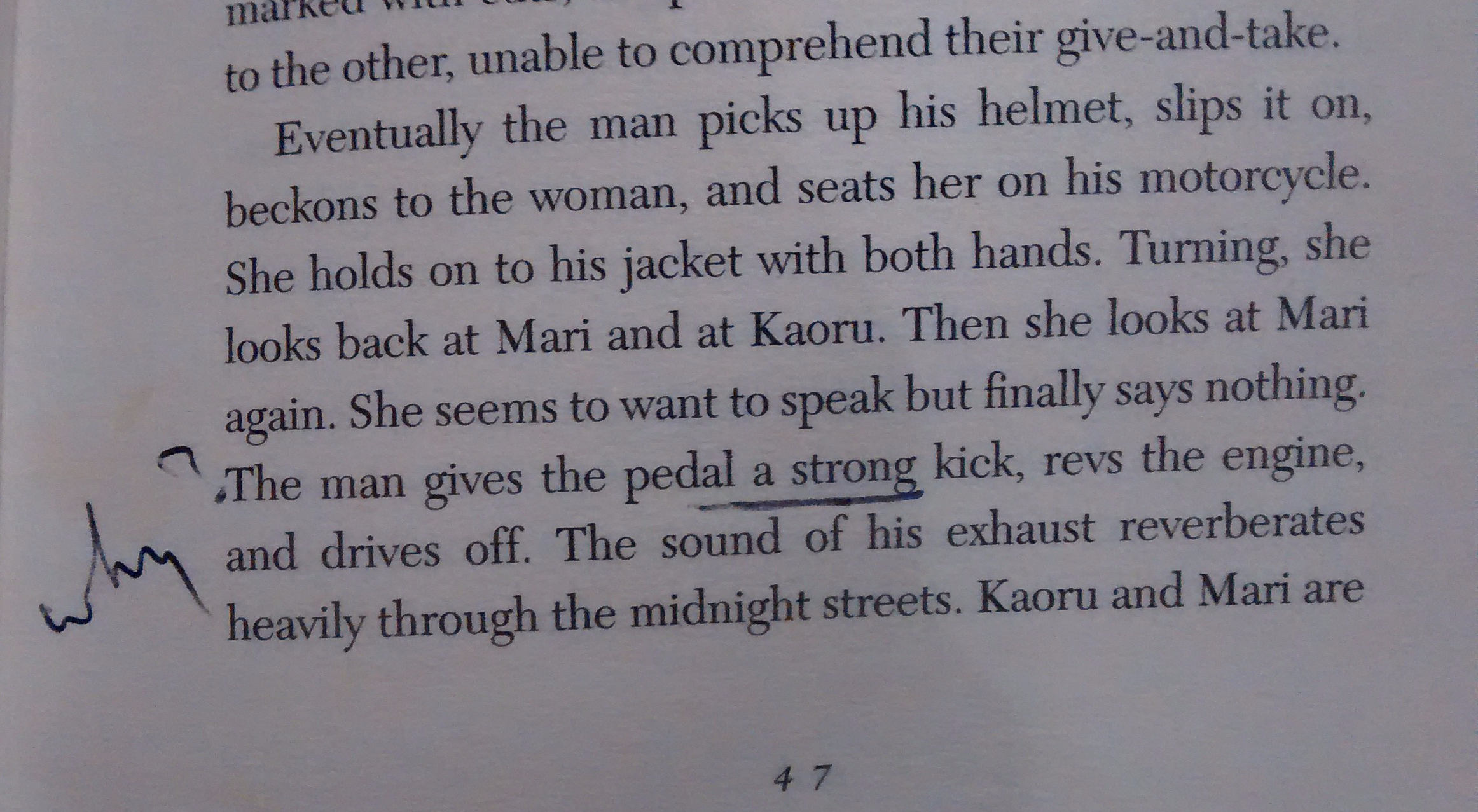
Here’s the first, from page 47:

After Dark: a strong kick, why?

There’s plenty of overwriting in After Dark. Murakami quite indulges himself by giving his omniscient, disembodied narrator full licence to describe the least consequential aspects of a scene and wax rhapsodical about these tiny moments of city life and what it all means. This technique is effective in building a small world of rich detail, but it can make for dull reading.

This previous reader, though, got hung up on Murakami’s (and translator Jay Rubin’s) decision to modify the motorcyclist’s ‘kick’ with the adjective ‘strong’. Now, I’m no line-by-line editor, but this choice seems quite reasonable to me; it draws attention to the motorcyclist’s physical presence, and to the machine’s weight. I feel like underlining their ‘Why?’ and writing the same thing alongside it.

Later, on page 79:

After Dark: a big kick

Now the kick is ‘big’, and that’s caught the reader’s eye. There’s no annotation in the margin this time. I can appreciate that ‘big’ is not as descriptive as ‘strong’, but is its inferiority as an adjective the reason for its underlining? Perhaps the reader thought ‘strong’ was too much, where ‘big’ is just right. Perhaps the reader is a motorcyclist and takes issue with Murakami’s representation of ignition. We can only speculate, because the reader isn’t giving us any more.

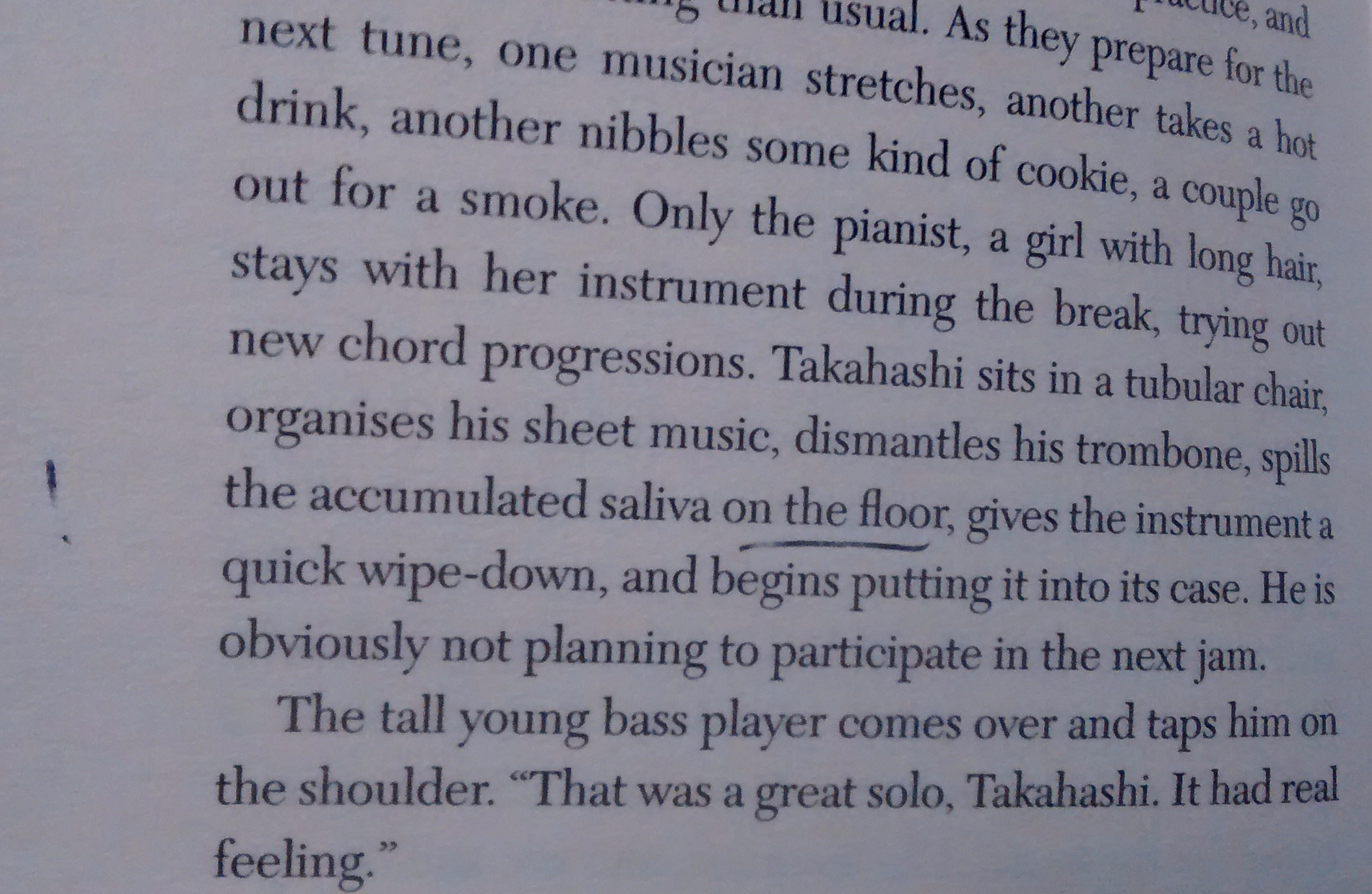
Finally, on page 172:

After Dark by Haruki Murakami, with accumulated saliva on the floor

Now there’s an image worth underlining, an image with real feeling. (!)

(See also: Inside David Foster Wallace’s Private Self-Help Library, a great piece in The Awl by Maria Bustillos. Now there’s a person who could write a good annotation.)

A study in disappointment: Tokyo Story (1953)

2379355012_5867d95fe6_b.jpg
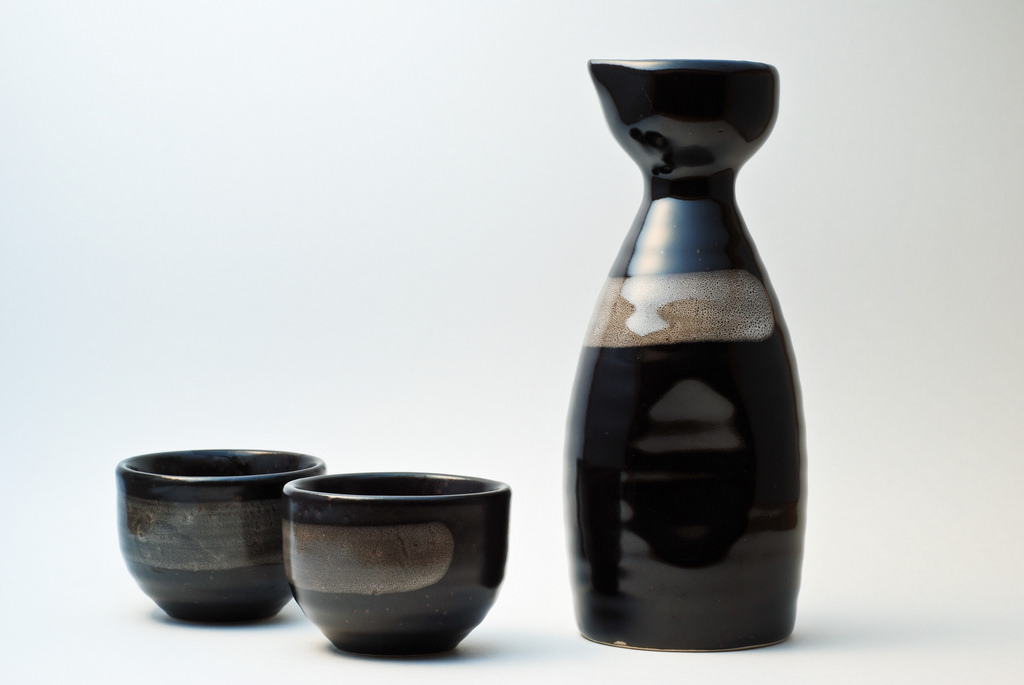
Sake. Photo by cleber (Flickr)

It is our nature to disappoint ourselves, and each other; to fall short of expectations, over and over, until we accept our flaws and lower the bar. We cannot bank on others to be there when we need them; to act nobly and selflessly in times of trial. Likewise, we cannot hold ourselves up as paragons of humanity because in the end, we all have a limit at which we give up and go back to looking out for ourselves. Everyone has to go back to work eventually.

***

So, there were three guys sitting next to each other in the front row. Two of them knew each other, the third was a stranger. For the first half hour or so, the older guy of the two who knew each other kept murmuring comments to his friend, and eventually, the third guy shushed him loudly. The older guy stopped murmuring and stared at the third guy, the guy he didn’t know, in what I judged to be a mixture of disbelief and rage. I readied myself to jump the row of seats and wade into the fight, but he calmed down and went back to watching the movie, and he didn’t talk again.

***

The classic, knockout, heartbreaker exchange in Tokyo Story comes near the end, between the naive and good-natured youngest sister and the ceaselessly graceful and understanding sister-in-law, who is ultimately the core of the film.

“Isn’t life disappointing?” says the younger sister.
“Yes, it is,” says the sister-in-law with a smile.

I waited for the subtly momentous emotional release of these lines throughout the film. I looked forward to the encapsulation of the entire film in Setsuko Hara’s beatific smile. And when they arrived, about half the audience laughed, including the guy right next to me.

I suppose it is kind of amusing, in an absurd way. The total acceptance of the sister-in-law is so at odds with our base nature that it seems unbelievable. And there’s the culture clash between 1950s Japan and 2010s NZ, one concerned with long working hours and emotional reserve, the other with mental health days and instant gratification.

And I suppose it was fitting that my expectations for that scene were disappointed by the reaction of my fellow cinema patrons.

***

I first saw Tokyo Story when I was 19 and didn’t really get it, though I could acknowledge how formally magnificent it was; a perfect technical expression of an artist’s vision within the limits of the medium. I’m now 31 and have a lot more first-hand knowledge of the various disappointments we are destined to experience, and of my own inherently flawed nature. The film’s central premise is therefore closer to my grasp, and exquisitely expressed in the writing, and by the actors, who perform their roles with a rare mix of functionality and precision.

This is a great film in every way.

THE TALE OF PRINCESS KAGUYA: My little princess

Kaguya-hime to sakura
(c) Hatake Jimusho – GNDHDDTK

THE TALE OF PRINCESS KAGUYA
Kaguya-hime no Monogatari
directed by Isao Takahata
Review: The Japan Times

A group of children, each aged somewhere between five and ten, call in unison to a toddler. They have just bestowed upon her the nickname ‘Takenoko’ (Li’l Bamboo) because of her freakishly rapid growth. “Takenoko! Takenoko!” they shout, and she starts wandering away from the front porch of the house where she lives and over to them, a grin on their face.

Her father notices her straying from home, so he calls after her with his own nickname: “Hime!” (Princess!)

She pauses halfway between the children and her father. The children shout louder. “Takenoko! Takenoko!”

“Himeee!”

“Takenokooo!”

It’s cute. There’s no danger; the kids, bred with the collectivist values of countryside life, pose no real threat to Kaguya. She is clearly not in any distress, just caught between two human forces eager for her attention.

The grin drops from her face as she looks from one group to the other in confusion. The calls grow and grow until they drown out the chatter of birds and rustle of nearby trees. The children point their heads to the sky and yell as loud as they can. Her father cranes his neck towards her and screams, his eyes closed and his cheeks red with effort. Finally, the smile returns and she starts toddling back to her father. The children give up and stop their bellowing.

You’d expect the father’s protective tension to dissipate, having won the vocal battle for his daughter’s affections. But it doesn’t. He yells even louder. He starts to cry. He can’t bear even to wait a few more seconds for his little princess to come to him, so he gets up from the porch and runs to her, taking her in his arms as tears stream down his face. It takes several seconds before the embrace starts to calm him down. His love consumes and overwhelms him to the point of delusion and toxicity, leading him — and her — into a mirage of happiness. It blinds him from the truth of his life.

This is just one scene from THE TALE OF PRINCESS KAGUYA, which is sad, contemplative, surprising, and indescribably beautiful. It’s also a bit longer than its thin story deserves, but that feels unfair in the face of such visual brilliance, which was a joy to behold from first minute to last. The animation resembles watercolours and charcoal drawings, and if ever there was a film from which you could print any frame and stick it on your wall, this is it.

I expected all that — just watch the trailer, for goodness’ sake — but I didn’t expect the story, and scenes like the one described above, to stay with me for so long afterwards. It touches on ecology, family relationships, parenting, and the folly of blindly following tradition. It reminds you to be true to yourself. A simple message, but one worth repeating — especially with such inspiration and beauty.

PATEMA INVERTED: Bloody kids

Patema InvertedPATEMA INVERTED
directed by Yasuhiro Yoshiura
The Guardian: 3/5

What an idea! Two groups of people, one with their gravity inverted so they walk on the ceiling and have to construct their lives around not falling into the sky. The two groups live in adjacent cities with little awareness of one another, primarily because their respective leaders do everything they can to keep them separate. PATEMA INVERTED brings them into contact through Patema, a teen girl heroine from the underground city with a penchant for unauthorised exploration, and Eiji, a fish-out-of-water in the 1984-esque Earthbound society.

So much potential. So many possible paths to tread, and so many facets of a compelling idea to explore. But while he sustained my interest through the premise, Yoshiura lost me with his characters. Often, just as the world began to draw me in and get my mind turning over, he’d hone back in on Eiji and Patema, stereotypical anime teenagers, alternately sullen and earnest. Their connection begins unconvincingly with youthful stargazing and, once cemented, blinds them to almost anything else. At one point, they reach an incomprehensibly vast city that appears to be deserted, but their focus remains squarely on each other. I wouldn’t mind, but if you’re going to make your film about the characters, then they need to be more captivating than this pair.

The ending is one of PATEMA INVERTED’s more satisfying elements, as it fits the scenario into a wider context and inverts our previous understanding of the characters. But I still left feeling cheated. Why couldn’t they have applied that level of inspiration to the rest of it?

The film I really wanted to see from this scenario would’ve had Eiji and Patema have sex as soon as possible, then focus on their offspring. Would they be able to fly? Would they use their understanding of both societies to bring about peace? Would they be unloved outcasts wherever they went? That would have been really interesting.

Do Not Leave Your Homes, Everything Is Fine

A reminder that Wellington is a small city, and New Zealand is a small country.

I normally walk to work along Willis St, the busiest road in Wellington’s CBD, and today was no different. This morning, however, this street – usually full of courteous cars and pedestrians holding takeaway coffee mugs – was almost deserted. The following photo was taken at 8:15am:

There hasn’t been a massive earthquake, nor has there been a zombie apocalypse. (Zombies are fake and boring and stupid and no reason to clear the streets anyhow.) It’s just a public holiday – Labour Day, in fact.

Because my job involves multiple time zones and countries, I’ve got work to do. Meanwhile, @mishviews on Twitter (and presumably a lot more of Wellington’s population, given that the semester also wrapped at Victoria University on Friday) is still in bed.

Being one of those pompous asses who cannot help but compare everything at home to my Big OE, I look at these near-empty streets with some curiosity. In Tokyo, no matter how important and respectfully observed the public holiday might have been, streets would definitely be full of people by now. Job comes before anything else, a hangover from the post-war years of working double to try and return a shattered nation to its pre-war glory. And if for some reason you have a whole day away from work, you’d better make the most of it. A day trip to Hakone, a jaunt to Tokyo Disneyland, some crepes in Harajuku. Don’t waste any chance to work or play.

Maybe that isn’t a fair comparison. Tokyo is the biggest city in the world, after all, and Wellington is the Coolest Little Capital In The World. But Varkala in the south Indian state of Kerala, a tourist town of about 40,000 people, was also a good deal busier than this at any time. So many people were in the midst of trying to be upwardly mobile that no matter the occasion, they needed to be out in the streets or opening the shop, seven days a week. Everything is in a constant state of development and transition and if you miss even one day, you might get left behind.

Here in socialist paradise New Zealand, as one US-based friend puts it, we are pretty comfortable and the city streets aren’t changing much. There’s no real worry of falling behind if you take a day off with everyone else, which isn’t that many people anyway. Things will be okay.

I think it’s really easy to forget this, because Wellington offers quite a lot to do and can seem like a bustling metropolis at times. When we decide to stop bustling, though, we generally can. And we’re very lucky for that.

An email from my Japanese former student

I had a lot of crazy classes during my time working as an English conversation teacher in Japan, but without doubt the most rewarding and enjoyable was the one with steelworkers at a Toho Corporation office. Every Wednesday eight burly Japanese men would join me, resplendent in hard hats and overalls, in a nondescript company classroom for an hour of (possibly dreaded) English tuition.

One of these men, Kazu, has kept in touch with me by email in the time since, which is – gosh, more than three years now. In class he was the boisterous one, quick with jokes (in English as well as Japanese) and boasting an impressive vocabulary. On the page, he is decidedly less effusive. He continually expresses a lack of confidence in his English, no matter how much I tell him how good he is, and his short messages often include an apology for his poor grammar.

We have been in touch a little more frequently since the Tohoku earthquake of February. He lives in Kanagawa prefecture, south of Tokyo, so is not directly affected by the earthquake or nuclear fallout – at least, not yet. Yesterday, I received an email from Kazu that moved me deeply for various reasons. I asked him if I could reproduce it here, and – admittedly after some gentle coaxing – he agreed.

This may be meaningless to the rest of the world, but it is so meaningful to me. I am putting it here to give a sense of a regular Japanese guy’s outlook in the wake of the earthquake, and to just see if it resonates with anyone else.

Thanks, Kazu.

*

Dear Banz

Thank you for the mail and thinking of me.

About 7 months have passed since the earthquake and tsunami hit the northeastern coastal area in Japan.
There have been several facts reported about it. I was surprised to find out that the tsunami was estimated to have reached 38 meters in height.
This was the second biggest tsunami in history. The biggest one hit the same area in 1896.

Prime Minister of Japan announced his determination to reconstruct the devastated area into one of the most desirable places to live in the world.
I am very much interested in his plan, so I will follow it closely.

We still have many aftershocks every day. However, the life is getting back to normal in many ways,
although we worry about the effects of radioactive leaks in Fukushima Nuke Plants.

I wish everyone a safe and peaceful life.
Kazu

NOW THAT YOU’RE GONE IT HIT US

I’m having to get this out slowly over a long period of time, as computers in India’s cyber cafes aren’t quite as cooperative as one might hope. Here’s what happened around the 24th of August.

On Friday (the 23rd) I said goodbye to my landlords Tetsuko and Kotaro, the sweetest folks one could hope for. The other housemate cooked an incredible Mexican dinner and T & K gave me a Japanese-style bandana, which was a wonderful gesture. A wise person said that once you’ve gotten past the surface of Japanese people and spent enough time with them, they will do anything for you, like they’re investing something emotional in you that they so rarely do.

I was to see this on an even greater level the next day. Mika, fellow teacher mentioned a couple of posts earlier, had said she would come to the airport to see me off, so I thought we’d have lunch or something and then say our sad goodbyes… instead, the whole family turned up – Mika & her husband, Koji, her mother, sister and sister’s 4 kids (2 of which I taught). At this point I understood what people mean when they say ‘my Japanese family’, because really, I felt completely accepted as if I had the same blood.

As if that wasn’t enough, the kids handed me a stack of 6 envelopes and inside each was a letter from a student in the class with a special message for me. “Do your best in India and please come back to teach us again.” “Enjoy eating curry!” “Please write to me and tell me about India.” There were drawings, too, and some more photographs from the party, plus an incredible moving card from Mika. After I went off through security and out of sight, I thought about what had just happened and the cards that were now wedged in my bursting laptop bag, and shed a few tears in the immigration queue. I couldn’t have dreamed of a better send-off, a better final memory of a country I’d come to believe I no longer wanted to function in. I’ve still got my shit to say about Japan and I think it’s valid, but every moment of the experience was worth it just for those last minutes in the country.

One last remarkable thing was to happen. I had intended to call someone just before getting on the plane, and was literally striding towards a payphone and reaching for my wallet when my phone rang for the last time. It was her; she’d had no idea when my plane was leaving, nor obviously did she know that I was, at that moment, about to pick up the phone myself. An extraordinary coincidence. More than a coincidence. I stepped onto the plane confident that Japan had been good for me, I’d been good for Japan and that the universe was aligning especially for me.

I’m now in Bangalore, it’s been kind of an odyssey to get here, worth it for every moment. That’ll be the next post…

I AIN’T GOT TIME FOR THE GAME

I’ve been in Japan for 14 and a half months now, and the longer I stay here, the less settled I feel. The concept of being ‘uchi’ (inside) or ‘soto’ (outside) is felt every single day in some way or another, whether it’s through furtive glances on the train, having the menu flipped for you in McDonald’s or the extra polite, nervous service gaijin often receive in department stores.

I suspect that it is still impossible for a foreigner to become uchi, what with the population being about 98.5% homogenous and still apathetically embracing traditional methods of conducting business and polite conversation. You can come pretty close if you try hard enough, though, and take on as many characteristics of your hosts as possible. Thing is, you have to want to, and I really don’t want to. In this situation, living somewhere but not wanting to become part of the current culture, you have two options: 1) leave the country, or 2) retain as much respect as you can for the country you live in, its people and customs; keep everyday frustrations to a minimum and accept things that frustrate you as part of the culture and something to be at ease with; and above keep your own sense of identity strong in a way that you’re comfortable with yourself without being aggressive about it, and comfortable with the way you’re received by the culture even if it isn’t how you’d have it ideally.

So, I’m leaving. Weren’t expecting that, were you? I’ve tried option 2 for a good while now, and if I’m honest, I could quite easily go on here for months, even years longer, but I’ve reached a point where I realize that the longer I stay, the more I have to suppress my natural self, and I can’t see how that’s healthy. It either means I’ll become something I’m not, or more likely, wrestle with myself on a daily basis knowing what I have to do in a given situation is quite different from what I want to do. As well as that, it’s a lot easier to survive in Japan if you think less – just do your job as you’re expected to and hang out with a regular group of friends, and your worries inevitable diminish – and until recently, I could feel my brain slowly shutting off, my mind consciously less stimulated, just coasting through my days giving very few things a second thought.

It’s my time. I’ve loved living here for so many reasons – the wonderful friends I’ve made, the beautiful kids I’ve taught, the incredible things I’ve seen… I’ve also learned more about myself and the world around me in this past year than the previous four combined, partly because of living in this foreign country, and partly through having my first serious relationship with a woman. I just have to go, though, and I have to go now. I have to go to a place which is different from this one, where I can focus on becoming more open and direct and not worry so much about keeping this safe and comfortable, which is such a big part of existence here.

India is my next destination. I’m not sure what’s going to happen there, but I know it will challenge me in so many ways and will be very, very difficult to cope with at times. But that’s good for me. It’s all about me, in case you didn’t notice. For once, I’m not that bothered about concentrating completely on my own development, and I’m very pleased about that.