UNDER THE SKIN directed by Jonathan Glazer Metacritic: 78
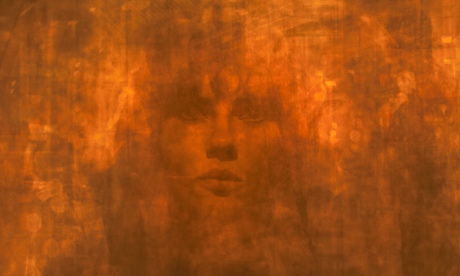
I laid my head down on the pillow and heard Mica Levi’s discordant, grinding score. It whirled inside my head, intercut with the most striking images from UNDER THE SKIN — particularly the 2001-esque pre-credits creation sequence — just as it had for the previous five hours since the film ended. The following night it was the same. There was no escape. I didn’t particularly mind; I like a film that makes me feel something.
Two phrases rang in my head as I settled into my seat way down the front of the Embassy Theatre. One: “it’s pretty visually intense”, spoken in warning by an usher as I tramped down to the front rows so I would be closer to the screen. Two: “misogynist”, a word David Larsen used speculatively in his brief review for The Listener (scroll down to Day Six). On reflection, I think that neither phrase applies — although a subjective case could be made for both. There’s little objective truth in UNDER THE SKIN, except perhaps the strikingly unsettling nature of Levi’s score. Scotland is as beautiful or desolate as you prefer to see it; there is a total absence of humour, or several chuckles of the blackest kind; bodies of liquid can be either vitally restorative or a death sentence. My own opinion on each of these questions changes from moment to moment.
There’s one scene where a character is introduced with the obvious intention of drawing a laugh from the audience. Glazer then flips that around with later scenes involving this character, providing — for me at least — the film’s most unspeakable horror. Despite its Kubrickian artfulness, UNDER THE SKIN seems to have been made in a sort of ramshackle, cobbled-together fashion, so it’s difficult to say whether this bait-and-switch was intentional. It’s that kind of thing, though, that makes it such a remarkable and unnverving work of art. Just like Scarlett Johansson’s appropriately blank character, haltingly drawing men into her van of doom, it hooks you in one way then smacks you around the head in another.
I have a lot of other notes from the screening, scribbled anxiously but legibly as I tried to make sense of it all. Samples:
So delicate that under a light touch, it shrinks to nothing. I went to LILTING for two reasons:
Ben Whishaw, the brilliant and honest young actor from CLOUD ATLAS and BRIGHT STAR, whose performance in this film was described in the NZIFF program as one of ‘exquisite sympathetic imagination’;
The focus on cross-cultural communication, a particular interest of mine.
Whishaw is just fine, as always, as is the rest of the cast. And the cross-cultural communication is reasonably realistically portrayed, if rather stagy. But this turns out to be one of the film’s biggest flaws.
The vast majority of its runtime is taken up by scenes involving Whishaw’s character, the prickly mother of his deceased partner (Pei-Pei Cheng), and a Mandarin-English interpreter (Naomi Christie), meaning we get each line of dialogue twice: once in English, once in Mandarin. These conversations-by-proxy may be realistic, but they aren’t particularly thrilling or dramatic, nor do they illuminate much about the characters’ struggle to connect. The differences between Whishaw and Cheng are immediately apparent — progressive, young, gay British man, and traditional, old, straight Chinese-Cambodian woman — and the way those differences are overcome ultimately has little to do with spoken language. More than anything else, the three-way dialogue scenes make for a film that’s at least one-and-a-half times longer than it needed to be.
Apart from all that, I was left with way more questions than answers. Not questions of philosophical import about the nature of communucation, as I’d hoped for, but vexing questions about the plot: what does Whishaw’s character do for a living, given that he’s able to live in that massive flat but we never see him work? Why does he want Cheng to stay romantically involved with a fellow retirement home resident? Suddenly, he and the interpreter — a woman — seem very close; how and when did that happen?
Khaou’s frustrating tendency in LILTING is to linger way too long on scenes of little consequence, then skim over the moments that actually catch the attention. He even turns up the score — the cloying, manipulative, ‘feel something you dicks’ score — to the point that it obscures what may have been some of the most tantalising pieces of dialogue, if we’d been able to hear them. It’s ironic that a film about overcoming the limits of our communicative abilities is itself spoiled by an over-reliance on withholding information from the audience.
The quirks of nziff.com’s online seat allocation mean that nerdy early bookers like me are almost always put in the middle of a full row, regardless of the overall house size. When I staggered into VOICES OF THE LAND, heaving after me a plastic bag filled with hardcover library books, I stared down that ancient social experiment: shuffle past two already-seated patrons and hope they don’t hate you forever. Fortunately for me, the two women — I’d guess they were in their seventies — stood with a smile. I still apologised for existing, as one must.
The plastic bag crashed into the second woman’s leg as I sat down next to her. “You’re quite the reader, aren’t you?” she said. I admitted the books had been borrowed by my girlfriend and that I hadn’t read a word of them. The woman segued seamlessly into a discussion of a book she recently read and was fascinated by. It went in one ear and out the other, but I nodded an acknowledgement and proceeded to tell her what I was reading: Netherland by Joseph O’Neill, which concerns a Dutch man living in New York when the planes hit the World Trade Center. His marriage steadily disintegrates thereafter, and the rest of his life devolves into meaninglessness. The man’s only solace is cricket, which he played often as a boy and is surprised to find in baseball-mad NYC.
The woman nodded back, then said her son was in New York on September 11 as well. She noted that his marriage had also fallen apart over the ensuing couple of years, and that he and his then-wife ultimately divorced. My brief description of Netherland must have sounded uneasily familiar, and I was struck by the reminder of how directly fiction can echo reality. But if the eerieness of the coincidence bothered her, she didn’t show it. In any case, it didn’t seem like the time or place to delve deeper, and I felt embarrassed at having unwittingly called to mind her son’s past trials, so I simply said “That’s no good” and asked what else she was seeing in the film festival. We went on to talk about our expectations of VOICES OF THE LAND and its subject, the brilliant Richard Nunns, a Pākehā who learned how to play Taonga pūoro (traditional Māori instruments) in dreams. Then the film started.
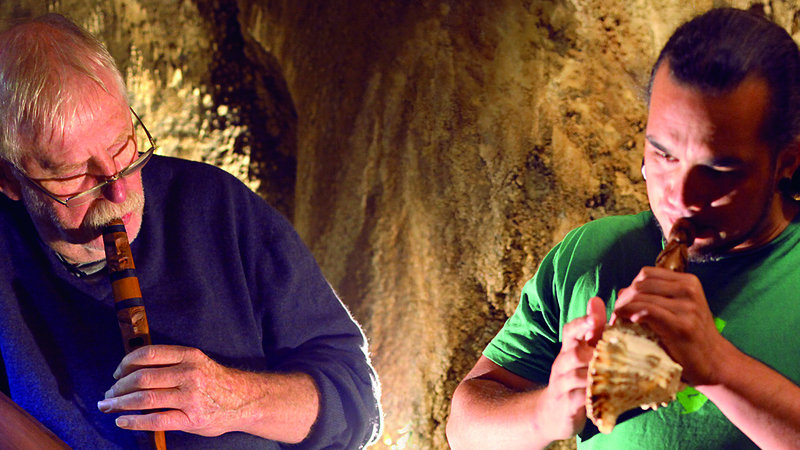
Nunns has Parkinson’s disease, and as you watch him shuffle with a stooped gait along forest paths and stony beaches with protégé Horomona Horo, it’s as if the Earth is slowly pulling him back down to it. His connection with the land is greater than most, comparable to almost any Māori. Over his seven decades, he has accumulated an unequalled volume of experience and knowledge regarding Taonga pūoro, and that flows into a wealth of other insights: about divine inspiration, about why Pākehā often fail to connect with Māori, about the nature of sound and its value to us, and about his own influence. He shares these insights in his own inimitable, rhythmic language: “these are the ways in which our sonic environment is subsumed.” As much as the land may be calling him back, Richard Nunns’ abundance of knowledge — and his awareness that it is held by remarkably few — may be weighing him down.
So he’s passing it on to Horo, an affable and deferent man with a hulking figure and a long ponytail. Through this film collaboration with Paul Wolffram, he’s also passing some of it on to us. Ninety minutes in Nunns’ company could never compare to the lifetime of looking and listening it’s taken to get him to this level of understanding, and Horo is clearly the next master of Taonga pūoro, but there is so much for an audience — especially in New Zealand — to take away from VOICES OF THE LAND. Take the headphones out of your ears next time you go for a walk. Allow yourself to experience the sound waves moving through you. Pay attention to where those sounds are coming from. Respect their sources, and remember that the river or the forest have been around a lot longer than you have. A lot of Nunns’ work with Horo, and previously with the late, great Hirini Melbourne, involves playing to the land: taking their instruments out to some barely touched forest or foreshore scene, usually by request, and following their sonic inspiration. Their mastery is not so much of the instruments but of their connection with them, and by extension the land itself.
Throughout VOICES OF THE LAND, I couldn’t help being reminded of my dad, who I sometimes feel I am slowly becoming. Like Nunns, he has an array of artifacts displayed around his house, including several creaking bookshelves bearing cherished works; like Nunns, he has a story for each of them, and for pretty much everything else in his sphere of orbit. Among the artifacts are some instruments, some of which bear some resemblance to Taonga pūoro. My dad was once in the Scratch Orchestra, a collective led by Phil Dadson that performed a combination of music and sonic experimentation. The one I always remember is the repeated scrunching up of a page of newspaper into a ball then reopening it, maybe fifteen or twenty times. Try this, if you have a newspaper handy, and notice how the sound and feel of the newsprint changes. It’s this kind of mindfulness towards the objects and sounds in one’s environment that Nunns has spent his whole life promoting.
I was lucky enough to see Melbourne and Nunns perform once, at WOMAD in Auckland in 1999. They took over the Auckland Town Hall for an hour and held everyone in their thrall as they moved between various instruments that had been placed on the stage. This music was like nothing I’d heard before: sparse, not particularly tuneful, but possessed of a seemingly inherent gravity that captivated me. (By the way, you probably already know this sound if you’ve seen any New Zealand film since ONCE WERE WARRIORS, but if you’re drawing a blank, have a listen here.) My dad was sitting beside me that day; he’d bought my ticket. Later, I was too embarrassed — too fourteen and pimply — to dance to Pacific Island fusion group Te Vaka out in Aotea Square, but my dad was shuffling away with a smile on his face in his huge black-and-blue jandals. At one point he gently admonished me for folding my arms and refusing to give in. “Can’t you just let it take you over eventually, just let it move your feet for you?” I remained coiled, and he carried on dancing.
VOICES OF THE LAND closes with one of the best final shots I’ve seen: a moment of dazzling, patient, inevitable simplicity, a reminder of the wonder in something that happens perpetually. It left me feeling inspired and moved. The woman asked me what I thought as we stood up and left the cinema, and I told her that I loved the film but felt embarrassed that I’d seen (and heard) so little of New Zealand. “Oh, you must,” she said. “Why haven’t you seen much? Are you not from here?”
I replied that I grew up in the Waikato and have since lived in Auckland, Christchurch, and Wellington; that I’d visited beautiful locations such as Cape Reinga, Mahia, the Tararuas, Abel Tasman National Park, and Castle Basin in the Southern Alps. And as I spoke, I realised that I have seen quite a lot of New Zealand. I’ve only seen the Tararuas and Abel Tasman thanks to my girlfriend, who is as filled with fascination in nature as anyone I’ve met. But I owe the rest — and many others — to my parents, especially my dad. We had so many week-long driving holidays when I was a kid, sleeping in tents and living on Rice Risotto as we took in the many sights of the North Island. My dad was obsessed with taking the back roads instead of the state highways, carsickness be damned, just to see something different. He lived for some years on the edge of bush in the Waitakere Range, west of Auckland, and he still feels its pull. Whatever connection I have to the land, I owe a huge part of it to him.
I spent three hours covered in black-and-white mud and shit at HARD TO BE A GOD. Should’ve walked out after one.
It’s based on a 1964 novel that sounds fascinating and philosophically rich. “The novel follows Anton, an undercover operative from the future planet Earth, in his mission on an alien planet, that is populated by human beings, whose society has not advanced beyond the Middle Ages. The novel’s core idea is that human progress throughout the centuries is often cruel and bloody, and that religion and blind faith can be effective tools of oppression, working to destroy the emerging scientific disciplines and enlightenment.” (Wikipedia) Anton, known in the alien world as Don Rumata, comes to realise that although his advanced understanding of society accords him godlike qualities, he is hamstrung by the low beliefs of those around him. What a quandary: to know how to alleviate people’s suffering, to feel obliged to intervene, but to know any intervention can only at best offer temporary relief. The struggle for knowledge and improvement will rage on, punctuated by faeces and entrails, and you are powerless to do anything but watch.
If only the film had stuck more closely to these lines! Instead, the philosophy is virtually absent as German insists on keeping his camera at the level of the sodden, shit-stained dirt. Scenes unfold incoherently as Don Rumata staggers from one set of filthy, snot-ridden characters to another, none of whom is meaningfully distinct from the others — at least, as far as I could tell. German’s shooting style relies heavily on long, unchoreographed takes and features wavering focus, an insistence on close-up rather than wide angle cinematography, and regular, indistinct intrusions into the foreground of the frame by otherwise unseen characters and objects. At no point are any concessions made to an audience’s expectation for plot or character development; it is all base elements, mud and bodily functions and weapons. For three hours, and in black and white for good measure, lest anything capture our attention or imagination.
The point may be that we, the 21st Century audience, are equally powerless observers to the horrors of history. A good point, if so. And I’ll never feel more like I’ve spent three hours in the unenlightened Middle Ages, nor more appreciative of modern conveniences. But the point is laboured, and every element of the film remains out of most viewers’ grasp. The society Don Rumata inhabits is called Arkanar; fitting, as HARD TO BE A GOD is arcane in the extreme.
What an idea! Two groups of people, one with their gravity inverted so they walk on the ceiling and have to construct their lives around not falling into the sky. The two groups live in adjacent cities with little awareness of one another, primarily because their respective leaders do everything they can to keep them separate. PATEMA INVERTED brings them into contact through Patema, a teen girl heroine from the underground city with a penchant for unauthorised exploration, and Eiji, a fish-out-of-water in the 1984-esque Earthbound society.
So much potential. So many possible paths to tread, and so many facets of a compelling idea to explore. But while he sustained my interest through the premise, Yoshiura lost me with his characters. Often, just as the world began to draw me in and get my mind turning over, he’d hone back in on Eiji and Patema, stereotypical anime teenagers, alternately sullen and earnest. Their connection begins unconvincingly with youthful stargazing and, once cemented, blinds them to almost anything else. At one point, they reach an incomprehensibly vast city that appears to be deserted, but their focus remains squarely on each other. I wouldn’t mind, but if you’re going to make your film about the characters, then they need to be more captivating than this pair.
The ending is one of PATEMA INVERTED’s more satisfying elements, as it fits the scenario into a wider context and inverts our previous understanding of the characters. But I still left feeling cheated. Why couldn’t they have applied that level of inspiration to the rest of it?
The film I really wanted to see from this scenario would’ve had Eiji and Patema have sex as soon as possible, then focus on their offspring. Would they be able to fly? Would they use their understanding of both societies to bring about peace? Would they be unloved outcasts wherever they went? That would have been really interesting.
After a note about the high volume of seat ushers and a small bitch about the seat allocation (I was stuck somewhere up the rear right of the Embassy Cinema despite booking my seats quite early), the first of my scribbles about THE LUNCHBOX was one word: ‘hungry’.
It’s not a film about food, exactly, although food is an important part of its subtly expressed message about the fundamental connections between people. But you see food early, and often, and you want to eat it, regardless of whether you’ve just eaten an enormous yum char lunch (as I had). With its combination of tastes and textures and unpretentious presentation, Is there any cuisine more visually appealing than home-cooked Indian?
Similarly appealing are Nimrat Kaur and Irrfan Khan, the housewife (‘Ila’) and salaryman (‘Saajan’) at the centre of THE LUNCHBOX’s straightforward plot of a dabba that repeatedly gets sent to the wrong man. The mistake could be corrected easily, but both Ila and Saajan settle into a note-passing routine that seasons their unfulfilling lives: she with her distracted, near-absent husband, he with his widowed malaise involving little more than cigarettes and government files. Kaur is just fine, and Nawazudin Siddiqui is perfectly pitched between irritating and charming in a supporting role, but you must see this for Khan, one of the great actors of our time. He does so much with so little.
The teeming metropolis that surrounds these characters seems to function more as a delivery device for boosted GDP rather than as a social structure. The man alone in a Himalayan cave for years could never be as lonely as the man in the city who lives alone, works alone, and travels on the packed commuter trains alone. But connections are possible. One of the most striking ways Batra illustrates this is by regularly overlapping sound between scenes — as if the previous scene continues to echo in a character’s head, even if they weren’t in it. They’re all in it together, for better or worse.
By the way, THE LUNCHBOX is set in Mumbai, a city I have visited and loved twice. The opening shot was of a mass of drab suburban railway tracks and the plain apartment blocks that overlook them. It gave me the chills. My impression of the film might therefore have been coloured somewhat favourably, but it is really good.
Werner Herzog’s maxim — that “we lack adequate images, our civilisation doesn’t have adequate images, and I think a civilisation is doomed or is going to die out like dinosaurs if it doesn’t develop an adequate language or adequate images” — has been quoted and espoused so many times, at least in the online company I keep, that it has almost passed into cliché.
But, as Ed always likes to say, clichés become clichés because they’re true — or at least, their initial effectiveness (and often timelessness) leads to their reptition. Somewhat ironically, Herzog’s ‘adequate images’ line is about avoiding the repetitive nature of talk shows and television commercials and expressing ourselves through new visual language. And from the hip-hop montages of Requiem for a Dream to Natalie Portman’s ballerina resting in the spotlight at the start of Black Swan, Darren Aronofsky’s ‘adequate images’ are the equal of any current director.
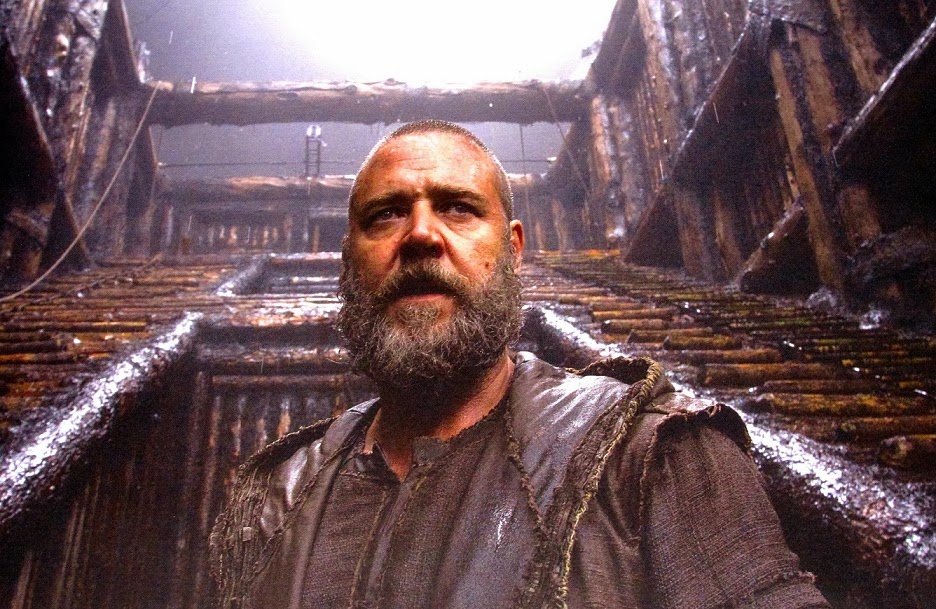
In Noah, Aronofsky offers more of the same, but he has a lot more money to throw at the screen (about $150m, apparently). From an unpromisingly derivative opening, Noah blossoms into a parade of breathtaking imagery, often on an epic scale. Here are some of the images I remember most clearly:
a bare foot tainted by the bloody earth
an underwater landscape slowly revealed to be comprised of dead humans and beasts
Russell Crowe’s face conveying gravity rather than ridiculousness, for a change
the Earth covered in typhoons
rock-and-mud behemoths, connected by chains, rising to protect the Ark
a divine rainbow
All that is well and good but if you don’t care, it doesn’t stick. The trailer for the new Godzilla played beforehand, and while it looked visually stunning, I’ll be curious to find out whether the concepts expressed in the film draw me in. You need good ideas to give those images some meaning that lasts longer than a few seconds.
Fortunately, Aronofsky and co-writer Ari Handel breathe life into this ultra-familiar story by a) chucking in Ray Winstone as a villain seeking his own special audience with God, and b) tying it to some fundamental human themes: our quest to find a balance between justice and mercy, our alternately symbiotic and destructive relationship with our planet, and the value we place in love. These are all ideas we’ve seen before — indeed, they are clichéd — but they were expressed earnestly and poetically enough to capture my attention and imagination.
The Bible has been the primary source of adequate images and clichéd notions in our civilisation for thousands of years. Speak of a well-known Bible story, and it conjures up cultural icons and universal themes: the Ten Commandments, Jesus on the cross, Noah and his ark. Aronofsky’s vision of Noah, filled as it is with broad artistic and emotional strokes, seems appropriate.
I’ve been taking Philip Seymour Hoffman’s greatness for granted for well over a decade now. Where did I first see him? Was it the devoted nurse Phil Parma in Magnolia? Maybe it was the alternately sweet and acerbic film critic Lester Bangs in Almost Famous. Or maybe it was Brandt, smiling assistant to The Big Lebowski.
I must have seen all of these films in about 2000-2001, associating Hoffman with quality in my mind. Over the next decade or so he would show up to great effect in film after film, serving each script in his own inimitably familiar way and to the best of his ability. The towering but soft-spoken intellect of Truman Capote in Capote. The hot-tempered mattress store owner/phone sex operator of Punch-Drunk Love. The charismatic cult leader of The Master. Best of all, the theatre director Caden Cotard in Synecdoche, New York, whose art slowly consumes his entire existence.
If current reports are true, it was heroin addiction that claimed his life. Hoffman gave two reference points for addiction: Owning Mahony (gambling) and Love Liza (huffing gasoline fumes). I often think back to a scene in Owning Mahony in particular, in which Hoffman’s character impassively describes his biggest gambling thrill as 100 on a scale of 1 to 100. Hoffman, who has previously discussed his problems with drug and alcohol addiction, brought an understanding to these performances that sticks with you long after you see them.
Based on the roles I’ve mentioned so far, it’d be reasonable for someone unfamiliar with Hoffman to imagine he was a serious, dour actor. However, he was quite capable of comedy, and a sense of humour shone through in most of his work in the same way a sense of humour is a constant undercurrent when you’re with your closest friends. His capacity to believably and naturally deliver the precise emotion required of a moment, combined with his often unkempt appearance, made him more relatable to audiences than most actors.
He was even capable of elevating painfully uninspired comedy into something quite enjoyable. I’m thinking of the Ben Stiller vehicle ‘Along Came Polly’, a bog-standard rom-com in which Stiller stumbles through a blandly wacky relationship with Jennifer Aniston. Hoffman plays Stiller’s best mate Sandy Lyle and steals every scene he’s in: trash-talking during a pick-up basketball game, delivering a nonsensical presentation to Stiller’s colleagues, and sharting at a party. Doesn’t sound like much, but in each of these scenes, Hoffman offers a different emotional hook we can all recognise: brashness to mask ineptitude (basketball) and ignorance (presentation), and embarrassment severe enough to demand immediate escape. All for the sake of amusement in a weak film, with genuine laughs as a result. That can’t be easy, but he makes it look like it is.
I only saw ‘Along Came Polly’ once, and that was ten years ago. I’m amazed at how well I remember Hoffman’s scenes. That’s a testament to the quality of his acting, which was so good for so long that it seems like he was much older than 46. His death is an unaccountable loss to cinema that will be felt ever more keenly over the years.
I’m now 29 and I have no kids. No property or other investments, either. I would like all of those things at some point in the future, but they aren’t my priority at the moment. I’m more interested in travel and pursuing new opportunities in my career. Round up a few other 29-year-old New Zealanders and see how many say the same thing.
Most of what follows is about me.
Music
The best twenty seconds of a song I heard this year were 3:10 to 3:30 of ‘The Red Wing’ by Fuck Buttons, from the album Slow Focus.
My music listening habits never really developed past the age of 16, when I got my first computer. I come across a new album and listen to it once or for months on repeat. Slow Focus was my favourite album of the ten or so new ones I heard this year. James Blake’s Overgrown would be next, and I also really liked Nothing Was The Same by Drake.
The steady accumulation of layers and abrasions on ‘The Red Wing’ reaches a glorious, spine-tingling apex about halfway through. My second favourite twenty seconds of a song are also from ‘The Red Wing’ as it starts to devolve from 6:10 to 6:30. The album as a whole is relentlessly dark, loud, and repetitive; it calls to mind the twisted sensations of being off your face in a dark nightclub, or the sick emotion that accompanies losing something important you can never get back. It drags me through a 45-minute catharsis. My kind of music.
Oh, the best New Zealand album I heard this year was Anniversary Day by JP Young. It would be my favourite album of the year but it came out in 2012. I recommend you go and listen to (and maybe buy) it now, especially if you have any connection to Wellington. It is a genuinely great album, poetic and easy to get along with.
Politics
In my dictionary (the excellent WordWeb), the first definition of ‘politics’ is Social relations involving intrigue to gain authority or power. No wonder it fills so many pages in the newspaper and minutes on the airwaves. Not here, though.
Sport
From in front of that massive, stunted goal in Shed 1 – about waist-high and about a third of the width of the pitch – James rolled the ball out to me. I was just on our team’s side of the halfway line, the opposition goal about fifteen metres behind me. We were ahead, but we’d just conceded a goal and needed to regain control of the run of play.
I leaned back slightly as the ball reached me and tapped it with the outside of my right foot to MHS, who was over by the left sideline. As he put his foot on the ball and drew a defender, I spun round and sauntered into space a few metres downfield. Just as I was nearing the penalty spot, with no defender near me, MHS took a couple more touches and tapped the ball past his marker, into my path. In my peripheral vision, I sensed two things: one, the opposition goalkeeper was positioned slightly to the left of the centre of the goal, back near his line; two, an opposition defender was rushing at me from my right.
As the ball ran in front of me, I controlled it with one touch from my right foot and – judging that I had less than a second in which to act before I would be tackled – snapped a left-footed shot along the ground, past the oncoming defender, and into the bottom right corner of the opposition goal.
The exact same sequence of events could have happened a hundred years ago, albeit on grass rather than turf and with a plain leather ball rather than a bright yellow plastic one. I will remember it for decades, just as I remember my chipped goal from near halfway in a second XI match at high school and a perfectly timed flick off my pads for four from the first ball I faced in house cricket. Such moments in our sporting lives are timeless.
Film
I seem to be getting more bored with the movies. I went dozens of times this year, more than I have since about 2006, and I always enjoyed myself from start to finish, whether it was any good or whether the dude behind me provided a running commentary throughout (as happened in The Hunt and at least one other film I can’t remember). But I rarely left feeling inspired to talk about what I’d just seen, or to think about it a week later. The prime example of this was Hyde Park on Hudson, a film so bland I barely remember seeing it.
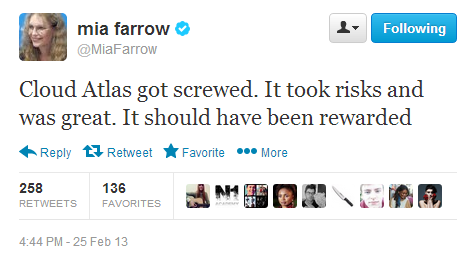
Casting a wide shadow over all my cinematic joys this year was the disappointment that Cloud Atlas was not released in cinemas in New Zealand. The distributor must have gotten cold feet at the prospect of selling Kiwi audiences on a three-hour epic with six ongoing storylines painted in broad archetypes, which seems like a fair decision when I look at that sentence, but Cloud Atlas somehow fulfils its extraordinary ambitions and offers a new kind of multi-layered spectacle in film. I watched it at home, alone on the couch wearing headphones, oblivious to a storm raging outside. It was the best new film I saw this year, and when a stranger says they also loved it, I feel like the film is recommending that person to me.
Tech
A couple of months ago, someone did a memorably recognisable impression of me. They held a smartphone close to their face, jabbed it with their index finger, and muttered, “Just… fucking… work!”
The way I treat the technology in my life has become a good indicator of my mood. The more accepting I am of my phone becoming unresponsive or my laptop shutting down unexpectedly, the better my overall frame of mind. If I’m already frustrated, I swear and click the mouse harder and bang my foot on the floor. I apologise to my colleagues for this.
The fact that my use of electronics can be seen as a barometer of my psychological state suggests how deeply I’ve involved these objects in my daily life. When you spend more than half of your waking hours with someone, or something, some irritation is inevitable. But if I lost them, it’d be like losing one of my senses.
Books
In August I went to the launch of Eleanor Catton’s The Luminaries, putting one foot in the world that knows her as ‘Ellie’. She complimented me on my yellow shoes, and I asked her how she was feeling. “A bit overwhelmed, to be honest,” she replied, looking around at the faces and wine glasses packed tighter than ever into Unity Books. This was a couple of months before she won the Booker.
After the launch, Nik and Ant and I discussed what a positive occasion it was. A good person being celebrated for an amazing feat of creativity. I still haven’t finished reading the bloody thing because I am so terrible at reading books, but it really is great, and I will get there.
Travel
In September I went to Brisbane, and in December I went to Nelson. First holiday was alone, second was with a companion. The weather was great for both.
People
I think it has to be Tara, four months in, as wonderful as my colleagues, friends, and family are. She plucks snails off the footpath and places them safely in the bushes. She attempts to identify each bird she sees: “Thrush? Female blackbird?” She is comfortable speaking to strangers on the phone. She writes good emails. She gives excellent gifts. Our conversations flow easily, weaving from meaning to silly madness and back. Perhaps I am overly observant, but she means a lot to me.
Also, the Internet has a slightly diminished role in my life right now but I was lucky enough to get to meet Charles, Dan, Kathleen, Isabel, Martyn, Naomi, Neha, Reena, and Sarah this year – all people I came to know about through Twitter, and who have all been teachers in some way or another. Each year brings more new connections, and some old ones rekindled. Many bleed happily from one medium into another: Twitter, then Facebook, then a coffee shop or a pub. There will no doubt be more new people in 2014 – more good people, and more effort not to spread myself so thinly.
*
Thanks for coming and looking at this. The years are all arbitrary but regardless of what has happened in 2013, I hope 2014 is all right for you.
(‘Bleakfest’ is the name of a real thing that my friends Amy and James did last year — a night of the bleakest films, screened back to back in a dingy Hataitai flat — but I’m nicking it for this section of my NZ International Film Festival, during which I felt like the Earth was a crusted, burnt-out husk.)
I did a strange thing. Instead of just rambling my thoughts about Jia Zhangke’s A Touch of Sin here on Jdanspsa Wyksui, I compressed them into a hopefully coherent form and submitted them to Stuff Nation, the often questionable user-generated content arm of Fairfax’s Stuff.co.nz news website. Here’s an excerpt:
In Jia Zhangke’s A Touch of Sin – one of the more bitter and cynical films I’ve seen in a while – China’s power is concentrated in the hands of an elite few, while the majority of the population is left to pick over the dust in their masters’ wake. […] What happened to the glorious idea of China for these people? Far from being marginalised, they are in the thick of the mainstream. Their aspirations for more money, more power, and more freedom lead them to fight against the current with whatever tools they have available to them – but the flow is always stronger.
You can read my full review here, which I end by saying that the film is worth seeing. My bitterness and cynicism straight after the screening overrode any attempt to judge the film’s quality, but the more time elapses since I saw it, the better I think it is.
On the other hand, Amat Escalante’s Heli is the absolute bleakest of the bleak, and impossible for me to recommend. Imagine a family of three generations that lives a purely functional life in a shack in Mexico, their lives as parched of emotion as the barren landscape that surrounds them. Then, imagine those lives being wrenched and battered by a mostly accidental run-in with a drug cartel. One reviewer walked out during the central sequence of chilling gang violence: “Life’s too short for that amount of bleak”.
My notes for ‘Heli’
Heli is the name of the main character, a young man in his early 20s who appears to be the main breadwinner of the household. There’s also his dad, his teen sister, his wife, and his baby daughter. Before the gang comes knocking, he moves from the breakfast table > to his job at a car manufacturing plant > to the dinner table > to bed, without ever cracking a smile. After the shooting and torture, his face remains as flat and emotionless as ever; the only question is what rage he will find in himself, and at whom he will direct it.
The following things are also presented in Heli, with the same passion-free realism as everything else:
A teen romance
A gynaecological exam
Two dog killings
A boot standing on a human face
2.5L Coke bottles
A sex scene
I’m guessing Escalante’s point was to simply show the plain reality of gang infiltration into Mexican society, and its effects on regular lower-class families. Okay, great: I feel the hopelessness, the flatness, the limit on aspiration. And I don’t plan to see this film ever again.











 Jdanspsa Wyksui