Film Review: ‘Four Lions’ (2010)

IMDb / Ben Walters (Sight & Sound) / Kim Newman (Empire)
Written by Jesse Armstrong, Sam Bain, Simon Blackwell & Chris Morris
Directed by Chris Morris

Rating: E

Four Lions, from the mind of Brass Eye/The Day Today genius Chris Morris, is that rarest of cinema commodities: something different. Earlier this year a film about a man sewing people’s mouths to other people’s anuses was released, and among seasoned viewers barely a bored eyebrow was raised; another, whose content contains purportedly the most controversial rape scene in film history, is upcoming and anticipated largely with detached groans and eye-rolls. But here is Four Lions, here is a film that is genuinely fresh. Rather than aiming solely for the gutter – which it hits in esteemed fashion with some of the most erudite dick and fart jokes in years – it also reaches for the stars, skewering almost everyone in its satirical sights and eliciting tears of laughter and pathos in the process.

Omar (Riz Ahmed, in a hopefully star-making performance) is the leader of a tiny stand-alone cell of British-born-and-based mujahideen, planning their entry into heaven by way of martyrdom as they blow themselves up at… a Boots chemist’s, perhaps? Well, they haven’t quite decided where yet. His brethren are Waj (Kayvan Novak), an imbecile whose idea of Firdaus is a ride at Alton Towers theme park; Barry (Nigel Lindsay), an Englishman convert to Islam in desperate need of a sense of humour; Faisal (Adeel Akhtar), a camera-shy, softly spoken guy unsure of the mission, and also a very poor impressionist; and Hassan (Arsher Ali), a wannabe rapper convinced of the worthiness of suicide bombing by Barry’s unusual methods of indoctrination. While this sorry lot look on paper like a typical motley crew in another stupid buddy comedy, they are elevated by a combination of sharp writing and excellent, naturalistic performances.

Indeed, one of the major elements that sets Four Lions apart is that emphasis on keeping it real. A clash of so many varied ideas could all so easily spiral out of control, but while the overall premise and events of the plot are almost all completely absurd, an insistence on a documentary feel grounds the film throughout. Omar and his band are shot in a mixture of sharp zooms, medium close-ups and detached long shots, and their performances overall seem improvised (although given how neatly each scene fits together, they probably weren’t). Most of the music – with the notable exception of Hassan and Waj’s hilarious rhymes, and the repeated use of a terrible pop classic – is simple Arabic-sounding tones and used only in rare cases during scene transitions, allowing the characterisations and dialogue of these lovable idiots to shine.

The key to the film, however, is in the scenes with Omar’s family, and one imagines this is where many viewers will lose interest and/or respect. His disapproving older brother, sweet and supportive wife and doting son could all come out of a season of EastEnders (and the actress who plays his wife is presently, as it happens, acting in EastEnders)… but this is precisely the point. The spectre of terrorism and terrorists, so puffed-up and sensationalised in the news media, is brought crashing to earth in a comparison with the preposterous unreality of a soap opera. At the same time, folks who watch soap operas on a regular basis probably swallow most of what popular news media throws at them, from nukes in Iraq to the inherent perversion of Britain’s footballers; Morris grasps the opportunity to bring that greatest fear of the day as close to home as possible, and show that, you know, these guys maybe aren’t all that different from us. There is an outstanding scene between Omar and his wife at the hospital where she works, a showcase for both the superb script and note-perfect performers that sums up the entire film before you can even realise it.

As for the jokes, there are often several classics in a given scene, and they cover the gamut – encompassing ridiculously rabid anti-Semitism, making fun of English and Asian accents, brutal slapstick, and of course the above-mentioned toilet humour (which, in a clever twist, is often in Urdu). Alongside all this are the innumerable perceptive lines that are at once amusing and disheartening, or in some cases deeply moving. One can only imagine that the process of writing was arduous: first to think of something funny, then to put it into a character’s voice, then to make it work within the framework of a scene, and finally to fit all this into the fabric of the film as a whole. Rather than trying to select some of the finer gems, it’s probably better to simply allow you to experience them fresh as you watch the film – much of their greatness is in their delivery, particularly by the fantastically poker-faced Barry. Anyway, if I tried we’d be here all night. It’s the kind of film where if you see it with friends, you start quoting it to each other immediately upon exiting the cinema and continue for days, months and quite likely years afterwards.

At bottom, it’s simply extraordinary that a comedy film about a group of suicide bombers was made at all, let alone one so expertly crafted. When it ended, I felt a rare sense of exhiliration – at having been completely enveloped in the film’s world, at having laughed myself silly, and at having witnessed something so brilliantly subversive it might even one day deserve comparison with that great master of absurdist cinema, Buñuel. I can only hope that Morris, a renowned near-recluse and non-participant in the modern media circus, suddenly starts to take pleasure in being highly productive, and we don’t have to wait another ten years for his next slice of Zeitgeist-distilling greatness.

Next (2007) (F)

IMDb / Rea / Ingman
Written by a series of shiftless, talentless idiots
Directed by Lee Tamahori

I’d never watch something like this, but a friend sent me an effusive email detailing how terrible it was and that I should watch it and see the ineptitude myself. It’s tempting to just post his email here, because I agree with everything he said, but that would be as lazy as the people who wrote this mess so I’ll put in a little bit more effort. It’s a movie about seeing a short time into the future, which – besides being impossible to make a decent movie about in the first place – should twig them to the fact that every single negative review will make a bad joke about it. Here’s mine: the future showed me turning the movie off and watching more Simpsons re-runs. But my friend’s words bound me to finish it.

The laziness of the writing truly astounds. I’m not kidding here: if anyone – you, my four year-old nephew, Rob Schneider – sat down and watched this, they’d think of better ways to write every last scene or line of dialogue. Without thinking. Things in this movie that are totally unexplained: 1) Cage’s ability to see the future 2) the reason for a plot to destroy Los Angeles with a nuclear weapon 3) why Cage can see all of Biel’s future, but nobody else’s 4) why Julianne Moore is hanging out at shitty Vegas magic shows looking for someone to help find said nuclear weapon… etc. A dead hooker appears in a shot for literally no apparent reason. The ‘it was all a dream’ cop-out is used more ridiculously than ever before. Worst of all, the film is 90 minutes long, but barely anything happens in the first hour, a balance which utterly fails to make you give a shit at any point.

Of course they’re not alone, though. In fact, it’s obvious throughout that every single person involved knows they’re working on D-grade trash. Every single person. And not the entertaining kind of trash, either, the kind which has violence or really bad acting or unintentionally funny lines. No, I imagine this film set was populated entirely by people who were only there for the coffee and donuts. I wonder how big Cage’s trailer was. I wonder what he thought as he looked over the day’s re-writes. Probably ‘do it for Kal-El’ or something, but I’d like to think there would’ve been a healthy dose of ‘gots to get paid’ in there. Anyway, the CGI smacks you over the head and says “I AM NOT REAL”, the cinematography ignores all basic film shooting principles at some point or another, and Tamahori’s direction is now officially the opposite of what it was back in ’94.

I do like Nicolas Cage as an actor, and I do always derive some enjoyment from his work, but he has two modes. One is mega-brilliant, inspired, inhabit-the-character Cage that we saw in Adaptation. and Leaving Las Vegas, while the other is often hilarious, sometimes overdone, always phoning-it-in Cage of Con Air and The Wicker Man. And in mode 2, which he offers up here, he is the least assuring person in the world to say the words, “Look at me. It’s okay. It’s over.” I’m not saying the role should’ve gone to someone else – nobody’s right for it – but he’s particularly not right for it. Same goes for Julianne Moore, the least urgent FBI agent handling a broken arrow crisis ever. Jessica Biel looks lovely as always, but pretty face can only distract for so long.

The music sucks, too. It’s all turgid shite, film ‘entertainment’ in the loosest sense of the word. The only thing I wouldn’t change is that bit where Dr. Strangelove was on the TV. In the above picture, an exchange of outrageous mediocrity has just taken place between Biel and a girl, the result of which is Biel learning that Cage ‘likes’ her; cut to Cage “leering at her like a deranged mental” as my friend so eloquently put it. The director asked for wistful, bashful longing; he gave him deranged mental. The audience asked for a solid helping of meat and taters sci-fi action; they were given a slice of mouldy bread and a packet of instant mash.

Half Nelson (2006) (E)

IMDb / Cale / Sragow
Written by Ryan Fleck & Anna Boden
Directed by Ryan Fleck

Traditionally, drug addicts in the movies are dealers or unemployed: figures on the margins of society physically and intellectually. They are certainly not people in positions of authority or importance. The protagonist of Half Nelson is Daniel Dunne, an inner-city high school teacher who smokes crack in the bathroom after coaching his basketball team after school. As such, this film offers the most mature depiction of drug addiction I’ve seen in movies. Dan is a real person, with real strengths and failings. He knows how his drug problem limits him, but he can’t be bothered to do something about it – or perhaps he doesn’t know how.

The film focuses on Dan’s relationship with Drey, a girl in his class who catches him slumped inside a toilet cubicle one afternoon at school. Drey lives with her single mother, a paramedic who works long hours, so Drey spends a lot of time hanging out with Frank, a drug dealer who consequently is wealthier than most of the community they live in. Frank has sold to Dan, and when Dan sees how Frank is taking Drey under his wing, he moves to intervene despite being in no real position to tell someone to stay away from drugs. It gives nothing away to say that she does eventually spurn Frank’s enterprise, and that this is a direct result of Dan’s actions, but certainly not in the way you’d expect.

This is typical of a film that doesn’t reach for anything beyond telling simple truths about normal people. Lofty ideas such as the current state of drug abuse in America, the battle between teachers and high school students of different races, or the problems of middle American families are avoided, but in the course of telling its story the film touches on all of these in some way or another. Instead of delving in and searching for answers, it succinctly shows what’s going on and leaves you to think about it. What I’d give to be offered such rich opportunities for thought every time I watch a movie, to have spoonfeeding struck from Hollywood conventions… some hope.

For example, we do get to kind of see where Dan’s problem stems from in a five minute sequence covering a night back home having dinner with his family. It only hints at the difficult familial relationships Dan has, and the escape drugs will have given him, but most of it is given over to contemplation on the viewer’s part. The movie is about the impact of his problem, not its origin. Fleck has said he was influenced by Altman, and it shows in these scenes in which people may be talking, but what they say isn’t really important: it’s the way the move, the way they sit, the looks on their faces that tell you everything. There’s no proselytizing – it leaves all the thinking up to you.

And you will think. Throughout the film, there are several of these wonderful periods of silence during which there’s so much going on even though nothing of consequence is said or done. It takes great skill to make scenes like these work. You have to make the audience forget they’re watching a movie and get them to live in the characters’ minds for the duration, and Fleck does it like he’s made a hundred movies (this is in fact his first). He achieves this not just through a great script, but by shooting the right thing in each scene to make sure its dramatic intent is understood. Like when Drey is having burgers with Frank, and Frank gets up and does the chicken walk, but the camera stays with Drey and her reaction. It’s another small moment that just works because we understand that Drey is what matters here.

Frank is the antagonist, I suppose, but he isn’t a bully or a thief, which is yet another of the film’s pleasant surprises. He’s a bad influence on Drey, but only in terms of the path he’s leading her down, not really in attitude. It’s a socially unacceptable path that could lead to hurt, and Dan feels that he must do something about it because he’s probably the only one who can, but how do you do that when your weekly budget includes $50 for crack & coke? There’s an incredible scene in which Dan confronts Frank without any real plan of attack, and what ensues will surprise any viewer.

Ryan Gosling plays Dan. He was nominated for an Oscar, and he probably should’ve won (though haven’t yet seen Whitaker in The Last King of Scotland). His is a performance of outstanding skill: subtle, understated, deeply felt and understood. He spends a lot of time brooding, but offers several moments of delight in his interactions with the kids. Then there’s newcomer Shareeka Epps as Drey, who is stunning in a role that calls for her to seem strongly independent yet vulnerable at the same time. Special mention should go to Anthony Mackie as Frank, who avoids caricature and gives us one of the most convincing opposing forces in recent history. Yeah, the whole cast is great, from these lead players to the smallest, single-line role. The set must have been a relaxed place of much laughter and creativity.

I’ve run out of steam. Just see it. I’ve watched it three times in a week, and I’ll probably watch it a couple more times before moving on to something else. It has everything I ask for from a film. (Except explosions. I’ll hopefully get those from Transformers and The Bourne Ultimatum.)

Notes on a Scandal (2006) (W)

IMDb / Cale / French
Written by Patrick Marber
Based on the novel by Zoe Heller
Directed by Richard Eyre

Notes on a Scandal is an oddity, a bizarre mix of melodrama, twisted comedy and thriller. Instead of writing ‘mix of’ like I did in the last sentence, I would often have written ‘caught between’, implying that it doesn’t know which kind of film it wants to be, and that it is muddled as a result. Fortunately, that isn’t true; Marber, Eyre, Dench and everyone else involved knew exactly what they were doing as they spun giddily through tonal shifts, inducing head-shaking one minute and laughter the next. It’s a strange feeling to walk out of a movie that, on the surface, seemed like such a mess, but feel satisfied because you know that’s what they meant to do. Just how well did it work, though?

I saw the trailer for this about four times before actually going to see it. Once was enough to put me off completely. It was a typical ‘give away the whole plot, and most of the best bits’ trailer – afterwards, I always think ‘Okay, I don’t need to see that now’. However, thanks to Cale’s positive review I sought it out, and was glad I did. The story is pure middle-class pulp: (underage) sex, bored married life, hints of lesbianism, ulterior motives… tick all the boxes, it’s all there. I imagine the book is an entertaining but completely forgettable romp, and it seems like the filmmakers were aware of that and, in an effort to make it a more interesting movie, decided to do a few things that couldn’t be done on the page.

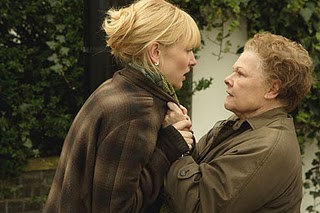
One such thing is to employ Judi Dench in the main role as Barbara Covett, a history-teaching spinster who, with her stone-faced demeanour and acerbic wit, acts as a deliciously enjoyable (and completely untrustworthy) narrator. From the film’s opening, with her schoolyard deconstruction and casually bitter remarks, I was hooked. Her performance remains a treat throughout. Every line is delivered with appropriate timing, and every beat rests exactly as long as it should. For the most part, her face remains weathered yet defiant, the corners of her mouth pointed permanently at the ground; however, as revealed in her diary scribblings, this outward indifference conceals a storm of confused emotions, and as the film goes on they spill out more and more. I don’t want this review to turn into a love letter, but Dench’s command of the character is of the highest order: we know she’s a barking lunatic, and the character developments are expected, yet we rejoice in her presence. Perhaps it’s precisely because Barbara is the kind of person we would studiously avoid in real life that we’re enthralled by her. And somehow, Dench makes us feel sorry for her, and never resorts to car-crash ‘can’t look away’ cheap tactics to get our attention.

Needless to say, the film suffers when she isn’t on screen. Blanchett is good as always, but her “bourgeois bohemia” art teacher just isn’t as fascinating a character. Still, her third act meltdown is a jarring and highly amusing sight from this always refined performer. Then there’s her twenty-years-older husband, a well-written supporting character that, in scenes of high drama, Nighy brazenly overplays until drool flies from his mouth. Everyone in the audience laughed as he screamed at his wife, and I’m convinced that’s exactly what he was going for. Same goes for the stroppy daughter whose previously detached language turns Shakespearean after she learns of her mother’s infidelities; the obese colleague who is the butt of several cruel jokes (in one of the film’s best moments, watch Dench’s and Blanchett’s reactions to her announcement of her pregnancy); and the headmaster who delivers his accusations with considerable relish. Everyone’s in on the joke, and we laugh along with them.

What’s really odd is that this film contains moments of genuine insight, mostly surrounding the meaning of Barbara’s less-than-charmed life. Another writer-director team might have made more of that, seeking to make a film that would leave a lasting impression rather than something uniquely enjoyable but ultimately incomplete. I’m not complaining – I lapped up every minute – but I can’t throw all my weight behind Notes on a Scandal because it is only the sum of its parts. Dench is remarkable, and everyone else does their job competently, but that’s it. There’s not really anything to pore over afterwards; it was all up there on the screen. Plus the film’s origins seem to have held it back. Still, see it for Dench and Dench alone – she’s pretty much as good as we’ll get.

Charade (1963) (R)

IMDb / Taylor
Written by Peter Stone
Directed by Stanley Donen

A different type of film entertainment existed in the middle of last century. It was funny and thrilling, breezy and clever, a classy sort of movie that captivates all who go into the cinema but leaves little to no lasting impact. They were made by people with a love for and great knowledge of cinema – Hitchcock, Reed et al – and they were designed only to keep your eyes glued to the screen. You don’t really see this today. Instead we get shit like Failure to Launch, Norbit and Saw 47, none of which resemble quality film entertainment. But don’t let’s get bogged down in the rubbish polluting cinema screens here and now.

Charade is the most enjoyable example of that classy entertainment that I’ve seen. It has just about everything: danger, romance, double-crossing and witty banter. A great director at the peak of his powers. Three huge stars, and another who would go on to become a legend. A twisting, cracking script, and excellent production values. Everything seems so effortless, but to get so many different aspects working perfectly in sync takes a lot of work, so the people involved were clearly professionals of the highest order.

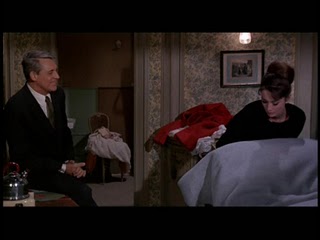
Hepburn plays Reggie, a widow, who is being chased by three men (including James Coburn) who think she’s carrying $250,000. Cary Grant appears to want to protect her, and Walter Matthau’s CIA staffer wants to help her, but who’s jeepin’ who? The plot unfolds at a swift pace, supported by a steady stream of great lines, most of which come in conversations between Grant and Hepburn’s characters. It’s easy to see why these two would rank extremely highly on lists of the greatest movie stars ever (I believe Premiere magazine rated Grant at #1), because their very presence on screen is enough to ensure a contented smile from me. With Stone’s wonderful words to back them up, they create iconic roles which made me wish for an infinite reserve of one-liners and comebacks.

For me, though, the real star is Donen. I always figured Singin’ in the Rain was more Gene Kelly’s show than his, but on the basis of this, he’s a fantastic director in his own right. One could film this script with these stars like a sitcom, and it would still entertain; he lifts it to another level by employing wonderful dollys and pans, and timing each shot just right so that the line gets the biggest laugh. He wasn’t yet 40 when he made this; unfortunately, he became swiftly less active as the years went on.

Aside from not having anything to keep your brain ticking over after leaving the cinema, the only quibble I might have harks back to an earlier point: people like Grant, Hepburn and Matthau are (were) such massive stars that they only really needed to turn up to get the audience on-side. That isn’t to say they don’t do a good job; it’s just that I sometimes wish for real characters when I watch these movies, not another identical performance in that star’s typical groove. I suppose that familiarity was precisely what made them famous and what got them the big roles, but acting has come a long way since then, and someone like Tom Cruise has to work extremely hard just to separate the audience’s preconceptions from the character he’s playing. And quite often, to my mind, he does it.

Anyway, if you enjoy life, see this movie. Two hours could hardly pass more swiftly and enjoyably. That makes it very hard to write about – it’s light entertainment, but made with the utmost precision to mine the most out of the material. All you can do is doff your cap, then move on to the next thing.

‘Babel’ (2006) (C) – A Debate

IMDb / Bradshaw / Lumenick
Written by Guillermo Arriaga
Directed by Alejandro González Iñárritu

What follows is Oscar Yesenin’s take on the film, followed by my response. Something like a debate. This is Oscar’s annual bit of film writing for the site (last year’s being this), unless he decides to do this more often. I enjoy his expletive-laden style, though I do wish he were more focused and comprehensible in his rage. Anyway, I’ll leave it up to you from here.

OY

Babel (Selfish God’s act of giving a people a linguistic handicap. God, you are such a prick)

Ok, what the fuck is happening to the Cannes Film Festival? How could they give this film the Best Director Award for 2006? I am highly disappointed in the quality of the decision made by the judges. Who is the head of judges of 2006 Cannes? It’s fucking Wong Kar Wai! Jesus fucking Christ! Check the name of the other members of the jury: Monica Bellucci, Samuel L. Jackson, Tim Roth!!! They should know what good films are; 2006 must have been the shit year of films, if Babel could come up this high. Or, Cannes is just turning into another Academy Award kind of shit-fest. Trying to exploit the profit for US, money grabbing assholes. No morals, more cash.

I’ll just give you a quick review of this film because there is not much to talk about. Babel is plus average film, because it’s really weak in overall quality, especially in character development, while some of the cinematography in the film has something worth looking at. Thing is, at the end of the film you’ll feel like, “So what?” Because there is really no meaning in the film. You don’t feel you learnt something or had your way of thinking challenged. Every issue raised in the film is so shallow, not deeply engaged as a part of the film. It scratches the surface of the problems, like just reading the newspaper headline, but ignoring the content of the article. It is not open-ended or ambiguous; it is just a lump of issues dumped in the film. Examples: drug issues, stereotypes (Edward Said’s theory of Orientalism), human ego, physical handicaps, border politics and many others. Just like, ‘here is the topic’ – that’s it, nothing else. This is not being ambiguous or open-ended; it is just being an undecisive motherfucker. The director doesn’t even give us his thoughts about the topic, it’s just being used within the film for no real good reason or to argue any case.

Take, for example, the use of Moroccan hash in part of the plot of the film to get a patient relaxed (by the way lots of the hashish in Holland is imported from Morocco, apparently it’s good shit), ‘so what?’ What are you trying to tell us? Weed is good in some uses? Anyway, it’s used very badly in the film, since patient was having a sort of panic attack before taking the grass – in reality if you take hash in that kind of condition, it could really give you a very bad trip and cannot be recommended. Sure, it can be used as a painkiller, but does more harm than good mentally. There’s other shit like this all the way across the film, this is just one example; you just don’t understand what the director wants to say with his film. Does the director try to incorporate Edward Said’s theory of Orientalism for stereotyping (‘Middle East = Terrorist country’ or ‘Arab = terrorist’) within Western cultures in the film to give an example to the audience? There are lot of ways to talk about film theory in any films, but if the director does not make a strong point within the film, either by using filmic language or plot, it just becomes a lump of shit.

The film shows us a series of characters making critical mistakes. (Fuck-ups beyond common sense, which fucks me off. In a way the film did provoke me, but it’s fucking pointless. They do this, they do that, here’s the outcome, The End.) As the film progresses their mistakes just get worse and worse. The film highlights the shadows of human behaviour, however it does not get into detail. It becomes like a shopping list of the fuck-ups you can do in critical situations. A few parts in the film tried to put themselves into an Italian Neo-Realism form of plot, to try to highlight the realism in the film and to be open ended, but it just does not work. They needed to choose either Art film or Art House film, you can’t be both ways because they contrast each other. That is why they’ve been differentiated into different categories. Anyway, the plot is very dramatic, so there is no way that this film could be manipulated into Neo-Realism form. The film failed to incorporate the details in filmic language within the mise-en-scene. It talked about light and dark, but it is very grey. Cannot say it a good film or a bad film, just a disappointment.

Oh – the film also used the same piece of music used in The Insider called ‘Iguazu’ by Gustavo Santaolalla. Iñárritu somehow decided to use this music in a similar way to how it was used in The Insider. It is not creative at all and I don’t think it’s a homage to Michael Mann either; it’s just a rip-off. Also I don’t get the significance of the title… Babel: ‘Sound of many voices talking at one time, especially when more than one language is being spoken’, yeah many other films are like that too. It’s just ironic that this film needs more filmic language though. It’s lazy, couldn’t be fucked thinking of a good title. What happened to those days with long-ass, thoughtful and original titles? Now film titles are so simple and most of the time meaningless.

Fuck it, I’m going to sleep.

BHM

Thanks for that explosion of innards, Oscar. I can’t say understand all of it, but I get the gist, and while I have similarly low opinion of the film to what you do, it’s largely for different reasons. You see, Oscar is a film academic, so he views things differently to an amateur like me; still that doesn’t make him right.

First of all, there is meaning in the film. It’s a clear attempt to make viewers see the similarities between our many disparate cultures, despite the obvious differences on the surface (the most influential being language). He called it Babel after the Tower of Babel, collective humanity’s Biblical attempt to build a tower to the heavens which God swiftly smote and, to drive home the point, messed up our common language so that we spoke in all different tongues. Iñárritu wants to show us that our distrust of each other – especially those from different cultures – is keeping us from reaching common ground. The whole movie is summed up in the look on Brad Pitt’s face as he looks at his long-suffering guide and translator, just before he gets into the helicopter. It’s a look that shows a connection has developed between them, but knows he worked against making that happen, and… oh, a whole lot of other things besides. It’s only a couple of seconds, but it is perfectly acted, and if the whole movie had been that clearly focused it would’ve been the masterpiece it ought to have been.

Second, what’s all this shit about categories of film? This is why I am so distrustful of academic writing on film: the need to categorize everything devalues the entire art. What’s the point of arguing whether the film is an ‘art’ or an ‘art house’ film? What’s the fucking difference? Do me a favour, man – it’s a ‘film’, that’s all, and should be discussed on its own terms. Of course it’s reasonable and helpful to look back at films that cover similar filmic or thematic ground, but dumping on it by saying the filmed it in the wrong category seems incredibly foolish to me. Of course, this has nothing to do with the film itself, only with your reading of it. Maybe I’m wrong, who knows? As it is, I disagree strongly with you.

One place I agree is in your disbelief at the character motivations, or lack thereof. Seriously, this is the movie where endlessly ridiculous actions are taken and you just stare at the screen, mouth agape, wondering why the bloody hell did they do THAT? Gael Garcia Bernal’s character is the major anomaly, a walking plot device so obvious he may as well be in the theatre, tapping each patron on the shoulder and explaining to them what’s going to happen next. A shopping list of fuckups? Great line, and 100% the truth. I was also kind of pissed when ‘Iguazu’ came on the soundtrack, because all it did was remind of how good The Insider was, and how shitty Babel had become.

What Oscar failed to directly mention is how much of a mess the script is, especially in the managing of different storylines. It’s all balanced out, with each plot strand taking up about the same amount of time, but each one would’ve been much better as its own film. This is from Guillermo Arriaga, who had proven himself one of the most deft storytellers in the current scriptwriting ranks with previous works, but now must be questioned as to his versatility. Babel is more or less a crash between Amores Perros, 21 Grams and The Three Burials of Melquiades Estrada, without the dramatic resonance of any of them. If you short-change your characters in a film like this, then you lose control of the movie, and it ends up a gelatinous mess.

I don’t mind saying the Japan-set stuff is actually pretty strong, and if it had been a 90-minute stand-alone film I probably would have liked it a lot. As 40 minutes in a 140 minute film, however, it is underdone, offering only glimpses of what it could have been. That’s the story of the whole movie, though. For every great facial expression from Pitt, there’s Bernal’s decision to step on the gas. For that amazing club sequence, there’s Barraza wailing around the desert having inexplicably left the kids by themselves. Yeah, what an incredible disappointment. Babel doesn’t allow itself to be hated because there are so many strong elements, but I can’t get behind a film that knows what it wants to say but doesn’t know how to say it. Most of the positive reviews out there were written, I suspect, by people who filled in the vast gaps for themselves. Me, I’m happy to think about that stuff, but I’m not going to give the film any credit for what I come up with.

2006: Good Movies (10-1)

At this point I must mention what films I didn’t get to in 2006 that I would like to have. This is in accordance with Andy Horbal’s much-referenced best-of lists critique (embraced by Jim Emerson among others). My writing isn’t yet strong enough to get behind everything he says, so my list is more description than discussion; next year I’ll no doubt be more adventurous and confident.

So: A Scanner Darkly and Fast Food Nation were two new films by Richard Linklater, one of my favourite directors. His failures are more interesting than most directors’ successes, and when he gets it right, his work is like nothing else (see Before Sunset).

Likewise, I missed Michel Gondry’s two releases, The Science of Sleep and Dave Chappelle’s Block Party, which I chastise myself over because Eternal Sunshine of the Spotless Mind was so good. How would he do without the safety net of Charlie Kaufman’s great screenwriting? I’ll have to find out later.

49 UP and Jonestown: The Life and Death of Peoples Temple were the documentaries I most regretted missing. As you can see from my list (and last year’s), I consider documentary cinema to be on equal footing with fiction, and as Hollywood’s outlook seems to change for the worse every year, the growing popularity of documentaries is a wonderful side effect.

Finally, I probably ought to have seen Casino Royale, Flags of our Fathers and The Squid and the Whale. And there’s probably a hundred other films that were good that I didn’t really know anything about. Instead, I saw a few twice (#2, #3, #5, #10). But with that out of the way…

10. Children of Men – Alfonso Cuarón
The Mexican director/cinematographer pair of Cuarón and Emmanuel Lubezki turned my world upside down with this, the most groundbreaking film of the year. I’ve never seen anything like it; I would liken it more to the computer game Half-Life 2 than anything seen before in cinema. And that’s a huge compliment – it is a very good game, but my point is that this film is arguably the most immersive ever made. A script that is excellent in places and incredibly weak in others is totally overshadowed by some of the most incredible long takes and set pieces we’ll see for a while, and they all contribute to a sense of being part of the action. It’s also set in a childless future where anarchy mostly reigns, and it features fine acting from Clive Owen and Michael Caine among others. The film that surprised me most this year, but don’t I wish it could have ended differently.

9. Munich – Steven Spielberg
Bursting through almost unprecedented media attention (no small thing given Spielberg’s often controversial and extremely well-examined career), this film showed itself to be nothing like the defamatory, politically driven piece of work that was written about by so many. Perhaps because of this, it seemed to be somewhat overlooked by many, where in fact it may be the best film of Spielberg’s illustrious and varied oeuvre. A long, expansive film, it was Spielberg at his best in all facets of the craft: visually superb, great use of music, perfectly paced, and a great example of narrowing a wide focus down to one simple thing – the effects of the events in question on one man. Many questions were asked of us, many challenges laid down, and one could not help but leave the cinema in deep thought.

8. Waves – Li Tao
Certainly the least seen film on this list, Waves deserves as wide an audience as possible. It is very much a New Zealand story, but its scope is truly global. Boundaries are breaking down, and in her chronicle of four Chinese high school students being educated in New Zealand, Tao gets inside their experiences so intimately that we feel as if we know them personally afterwards. They are all very different people, and we understand why they live their lives as they do. Never ‘messagey’, never forced, this film will strike a chord with all who see it, because it offers a way of seeing that acknowledges cultural differences and shows how we are all similar. A vital, thought-provoking work.

7. Enron: The Smartest Guys in the Room – Alex Gibney
I saw this right at the end of the year on DVD, and I just thought, wow – documentary perfection. The subject matter is fascinating, the talking heads insightful and passionate, the music expertly chosen, and the archive footage perfectly edited into place. It all adds up to a masterful blow-by-blow account of just what made the Enron debacle one of the most incredible events in Wall Street history. It’s a parade of scum, low human beings who knew they were fucking over millions and just laughed about it, even as they kept the public outlook positive. It would make a fine double bill with #6 – two films that expose the hubris and sheer audacity of some of our most powerful members of society.

6. Good Night, and Good Luck. – George Clooney
No messing about from Clooney on this, his second feature, which heralds a very encouraging future behind the camera. Respect for the audience is paramount as this straightforward, free-flowing films moves quickly through the story it has to tell. And what a story, especially in these times of pandering and dishonest journalism – much of the dialogue is directly taken from what the real people said, but their words are clearly chosen to reflect our current climate. Shot in glorious black and white, and enlivened by great acting by all (especially David Strathairn’s amazing performance as Ed Murrow), this is a finely orchestrated, highly enjoyable film. If it had been a bit longer, I might have placed it higher.

5. Tristram Shandy: A Cock and Bull Story – Michael Winterbottom
Not quite as flat-out enjoyable as the director’s earlier 24 Hour Party People, this was still one of the funniest movies of the year. More than that, though, it was one of the better films about films, a look at how absurd film sets really are. It is rambling and unfocused, like its predecessor, but the characters – from Steve Coogan and Rob Brydon hilariously playing themselves, to Naomie Harris’ passionate PA, to Mark Williams’ enthusiastic battle expert, to Elizabeth Berrington’s fragile costume lady, ad infinitum – are so well-drawn that you just slip straight into their world. Almost like real life! It helps if you love movies, but their ought to be something for everyone here.

4. Syriana – Stephen Gaghan
The one film of the year that had my brain in a total storm afterwards, I really, really need to see this again – it’s been almost a year. Each time I look back on it, my admiration grows. I had no idea how to write about it then, and I still struggle to have any coherent thought to express. It drops you right in the characters’ world without any preparation – the opening bombing set piece is masterfully executed, and sets the tone for the whole film – and throughout you feel one step behind, just as the characters invariably do. It’s like nobody connected with oil knows exactly what’s going on; many can see one small part of the picture, but never the whole thing. Either that or the people that can see it all are exploiting for all it’s worth. Like I said, I’d have to watch it again to make any sound judgment on it, but such daring, urgent filmmaking as this has to be encouraged.

3. De battre mon coeur s’est arrêté – Jacques Audiard
More excellence from one of France’s strongest filmmakers currently working, The Beat My Heart Skipped was probably my favourite film of the year (though obviously not quite the best). Like with his earlier (and slightly superior) Sur mes lèvres, Audiard places us in the utterly subjective film universe of Romain Duris’ Tom, a nervy, tension-filled ‘real estate developer’ looking to go straight by getting back into classical piano. Brilliantly, it is shown that practising the piano is a far more infuriating and spirit-crushing enterprise than beating up thugs for collection money. Alexandre Desplat’s score is great as usual, especially alongside the Paris dance-pop that is almost always in Tom’s ears. The epilogue will alienate many, but I thought it put the perfect full stop on an exhilirating and fascinating film.

2. Caché – Michael Haneke
Haneke’s latest assault on his own class is a clinical, endlessly debatable work that, like everything else he’s done, is deliberately designed to provoke. He doesn’t care if you walk out pissed off, upset or suicidal, as long as you have a reaction. And you will. What were they saying in that final shot? Should we feel sympathetic towards or disapproving of Auteuil’s character? The questions didn’t stop for me; in fact, I saw it twice to see if I could ‘get it’ on a second viewing (I didn’t). Afterwards, I felt manipulated like a patron at a magic show, but I’m damned if I wasn’t awed. This guy is in total control, and his brand of unsettling cinema is something I will return to again and again.

1. United 93 – Paul Greengrass
In the ultimate year of challenging, questioning cinema, United 93 outstripped everything else with its raw intensity. Instead of asking questions, it just laid the events bare and let you question things yourself. I was incredibly distressed by it, particularly a final shot of such horror and audacity that I am wary of seeing it again. There are no hidden agendas; this film is about nothing more than the events that occurred on September 11, 2001. No room for proselytizing or polemic here, just cold, hard facts. Many saw this as signifying a lack of meaning, a kind of needlessness; me, I thought it showed how Greengrass nailed our feelings by cutting through the hype and emphasizing how purely bloody frightening the whole thing was. Imagine being in that plane! Now you don’t have to. A staggering achievement.

2006: Good Movies (20-11)

Because I live in New Zealand, and better yet, in the South Island, I get to see most films between 3 months to a year after their original US/UK release. As a result, several films on this list appeared on many US critics’ 2005 lists, and the films appearing on their 2006 lists will have to wait until next (this) year for me.

Not that I’m complaining. I saw more movies last year than probably any other year in my life, and I enjoyed a great many of them. For the first time, I kept records of what I saw, which ended up tallying around 150; between 30 and 40 of these were at the movies. For me, there’s no better way to spend my disposable income than to go to the cinema, and I am totally unrepentant about that.

On with the list, anyway. I saw enough to have a top 20 instead of a top 10 this time, so I’m splitting in half to make it more digestible. Also, I’m counting down rather than up, because I find that reading someone’s top choice first renders the rest of their list less interesting. Part 2 will appear sometime in the next couple of days.

20. Manderlay – Lars von Trier
More straightforward and less challenging than its predecessor, the excellent Dogville, von Trier’s latest brash critique of human nature is still a difficult film to wrap one’s head around. Like all his films, it is designed to bring about a reaction in the viewer, be it positive or negative; he wrings this from us not with subtlety, but with tremendous insight. Many would consider this a pack of lies and a waste of time, but I think he got it right again: we are weak in more situations than we are strong, and racism, especially views of one’s own race, does not die out.

19. The Aristocrats – Paul Provenza
Dozens of comedians tell their own variations of the world’s filthiest joke, and in doing so provide us with a few of the mechanics of what makes something funny, and/or offensive. I expected a good laugh, and it gave me that (once I’d settled into the baseness of it all), but there was also a strong awareness that most of these people were very intelligent as well as highly amusing. They knew exactly where to insert beats, when to take it further, when to cut it off. A fascinating and hilarious film.

18. L’Enfant – Jean-Pierre & Luc Dardenne
Silly young Bruno deserved none of our sympathy, but the Dardennes forced it from us without resorting to any kind of cheap cinema trick. He’s just a kid, after all – a kid who went out into the world too soon, who had a child too soon. This Palme d’Or winner at Cannes in 2005 is an intimate, unsentimental account of one very naughty boy’s actions and desperate attempts to make amends, and I was moved by its simple truths.

17. The Queen – Stephen Frears
Frears has directed a great variety of good films over the years, from to My Beautiful Laundrette to High Fidelity to Dirty Pretty Things. He did it again here, but Helen Mirren was the reason for going with her pitch-perfect performance. All the sternness and unshakeability was there, but in the film’s best scenes, so was a vulnerability we couldn’t imagine HRH QEII displaying in public. In particular, the scenes involving the stag stood out in a film that did the basics right – a good (but not great) script, adequately directed, with fine acting across the board.

16. Darwin’s Nightmare – Hubert Sauper
Helplessness was the key word here in one of the most depressing, spirit-crushing films ever to be made. It is important that people see films like this to have their eyes opened to the horrors still going on in parts of the world – things we can’t imagine in our First World cocoon – but when it ended, I felt impotent. What could I do to help someone like Eliza, the prostitute servicing foreign fish-plane pilots (who are often violent) for a dollar a trick? What could I do to give the fish-frame sellers a better go at life? Sauper wisely doesn’t offer up any solutions, because no doubt he’s just as clueless; still, he’s getting the word out there.

15. An Inconvenient Truth – Davis Guggenheim
For the first time in nearly 40 years as a movie reviewer, Ebert told his readers “you owe it to yourself to see this film”. And he’s right. Half of it may be a vanity project for Al Gore, but the other half is so vital and surprising that if you do not see it, or are not aware of the things it discusses, then you are taking the future for granted when you should not be. The effects of global warming are real, and we have to start doing something about it, now. Gore is a good speaker, and his high-budget presentation is worth every penny if half the people that see it change their views.

14. Out of the Blue – Robert Sarkies
I’m somewhat embarrassed to say that I only got to two New Zealand films this year, skipping River Queen, No. 2, and Sione’s Wedding among others. This was the second, a vast improvement on Sarkies’ earlier Scarfies, and a solid entry in the Paul Greengrass-led documentary fiction genre. Through a few brilliant shots, Sarkies shows how much of a wake-up call the Aramoana massacre was, subtly embracing the bigger picture while carefully portraying the events in chilling fashion. Non-professional Lois Lawn gave one of the performances of the year as 73 year-old Helen Dickson, one of the heroes of the real event; Karl Urban was bloody good too, showing there’s life after Doom.

13. The Proposition – John Hillcoat
The best Western in years, driven by Nick Cave’s poetic screenplay and music, and by Guy Pearce’s typically excellent less-is-more performance. The film meanders aimlessly at times, but that is offset by the impressiveness of some scenes, and by the overall look and feel Hillcoat and his team achieve. Its stripped-back nature worked in its favour, keeping things unmuddied by unnecessary plot elements, but always retaining a sense of something extra going on (as indeed is revealed in the final scenes). Also, it represented the beginning of my fascination with Danny Huston, who seemed to pop up in every other film I saw last year.

12. Miami Vice – Michael Mann
If your name is Michael Mann, you don’t need a good script. Collateral had an okay script which Mann enlivened with his new-found love for digital video and general badass-edry; Miami Vice was a shitty, even awful script which he managed to fashion into one of the most intriguing and thrilling films of the year. Again using Dion Beebe’s incredible DV, he crafted a lengthy atmospheric piece that barely hung together plot- and character-wise, but when the atmosphere is that thick, I don’t care what’s going on. It was a true triumph of style over substance, like Kill Bill, or as I will discuss in part 2, Children of Men. In particular, it had the most artful violence of the year.

11. Brokeback Mountain – Ang Lee
A fine tragic love story, free of pretension or sentimentality (apart from an occasionally grating score). Heath Ledger’s performance won all the plaudits, and excellent though he is, I say don’t overlook Jake Gyllenhaal. Both commit themselves to their roles completely, and their scenes together (of which there are less than I expected) are by far the strongest in the film. Rodrigo Prieto provides his usual high standard of cinematography, but it’s very much Lee’s film with its careful compositions and thoughtful, meditative pace. You think you ain’t never goin’ to see a movie about no queers? Watch this, and be surprised at how much you care.

2006: Music

Similar to last year, here are 13 new albums I listened to this year, in order of most appreciated to least appreciated. I am laughably inept at this sort of writing, but I’m putting it down in the hope that someone will listen to something new because of it. If you prefer, just scan down the list.

1. Night Ripper – Girl Talk
Mashups are becoming more and more popular, and Gregg Gillis (aka Girl Talk) might just be the man to bring them into the mainstream. I heard that he’d made an album containing samples from hundreds of different songs from the 60s to the 00s, but I got it more as a curio than anything else. The mashups I’ve heard in the past have occasionally been worth repeat listens, usually drab (though clever) after you’ve played it once. Night Ripper is a lot more than clever, though. It flows seamlessly from one sample into the next for over 40 minutes, layering them on top of each other, slowing them down, chopping them up, and sometimes using two or three conjunction to create some sort of delicious irony. In my head, all the samples contained within will forever be associated with this record, even the ones that I knew and loved before hearing it for the first time. It’s fresh, it’s now, it’s great.
Favourite track: 03 – Hold Up. It isn’t right to play favourites with an album that continuously segues (and that I can only listen to all the way through), but if there’s one track that best demonstrates Gillis’ ability to throw seemingly disparate sounds together and make them sound like they should have been heard that way before, it’s this one.

2. Return to Cookie Mountain – TV on the Radio
Into my African-American section now, and first up are the Brooklyn rockers TV on the Radio. This is somewhat less experimental than their excellent debut Desperate Youth / Bloodthirsty Babes, but it is a better record because of its more focused sound. While there’s nothing as spectacular and unusual as that earlier album’s Staring at the Sun, there’s still plenty of messing around. There’s nobody else that sounds like these guys, truly; combine that with lyrics as poetic as anything creeping its way into the mainstream, and you’ve got pretty much my favourite musical group of the moment.
Favourite track: 02 – Hours. The shortest and most straight-ahead track on the album – I love it because it provides the best vehicle for Tunde Adebimpe’s incredible voice and songwriting ability.

3. St. Elsewhere – Gnarls Barkley
DJ Danger Mouse topped my list last year by producing Gorillaz’ Demon Days, and he came very close to doing the same again in 2006 with this effort. Another I have to listen to from start to finish, DM and Cee-Lo Green’s first collaboration doesn’t really sound like rap, or rock, or pop. Yeah, I like things that are different and defy categorization (which is mostly fruitless with music anyway). Crazy was the song of the year and possibly decade, something so odd yet soothing as to captivate me whenever and wherever I hear it. If anything’s wrong, the album is very short at just over 37 minutes.
Favourite track: 02 – Crazy. Definitive.

4. Food & Liquor – Lupe Fiasco
Setting aside the absurdly self-indulgent namedrop-fests that are Intro and Outro (‘outroduction’ isn’t in the dictionary anyway, rappers take note), Lupe Fiasco’s debut was what Kanye West fans such as myself turned to this year to provide them with their hip-hop brilliance. Every track is catchy and innovative from the first listen, and lyrically he’s almost as smart as West, rapping about subjects more of us can relate to – particularly on the Kick, Push tracks. There’s no clear theme that runs through it all, but pretty much every track from 02 to 15 has wizardry of some kind.
Favourite track: 15 – Kick, Push II. Came a long way from dirty ghetto kids, yeah.

5. The Warning – Hot Chip
NME named Over and Over as the track of the year, and I’ve to agree it’s not far off. I was enamoured with it immediately, being as it was the most catchy song I heard all year, but it took me a while to warm up to the rest of it; once I did, I discovered something I liked very much. They’re a pop/electro mixture that is unusual yet strangely relaxing to the ear – often seemingly unstructured, but always knowing where they’re going. I have since obtained their first album, 2005’s Coming On Strong, which is of similar (though less daring) quality.
Favourite track: 11 – No Fit State. The darkest and most introspective on the album, with a driving beat/synth mix that you can’t shake from your head, and lyrics that will either delight or frustrate (in my case, the former).

6. Peeping Tom – Peeping Tom
Whether or not you’re a fan of Mike Patton (Faith No More, Mr. Bungle, numerous other projects) shouldn’t matter in this case. It’s pop music as he’d like it to be, and it has a dirty, grimy feel that appeals to me very much. Each track is a collaboration between Patton, with his unmistakeable glam metal voice and unique musical innovations, and a different well-known musician or group, ranging from Amon Tobin to Massive Attack to Norah Jones. Despite that, it’s consistent all the way through, and there’s no real dead weight.
Favourite track: 11 – We’re Not Alone (Remix) feat. Dub Trio). I love a good closer, and this is a very good one – it stands alone just fine, but gives extra coming at the end of all the other tracks.

7. Taiga – OOIOO
Definitely the oddest thing I branched out to this year, this is the fifth album from Yoshimi P-We (subject of The Flaming Lips’ most well-known album) and her fellow female experimental punk rockers. I gave it repeat listens solely on the strength of the opening track, UMA, which had the most kick-arse drumming of any song I heard this year; as I got to know the rest of it better, it began to resemble something more interesting than a rack of confused sound. I wouldn’t say I love it, but I certainly enjoy and admire it a lot more than I expected to.
Favourite track: 01 – UMA. More than anything else this year, I’d love to see this performed live.

8. Confessions on a Dance Floor – Madonna
Yeah, I can’t believe it either. Lyrically she’s worse than ever (“I don’t like cities, but I like New York / Other places make me feel like a dork”), but das Queen of Pop reinvents herself better than anyone else. I never thought she’d do anything better than 1998’s Ray of Light, but she topped it pretty comfortably with this no-mucking-about dancehall extravaganza. It flows better than anything else this year except Night Ripper, and whoever she’s got producing now really knows how to churn out a good synth hook.
Favourite track: 02 – Get Together. Chosen as the third single; I particularly love the way it segues out from Hung Up, into this, then into Sorry.

9. Tropicalia: A Brazilian Revolution in Sound
This was my introduction to Brazilian music, and it’s great. Os Mutantes, Gilberto Gil and Caetono Veloso are now names that will always prick up my ears when heard. I don’t think it’s cheating to put a compilation on here, especially when everything on it is good and quite alike-sounding.
Favourite track: 05 – Alfomega – Caetano Veloso. Supposedly the man is reviled by some in Brazil for his general pretentiousness, but he makes interesting music, so he gets a pass from me.

10. Scale – Herbert
Politically charged electronic music from the man who, from his lofty perch, looks down on anyone who uses non-original samples. He doesn’t fit well on a list that has Girl Talk sat at the top, but he’s always done pretty good stuff, and there are some very interesting tracks here. Unfortunately, there’s an equal amount of filler; he doesn’t seem imaginative enough to produce consistently intriguing music. Definitely worth a look for the standouts, though.
Favourite track: 01 – Something Isn’t Right. Extremely catchy, and vocally superior, anti-war / anti-Bush / anti-Blair / anti-establishment track – one of the best on any album on this list.

11. Black Holes & Revelations – Muse
Everybody’s favourite hilariously overblown rockers (or, as Ed would say, metallers in popular disguise) returned with another ‘more-is-more’ effort this year. I like Muse a lot, but I’m not getting behind any of the critical acclaim for this album, and certainly not for the much-vaunted second single Supermassive Black Hole. There are some very good tracks, as always, but as a whole it’s a pale imitation of Absolution or Origin of Symmetry, and a little way off the quality of their debut Showbiz. Matthew Bellamy remains, however, one of the most talented musicians working today – he is Muse.
Favourite track: 02 – Starlight. For a change, they toned their WORLD IS ENDING shtick down a bit here, and it worked wonderfully.

12. Half These Songs Are About You – Nizlopi
I listened to this on the back of the delightful JCB Song and its great video; the rest of the album is mostly not up to much, except for a couple of very good tracks. This is the sort of music I thought could be very, very successful, that inspired-by-Coldplay brand of wailing and gentle orchestration that everybody seems to love. Nizlopi haven’t hit it big yet, but they may yet do so; if they do, I will applaud respectfully, but with reservations. One thing the singer does extremely well is use swear words: sparingly, startlingly, in a way that makes you sit up and pay attention.
Favourite track: 08 – Freedom. A good song for feeling unhappy to; actually, just a good song.

13. The Hardest Way To Make An Easy Living – The Streets
After two masterpiece albums about generally being an average yob, Mike Skinner turned to his now massive fame and fortune and tried to make it funny and interesting to us, his adoring listeners. Bzzt! No good, mate. It isn’t that his rhymes and flow have dried up; the stuff just isn’t nearly as inherently interesting, and it’s barely half as clever as what he’s put out before. On top of that, the hooks and beats are much more dull. File under ‘disappointment of the year’, apart from a couple of lights in the gloom. Hopefully he makes amends next time by returning to what he knows best.
Favourite track: 01 – Pranging Out. Falsely heralds the album as being as excellent as its predecessors, but the poorness of what follows shouldn’t distract from the fact that this is one fine track.

That’s it. Artists/groups that I discovered for the first time this year, but who did not release albums in the same year, included NoMeansNo, Modest Mouse, The Bravery, The Wrens, Benjamin Diamond, Masters of Reality, Hüsker Dü… and モーニング娘。Don’t laugh at me; I was once like you.

Children of Men (2005) (R)

IMDb / French / Cossar
Written by Alfonso Cuaron and Mark Fergus & Hawk Ostby and Timothy J. Sexton & David Arata
Based on the novel by P.D. James
Directed by Alfonso Cuaron

There’s kind of a rule when it comes to screenwriting: the more writers collaborate on a screenplay, the lower the quality of the finished product. Point of trivia: the use of an ampersand (&) in screenwriting credits indicates collaboration, while the use of the complete word ‘and’ indicates a separate re-write. I’m not even sure if what I’ve used above is correct here – I’m just going by what Yahoo! tells me – but if I’ve got it right, that’s a minimum of three separate writes and re-writes for this script. So, it must be rubbish, right?

Yes and no. Yes, the screenplay for Children of Men is loaded down with plot holes, contrivances, out-and-out stupidity and a large degree of overwrought (usually religious) symbolism. No, because if a poor screenplay can attract a good director, gold can still be spun. It was the case with Miami Vice – Mann’s script was crap even before Jamie Foxx forced him to change half of it – and it is the case here. Cuaron’s direction is better than good – it’s great, and most surprisingly, it offers something almost completely new in cinema.

It’s not unusual for directors to indulge in long takes: extended, carefully choreographed and skilfully created shots that make what is happening seem all the more real. But in scenes of high action? Almost unheard of, especially these days when you’ve got films like Batman Begins preventing you from seeing anything in the fight scenes because of their 0.1sec average shot length. Here, Cuaron has his most thrilling sequences play out in shots of up to four or five minutes in length, and the plight of his characters takes on such an immediacy that when the camera moves into an unprotected place, we fear for it as we fear for the characters. He cheated by patching shots together to make them look like one – this is obvious in at least two places – but it’s still remarkable, and never loses its novelty or impact.

So, as we check off more boxes on the hokum list – animals love hero, Mary-figure draped in old cloth, a boat to salvation called ‘Tomorrow’ – we are forced to put the clipboard away and marvel at what’s being shown up there on the screen. Likewise, as advantages materialise in front of our hero, we don’t really mind because it all feels so real. (Occasional comment poster Helen Back would disagree, but ignore her if she pipes up, even though she’s partly right.) Kudos must be extended at this point to the excellent work done by the cinematographer and production design team, because they create a vision of the future which is at once believable and nightmarish. Wisely, they add little to what already exists today, instead concentrating most of their efforts on what would be missing.

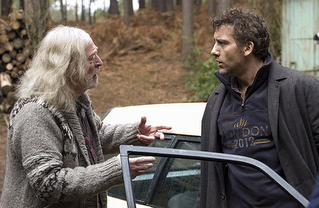
Praise also be to Clive Owen, who gives his most complex, wide-ranging film performance yet. I’ve never been quite sure what to think of him because he always seems kind of flat, like he’s just playing himself, but he uses everything he has here without making it look obvious. It would have been so easy to drift into caricature, being as his Theo is the classic put-upon hero, but with his stumbles and swearing he crafts a unique screen character. (I really love it when film actors can swear well repeatedly; I think it’s a great sign of quality.) The supports are good too, especially Michael Caine as a Steve Bell-type with a great taste in music.

Children of Men is a strange beast, then. Like so many films, the greatness of some aspects (direction, cinematography, design) fights tooth and nail against the crapness of others (screenplay, screenplay, screenplay). However, unlike most of these films, the greatness wins out over the crapness for a change! Seeing as Cuaron was heavily involved in the writing, he doesn’t deserve all-consuming praise, but as a director he’s produced some of the best work on offer this year. Forget all the bullshit flying around the story, and watch it for the darkness (and dark humour) that drips off the screen.