PEOPLE SAY I’M BIGGER FOR WALKING THIS TOWN

This week I ordered a pizza over the internet. Big whoop, you say. Anyone can do that. Yeah? Go to the Domino’s website and try. Seriously, try it: go through everything, right up to the final click to confirm the order, and see how far you can get. (If you can read and understand Japanese, well, don’t.)

This isn’t really a big deal in and of itself – I figured out a few online forms with the help of a character translator (called Rikaichan, an incredibly useful tool if you have to visit websites written in Japanese), and got a greasy dinner. However, it’s an important boon for my confidence. I’ve been here nearly five months now, and I still haven’t been to a post office, or bought clothes, always doubting that I could communicate to the extent required. But here, I managed to communicate with a machine that only understood Japanese input. Surely, then, communication with a shop assistant would be less of a challenge?

My point is that I haven’t tried things in Japan purely because of a lack of confidence. Life here is very easy if you stick to the basics: supermarkets, convenience stores, the train system. You really could live here a long time without actually learning how to speak Japanese. That’s not good enough for me, though – I mean, the whole point of coming here was to be challenged in my everyday life, and it’s like I’ve erected a barrier around me to stop that from happening. Not anymore, though! The pizza may be just as greasy, stodgy, and regret-it-afterwards as back home, but with it at my side I shall conquer all!

***

Let’s keep talking about food – I went to a shabu-shabu restaurant for the first time on Friday. It’s something that I’ve wanted to try for a while, one of those cook-your-own type deals with boiling water on the table and an array of raw ingredients you dump into it. The place was Imahan in Asakusa, an apparently quite famous restaurant with appropriately famous prices (thank Christ for lunch menu deals). It was, to quote Henry Rollins, really fucking good. Fresh, delicious beef and veg, tasty sauces, good noodles… worth the $40, absolutely.

We then went to Kamiya, an incredible and widely-known bar, which was more like the dining hall at school than any other bar I’ve been to. As we walked in, an older gentleman called to us across the busy room and motioned for us to join him. My companion said we shouldn’t, citing some rubbish excuse about him being drunk and this area being a Yakuza stronghold. Bah. We had enormous beers that were a struggle to finish, then staggered home.

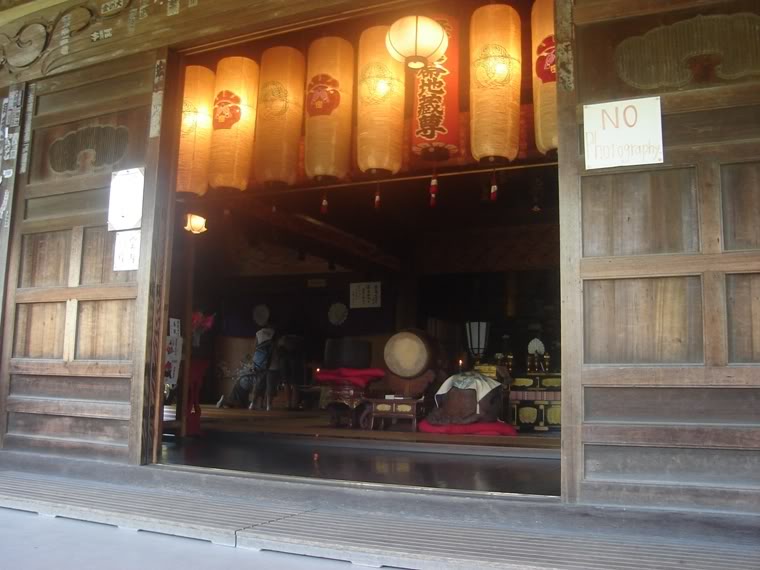
It was a day full of ‘here I am’ moments – like, this is Japan, and I am in it, I made it here. Standing before the massive gate at Asakusa shrine, shabu-shabuing at Imahan, looking across the Sumida River to the bizarre Asahi building… I’m in the foreign country, and things are all foreign, and I’m really enjoying it.

TODAY WAS A GOOD DAY

Somebody in Japan had this wonderful idea that there should be at least one public holiday every month. At the moment all that misses out is June, so this means we have wonderful holidays like Marine day and, this past Monday, Respect for the Aged Day. There’s also the Autumnal Equinox and Health and Sports day coming up in the next three weeks, so it’s all coming up sunshine and roses.

As a result, I decided to do something different and go out on Sunday. I was on the train to Shibuya, listening to Dreadzone, when an elderly couple came and sat down either side of me. Normally this wouldn’t be anything special, but the fact that chose those seats over several pairs of adjacent seats in the carriage told me I should prepare for some light conversation. Sure enough, they both leaned around and front of me and hit me with all the English they had.

Nice cellphone! Which cellphones are better, Japanese or Western? Are you from America? Is today your day off? Etc. Of course it wasn’t as grammatically correct as all that – just “today day off?”, for example – and there was plenty of Japanese vocab sprinkled in too, but I could understand and I responded to all their queries with civility. Half the people in the carriage were giggling uncontrollably to themselves; I’m sure the sight of a very tall gaijin being accosted by a typically earnest old couple was a hilarious sight.

After a while they got off, and I was able to return to my soothing, unchallenging music. Upon reaching Shibuya, I soon learned it was the day of the local matsuri. I’d never been to one of these before, so you can imagine my excitement. Teams of shouting, grunting people were carrying heavy mikoshi up and down the closed-off streets and, by the looks of things, having a lot of fun. What I’ve heard is that basically it’s one long day of drunkenness with alcohol flowing beforehand, at several stops during, and long into the night afterwards. I don’t know whether that makes hauling these things around in the brightness and heat easier, but most people seemed to be enjoying themselves.

Several hours and a bottle of shochu later, we picked up and headed off to a club called Womb. I tell ya, I never thought I’d happily pay ¥3500 (around NZ$40) just to enter a complex of darkened rooms, but there it was. It was AMAZING. There was the thumping electro/house, the laser lights glowing over the crowd, the dry ice turning people more than five feet away invisible… the atmosphere was perfect. Most of all, it really felt like everyone was there to have a good time, which gave the unusual effect of a jam-packed dancefloor filled with happy people. Unusual, because back in NZ, you couldn’t have that without the requisite pushing and shoving. Here, everyone was just glad to be in the company of about 750 like-minded people.

What’s more, being taller than pretty much anyone else in the room, I was an obvious visual focus for a lot of people. This meant that, in a very foreign experience for me, they would often follow my lead. I put my hands up, they put their hands up, and so on. I became very excited and was soon taking every opportunity to string people along, which is hilarious if you can imagine me with my lanky, unco dance moves being the leader of the pack. They all kept smiling and laughing, so I carried on until my shirt and pants were so soaked with sweat that I had to leave the dancefloor and re-hydrate.

I’m not sure I’ve ever felt so disgusting, or euphoric, in my entire life.

I WOULD LIKE TO LEAVE THE RIDE

Hello, 11th of September. I have an appropriate post for you.

I don’t know if I should be writing about this – not because it might get me in trouble, but because I’ve been here such a short time and I’ve only had one relatively tame experience with racial profiling by police. I could also be accused of fearmongering and of racism as strong as anything I mention. However, it is important and I should know as much about it as I can just in case something happens; also, perhaps this will be a useful set of links for other people. I don’t know. On with it.

Last Friday’s Metropolis had a feature by a gaijin on his experience of being arrested in Japan. He was held for 19 days without charge, suspected of “not cooperating with the police and hitting a man with a bottle”. It reads like you’d imagine a standard account of jail experience in a foreign, first-world country would read; indeed, not unlike the great Matt Frear’s. Most of it doesn’t sound that awful, but you can feel that the worst thing would be the absence of those daily comforts we most take for granted. A shower, a decent meal, a book to read.

Thing is, Matt was held for a day, while Paul was held for 19. Without charge. I must repeat that because it is most important. How can this be legal in a supposedly ‘free’ country? I turned to Wikipedia (what? It’s usually right) for clarification of the law that makes that possible, whereupon I found a page about Daiyo kangoku, or ‘substitute prison’. The stipulation is that under standards of habeas corpus, you can be detained by authorities for 72 hours; next, the prosecutor can request ten days’ detention (a right that is frequently exercised), usually used to elicit a confession; finally, a further ten days can be requested for the same reason. 23 days altogether. Paul got off light.

My first reaction was to think that this must not happen too often, but then I remembered back to my first day of training for work. During the persistent ‘don’t do drugs’ spiel drummed into our heads by the trainer (Simon Amstell from this entry, a really top bloke I’ve found), he said that judges really don’t give a shit about you. They just want to stamp the piece of paper and go home. So that’s what they do. The same Wikipedia page says that further detention past 72 hours is requested in 85% of cases, and 99.8% of those are approved. These figures date from 1987 so things could have changed, but it’d be foolish to write them off just for being 20 years old.

Concerned at this sentence in Paul’s article – “His two friends, mere onlookers, were also guilty and spent the same 10 days as their friend” – I thought shit, this could happen to me even if I did absolutely nothing wrong, I must find out more. The following is a list of things I found interesting (needless to say, some of them contain fucking strong language):

*A 2000 Shizuoka Police guidebook called “Characteristics of Crime by Foreigners Coming to Japan”
*A magazine on ‘Shocking Foreigner Crime’ that was stocked in convenience stores (and quickly withdrawn after protest)
*Do gaijin commit more crime than Japanese nationals? Not really. So why are they being vilified in some quarters?
*Instant Checkpoints in Japan: Extranationality as Sufficient Grounds for Suspicion
*Don’t leave home without your Gaijin Card
*Looong account of experience with prison in Japan (if you ask me, the guy behaved really stupidly and deserved some kind of retribution, but y’know… civil liberties…)
*Japan Times reporter arrested for kicking “No Japanese” bar signboard (this is a real clusterfuck, with bigots and idiots on both sides)
*Gaijin achieves EPIC LULZ by accosting a homeless man in Osaka, then throws the guy’s bike at a garbage truck, then gets beaten by the garbage truck driver (video)

A guy called Debito Arudou features heavily in all of this. He appears to have the biggest online presence of any gaijin rights activist, and while he appears to be the kind of guy who would be an activist even if he lived in the Garden of Eden, he’s smart and he knows more about this shit than anyone else I could find. He’s also a naturalized Japanese, putting him in the unusual position of looking like a gaijin (and presumably being subject to the same racial profiling) but carrying documentation which qualifies him as a Japanese citizen.

All I’ve really done here is compile a list of things to get upset about, mostly things that could happen in any Western country, but when you put them in the context of that 23 days I think the implications are a bit different. I’ve learnt tonight that idiots are idiots in all countries, some people can’t handle their piss, and that I put myself in serious danger that time I went all the way to Ginza without carrying any official identification. I must state clearly that this isn’t a bitchfest about how Japan sucks, because it doesn’t and I’m loving my time here. I do, however, find it interesting when civil liberties I’ve previously taken for granted don’t exist, and when any kind of racial profiling is supported by police/politicians/press/a general authority.

THE FEELING IS FRIGHTENING, BUT ISN’T IT EXCITING

Typhoons are a big deal here. A typhoon hitting the mainland will dominate all news hours and publications, and has every man, woman and child on the alert. Schools wait anxiously, ready to close their doors, and train lines shut down at the first sign of danger. Calls to loved ones run at about 500% of standard (my estimate). Cellphone companies must love typhoons.

My first Japanese typhoon hit in August, and I was told by everyone I met that I should be careful and not make too many plans because if I went somewhere, I could get stranded. Over the course of the weekend it struck, I received about five messages from various people making sure I was okay, even though I’d only been in the country for seven weeks. And of course, it was a massive anticlimax. It rained a little bit, and the wind was a tiny bit stronger, but there had been much fiercer storms since I’d moved here. I continued drinking as usual (yes, that’s right Ed, drinking).

This week another warning went out all over the news. Typhoon coming, lock up your daughters etc. I was like, yeah, whatever, strike me down with your pathetic volley, I’ll be on my feet and coming back for more. But this time, they weren’t kidding. I went to work on Thursday in steady rain, and by 6:30pm – halfway through my shift – it had picked up sufficiently that all of our schools in the region were closed, so that people could get home before the trains shut down. That night, sleep was difficult as the trees outside flailed about and sideways rain splattered against my window (which I now know leaks like a sieve in extreme weather).

On Friday the rain had stopped, but the gusts of wind remained. I was meeting friends in Tokyo, so I went to the train station, where I found that most trains weren’t running and the ones that were had been delayed by about 50 minutes. I waited, it eventually came, and it was PACKED – packed like you would imagine Japanese commuter trains are, with guards shoving passengers inside so the doors can close.

Being squeezed in such a tight space was something I hadn’t experienced since the dining hall queue at school. I wanted to take out my camera and get a photo, but this was impossible because my arms were pressed against my sides by the two young guys and tiny old woman to my left and right respectively. To my surprise, even in these conditions, people still closed their eyes and went to sleep, no doubt dreaming of that PlayStation ad where millions of people have a huge pile-up. By the time I came to get off, we may have been lovers; I can’t be sure.

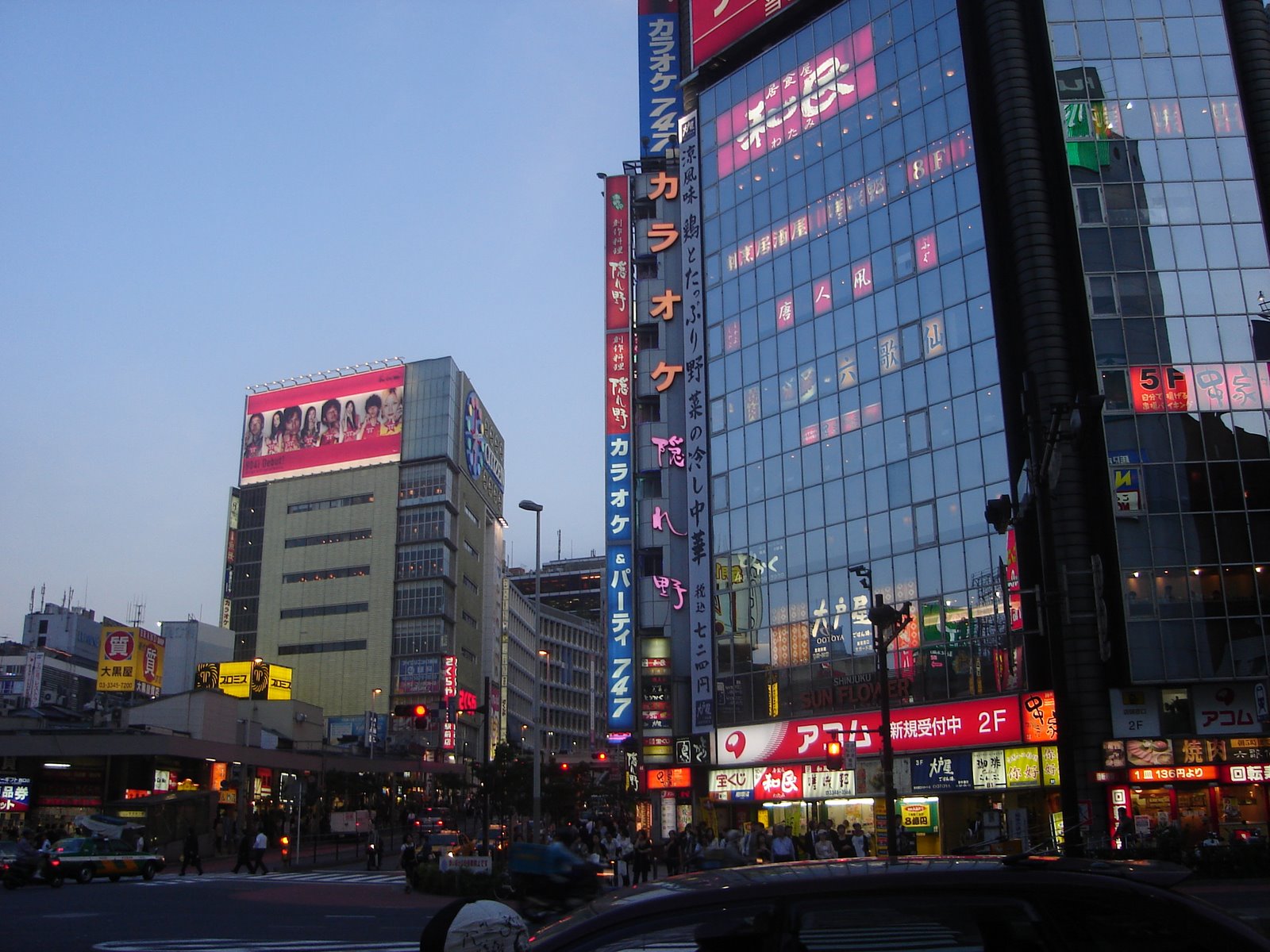
I arrived in Shinjuku at 2, by which time the nastiness had been replaced by brilliant sunshine (well, as brilliant as it can be through the thick smog). I met my friends, and had a very pleasant afternoon and evening drinking and eating. Can’t wait for the next one. I can be like Philip Seymour Hoffman in Twister.

MOVING WITH THE PACKS LIKE HYENA-ENA

New article today in The Japan Times: The blame game. It gives a summary of some recent scapegoating of foreigners in Japan, and the picture it paints is one of all-around unpleasantness in a great many aspects of Japanese life. Foreign or half-caste children in schools are unclean and smell bad because their foreign mothers are sending all their money back to their home country! War brides are foreign spies! Too many African kids on a school running team gives them an unfair advantage! If the thousands of foreign workers on Japanese ships had to return home due to turmoil in their country, Japan’s shipping industry would grind to a halt! It’s a pretty angry editorial written with maybe a little bit too much passion, so you’ve got to question how reactionary it is. Especially me, someone who’s only been over here three months. Who am I to comment?

Well actually, just last weekend I had my first experience with police in Japan, and this article pretty accurately reflects my (admittedly tame by comparison) experience. E and I returned to Roppongi (yeah I know, don’t ask) and were still there at about 7:30am dancing when we noticed one of the girls we were with had been gone a while. We went outside and she was crying on the steps, her bag having been ripped from her hands by a group of men. I stayed to comfort her while the others went looking for culprits; about ten minutes later they returned with police. They established pretty quickly that I couldn’t speak Japanese, which I guess gave them confidence to say what they said next.

I can’t say I speak Japanese, but when I listen to people talk I can usually understand enough to make out what they’re saying, especially if it’s clear-cut and unambiguous. The following exchange happened about three times:

Policeman/detective: Who’s this guy?
Girl (through tears): A friend.
Policeman/detective: OK.
*three-second pause*
Policeman/detective: Are you sure?

E said that at the bottom of the stairs, he was experiencing the same thing, though he could understand more than I could. They referred to him as ‘koitsu‘ (this is very informal, possibly rude between strangers, and basically means ‘that guy’), and their tone was particularly suspicious – “what’s he doing here? I reckon he probably did it” etc.

Eventually they understood that we weren’t evildoers, she got into the police car and they went off, and we sleepwalked home swapping our tales of discrimination. It’s not like it was a big deal for me or anything – I was never in any doubt about whether I would be hauled off to jail or not – but it was interesting. And in light of the above article, I’m beginning to feel like it’s symptomatic of a pretty common attitude towards foreigners. Admittedly some of these foreigners are 50-something men with a bad haircut throwing themselves at barely resistant young Japanese women in Roppongi bars (don’t take it personally, guys), but we’re not all bad, not really.

FIND MY WAY INTO THE GOLD RUSH

I only live about a half hour by train from Kamakura, which is referred to by some as the Kyoto of Eastern Japan, which is to say there are a lot of splendid temples to be seen there. It being summer vacation and all, I woke up on another beautiful morning yesterday and decided I’d go and check it out.

I arrived there around midday. MISTAKE. It was about 33°C with ~80% humidity, so it felt like 40°, and I was melting. Cleverly, I had stopped at Shop99 on the way and bought some face and body refresher towelettes – portable showers, basically – but I could see that they would only provide fleeting relief. As I walked through the Shopping Town, I would hear someone say ‘atsui’ (hot) about every five seconds, so it wasn’t just me with my New Zealand-accustomed body.

I also arrived wearing $3 jandals from the Warehouse. Again… MISTAKE. When choosing my wardrobe for the excursion, I didn’t really consider the possibility of walking for about 10km on stony roads and steps, but I figured I was stuck with them. In case you’re wondering, Ma, I also forgot to put on sunscreen, and no, I won’t do that again. Although it would’ve been much worse under New Zealand’s cleaner skies.

Enough of that, though, because it was a really great day out. I set out from the station amid hordes of holidaymakers, armed with my DK guidebook and a willingness to beat less travelled paths. What most people do is head straight for Hachimangu, which is quite close to the station, but I decided I wanted to get away from the noise and bustle of crowds. So, when I got near it, I hung a right and struck out in the direction of Zuisen-ji, renowned for its Zen garden. On the way I stopped briefly at Hokai-ji, a small, quiet, rather poorly maintained temple. Not much to see there apart from a poorly concealed corrugated iron shed and a bunch of kids possibly up to no good, so I carried on.

If I wanted to escape noise, I was kidding myself, because I was truly in the Land of Enormous, Incredibly Loud Cicadas. It’s not like I haven’t seen or heard them before, but man, not like this. It’s a generally uniform sound though, unlike crowds talking, so it eventually becomes part of the wallpaper. Which makes it better. Right? I mean, it’s more peaceful, more natural. And as I got closer to Zuisen-ji and further away from the main drag, the cars and motorbikes thinned out and the serenity began to take over.

Zuisen-ji wasn’t quite what I was expecting. They had the most detailed information leaflet, complete with a detailed explanation of the place and its philosophy and an impressive old-style map which made the water garden seem enormous. However, when I eventually I got there I found it wasn’t any bigger than my apartment. Quiet and peaceful, certainly, but it didn’t seem like there was really a lot of beauty about it. The temple itself was not open to the public, so you could only peer into small sections of it from behind a barrier. The history was all there, but it was almost like it was protected from the prying eyes of visitors.

I pressed on to Sugimoto-dera, which was the greatest delight of the day. Where Zuisen-ji was prohibitive and unwelcoming, Sugimoto-dera was informal and open. There were places where you obviously weren’t supposed to go, but they didn’t throw up KEEP OFF THE GRASS signs everywhere; instead, they leave it to you to figure it out. The temple itself was compact but impressive. I spent a good ten minutes in there just looking at statues, smelling the incense and enjoying the calm atmosphere. The rewards of this place weren’t spelled out for you, but they weren’t sheltered behind poles of bamboo. Perfect.

By this time my feet were really bloody sore, so I headed back to Hachimangu to see what all the fuss was about. I must confess, it was a really cool place, and the crowds were actually one of the best things about it. I realised that I was wrong: the sounds of nature aren’t superior to those of humans, they’re just a different type of deal. Here you could revel in the energy and fascination of others and feed off that, not to mention simply being able to watch people do interesting things. Like the pilgrims throwing coins into a shrine and praying briefly, before running off to get their children under control or charf some shaved ice.

I wondered, is there more holiness in the lives of these pilgrims than there is in mine (if there is any)? They throw in their coin, put their hands together and bow their heads for a few seconds, and presumably recite what they’ve been taught. To my secular thinking, that doesn’t constitute being holy; it’s just a procedure. But then, some are more diligent than others. One guy took ten minutes to get through it, while another couple was done in fifteen seconds. Just like Christianity I suppose, there are varying levels of diligence, of faith and adherence.

My thing is that I came to these places and I greatly admired what they stood for, without actually believing in it. I soaked up the atmosphere and took several moments of pause (especially at Sugimoto-dera) to reflect on why I was here, and none of the reasons were religious. Is my way of thinking less appropriate for these stunning locations than that of those pilgrims? I mean, it’s not going to keep me awake at night, but I just wonder if it really matters. It’s easy to say no, it doesn’t matter at all, and that’s probably what I think, but I’m not going to commit to that without at least considering the idea that I may not be doing it right. After all, those who know me will tell you that I’m not at all an arrogant, elitist, selfish prick. Not in the slightest.

STITCHES OF SPACE THAT SLOWLY COME AND GO

About 1000 JETs have passed through Tokyo in the past week before heading out to their various outposts around the land. When I first decided to come to Japan, the first avenue I explored was JET, and by all accounts it’s the most attractive option for people arriving in this country. The pay is better, the work is more enjoyable, the lifestyle more interesting. Still, I’m really happy with the decision I made. My transition from New Zealand to Japan was near seamless, and that’s almost entirely down to the hard of work of people at the company I work for. Plus a healthy dose of optimism and self-assuredness on my part, of course.

I knew a couple of people from Christchurch in this JET intake, so I headed into Shibuya on Tuesday to have a few drinks with them. A few drinks turned into pitcher after pitcher at nomihoudai karaoke, and various drunken introductions. Here’s the crazy thing: two of the other guys in the group we were with came from Christchurch, and it turned out that they knew some good friends of mine who are now scattered about the globe. Then there was another guy who was taught maths by my friend Marty’s dad. And the other week I met a guy whose brother used to live in my last flat.

That’s the thing about New Zealand. You talk about there being a maximum six degrees of separation between any two people in the world, but in NZ I reckon it’s more like two or three, and often the connection is even more direct than that. It’s a small country, and people move around a lot – around the nation and around the world – so it ends up being pretty easy to find a link with another person, and that tends to be first on the order of business when you meet another NZer. I’ve lived in the Waikato, in Auckland and in Christchurch, plus I have friends from all over the country – and some from overseas – so it really isn’t hard. Still, it surprises me every time.

Last night I headed back into my favourite part of Japan so far: Ginza/Nihonbashi. Shibuya’s cool and all, but you won’t see ganguro girls or hordes of hosts dirtying the streets around here (although I was offered a massage on my way to the station – which I declined). I visited the Tokyo International Forum, which has an extremely impressive glass atrium, and took lots of arty photos. Then we went to 100 Dining, where drinks and food are very cheap (usually ¥100 or ¥200) and pretty nice, and after that to an izakaya called Gohan. Gohan means ‘food’. I love that. Where shall we go for dinner? I don’t know, shall we go to Food? We haven’t been there for a while. They had some really great stuff there…

EVERYONE CHOOSE SIDES

An election was held in Japan last Sunday for the House of Councillors. Because campaign rules are so limiting, candidates resort to parking a van on a corner and having one of their cronies bark out ‘Please vote for me!’ speeches as they stand and wave. This is inescapable, wherever you go, for the three weeks or so leading up to the election (and reasonably apparent outside those times, too, as the more extreme parties drive around making rallying cries). Usually the leaflets and packs of tissues thrust into our hands by street walkers advertise izakaya, hostess bars and English schools (of course), but around this time a good chunk of them say how great and banal candidate X will be if you give them your vote.

So the election happened. The people voted for change, incidentally – the Democratic Party of Japan took a majority in the house while the incumbent Liberal Democrats lost seats all over the place. (Why do these parties have nearly identical names? Then again, the two Koreas are the same – perhaps it’s a regional quirk.) Right, that’ll be enough loudspeakers, won’t it? Wrong. Instead of a return to the comparative quiet of car and train traffic, the same vans drive about the place thanking everybody for voting for them. Even if they lost! Which means that the Japanese electoral campaign is as follows:

before vote: Please vote for us! Please vote for us!
*voting*
after vote: Thank you for voting for us! Thank you for voting for us!

I’m sure they stated a whole lot of campaign promises in there that I couldn’t have a hope of understanding, but that’s basically what it comes down to. A month of noise pollution. You’d think people would hate it, and I suspect many do, but that doesn’t stop crowds gathering and staring whenever one of these vans is on show. I don’t know, maybe they’re onto something. Maybe Helen Clark should hit the streets in an ice-cream van next year, with my mother at the mic.

In other news, I’ve discovered after two months of trials that DJ Shadow’s Endtroducing… is the best train music. Listening to Mutual Slump or Napalm Brain/Scatter Brain and looking at the scenery going past, the people sleeping or emailing on their cellphones, is somehow perfect. Oh, and I’m on vacation for 13 days starting Tuesday. Maybe I’ll have something interesting to talk about for a change.

I CAN HEAR MYSELF

I don’t think I’ve ever experienced a lightning and thunder storm as fierce as the one going on right now. Every few seconds there’s a series of flashes closely followed by impressive claps and growls. The rain’s so loud against my window that I feel like it’s coming down the inside of the wall. I want to go outside and run around madly hailing the second coming of Christ.

It wasn’t raining on Friday – in fact, it was brilliant with sunshine – so I finally got down to the beach, which is barely a ten minute walk from where I live. For eight weeks I’ve managed to avoid it through a combination of bad weather, the effects of alcohol, and flat-out laziness. There wasn’t much special about it, really, apart from the fact that a big main road and particularly faceless apartment buildings were right behind me as I looked out at the sea. There’s a pretty small area for swimming, sunbathing and cavorting; several ramshackle food/drink establishments; part of an 8.4km walkway along the coastline; and the tiniest waves I’ve ever seen surfers attempt to ride. Not an amazing place, but it changed my perception of where I live. Where I used to think it was a bog-standard Japanese suburb, I now think it’s a bog-standard Japanese suburb next to the sea.

I went to another kaiten-zushi place on Tuesday after work in Yokohama, except it wasn’t revolving because we were there in the last half hour of business. Instead, we had a menu and placed our orders directly to the chef. I had four plates, one of which was blowtorch-roasted tuna sushi and tasted unbelievable. It was the best sushi I’ve ever had. By far the most exceptional thing about the place, though, was their system for billing your order. Usually at these places a waitress will manually count the number of plates you have in front of you, write the total on a slip of paper and hand it to you. Not here.

We’d been receiving different-coloured plates according to the varying cost of our orders. No problem; I figured they’d just add up the different values and write them on the paper. Instead, the waitress pulled out a scanner and positioned it on top of my pile of plates. A few seconds later, a printer on her belt spat out my bill. What? The guy I was with informed me that the plates were all microchipped, so all the waitress had to do was move that scanner near them and it would do the tallying up for her. Brilliant. I will go back and take pictures.

I don’t really get homesick. I have a way of being very practical about changes in my own life so that when they happen, comparisons between the former situation and the current situation don’t really occur to me. I’m here now, so I’d better deal with it. If you can believe this, though, the thing that finally made me miss home a little bit was reading about New Zealand supermarkets (Pak ‘n Save, New World, Foodtown etc.) on Wikipedia. The information on those pages is totally banal, but because you go to a supermarket at least once a week, as a touchstone of times past it takes no effort to recall.

I remembered all my hungry walks from Rata St to Riccarton Mall, from Worcester Blvd to Moorhouse Ave. Then I remembered running around New World Tokoroa searching for the coupon items my dad had given me to find. It’s essentially the same here, of course, except with none of the same stuff, and I’ve gotten used to that without any problems… it’s just that after twenty years of it back home, I kind of knew where everything was. It was easy. That’s why I came here, though – to challenge myself and open new doors in my brain. (Er… at the supermarket, oh yeah.)

THE BEAT DON’T STOP IT DOESN’T STOP

Roppongi is everything I’d been led to believe. Nigerians appear at your side and wax lyrical in a hybrid English/West African/American accent about this awesome bar just down the street, nah just back here, it’ll change your life. Young Japanese women in tight, skimpy dresses flit from bar to bar looking for hot (or not so hot) foreigners to attach themselves to, of which there are hundreds, perhaps thousands, likewise looking for cute Japanese girls to feed their Yellow Fever. When the sun rises, everybody is still going, and they keep going until they fall asleep.

Am I making it sound good? Some sort of Platonic ideal of a nightspot? It isn’t. It’s a meatmarket, a parade of flesh, where the seedy and moralless come to get their kicks. (I shouldn’t be bandying words like moralless about, not from my position, but it feels apt.) Image is everything. The music in the bars is too loud to talk over and, most of the time, too shitty to dance to. Women live off free drinks, bought for them by men who are sure they’ve cottoned on to their lucky ticket for the night. Not necessarily bad people, just… not my people.

I was surprised at how Christchurch it all was. Music too loud to talk over? Check. Music too shitty to dance to? Check. Overpriced drinks? Check x3. The only difference was that people were a bit more approachable – like, where in Christchurch I would stick to people I knew, here I could talk to strangers without them insulting me or leaving immediately. Like I said, though, a voice as mumbly and inflectionless as mine can’t easily be heard over the din, so I ended up resorting to the dancefloor. Truly, it’s perfect if you go out looking for a piece of ass, but I won’t be going back in a hurry. (Disclaimer: I do in fact like good pieces of ass, provided that’s not all they’re advertising.)

I went there with E. (Wish he was still writing – he wrote a far more poetic and vivid description of Roppongi than this, but his site’s long dead.) He lives in the most opulent, comfortable living space I’ve ever occupied – and yes, K, that includes 505. Plus it’s five minutes from Hachiko Crossing. Coming home to my shitty room in my shitty flat has never more difficult. Although it isn’t as bad as it was: turns out I’ve been living here for seven weeks without using the air conditioner placed conveniently above my bed. All this time I’ve been sweating my way through nights in a stinky, humid room, keeping the window shut to keep out bastard insects, when I could’ve been sleeping in blissful comfort. What a prize idiot.

Oh, you want to hear about work? It’s all right. Same old same old. I did mock interviews for the flight attendant class at Yokohama last Tuesday – like, I was the stern executive asking them hard questions such as “Could you spell your name?” and “What do you like to do in your free time?”, for all of which they’d prepared and memorized answers. As they spoke, their eyes flitted back and forth as though they were reading off a page. If they spoke at all, that is – they were nervous as hell. Most of my debrief revolved around telling them to relax in interviews and trust themselves. After all, it worked for me!