THINK OF PEACE AND MEDITATE

Waking up around midday after a fitful sleep, I ordered in a terrifically bland Palak Paneer from the restaurant on the roof of the hotel. Nice place, with a view of the area and plants all about the place, but rubbish food and service. No matter.

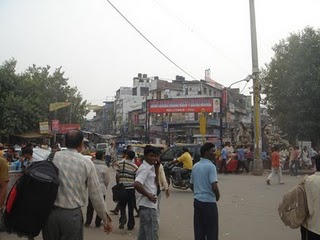
When I finally ventured out into the madness that is PaharGanj, I was greeted by not less than five drug pushers in a 20-minute time period of walking up and down. “Hey man, still in Delhi?” Yes, and you don’t know me. “Yo, you smoke hash?” No. “Hey man, where you from? I can get you anything man, hash, H, E, you name it.” I’m from New Zealand, now go away. Etc.

Admittedly I only spent a short time on those streets, but I felt like everyone, whether their business was legit or not, had nothing but rupees on their mind. I stopped and talked to a couple of shopkeepers, and in both cases I didn’t detect any flicker of genuine empathy in their eyes. It was all patter, all opening lines and techniques and always-be-closing, in a way that is hard not to admire because it’s so slick but puts you at such a distance from them as a person. I came to India because I’d been told it was a far more open culture than pretty much anywhere I’ve been but especially Japan; here in PaharGanj, with the dozens of sets of eyes that never smile, I felt like a true outsider, like I wasn’t really welcome.

After a few moments of embarrassing, Kit Moresby-esque mania in my hotel room (brought on by the prospect of having to stay a lot longer than 2 days here, which was looking likely but thankfully didn’t eventuate), I started to get the hang of social interactions and how to get things done. By the end of that second day, I felt like I could cope here for as long as I needed to, but it required a closing off of the more loving parts of my heart in order to remain on top of things. Several folks on the train and in Bangalore would go on to tell me that my instincts were pretty much right, that life in Delhi is quite different from most other Indian cities and that you do have to regard pretty much everything with a suspicious eye. Shame.
Onto the train, then, which I had been looking forward to so much. Nearly 40 hours, well over 2000km, all in a packed air-conditioned space! Ahh, this is real travel. I was lucky enough to sit with a group of men who, in various ways, were extremely friendly and open people. They asked me many questions about New Zealand, about Japan, about my purpose for being in India. I noticed in these men that they were able to be honest, genuine, completely open and friendly despite rarely offering a smile. It’s all in the eyes.

One was a Swami of the Sivananda Order, based in Ajjampura, and he very quickly saw through my happy veneer to the unease rumbling beneath. I had a lot on my mind about things I won’t detail in here, and it was written all over my face and body language, no matter how many times I extolled the virtues of being in India. “Too much feel,” he said. “I think you have too much feel. No feel, no worry.” And then, with a calming gesture of both hands lightly falling, “everything is clearing”. Again, this man rarely smiled, but he had an aura of positivity and simple calm that affected everyone around him. I asked him if he had any brothers or sisters; he replied, “No. Before I did, but now, no… you are brother. He (points to another man in the carriage) is brother. She is sister. Everyone.” He gave me his phone number and address and instructed me to come and see him. I think I will.

The hours – well, days – passed swiftly thanks to Swamiji and my other companions’ ideal attitudes. I got sick, a sickness in the bowel which has only just passed, but I didn’t care – I was experiencing India as I’d hoped I would, and that came as such a relief after that brief episode in Delhi. To Bangalore, then, and even more positive experiences to be detailed soon…

I GOT THE GREEN LIGHT, I GOT A LITTLE FIGHT

I got on that plane, still buzzing from all that had just happened, and the first leg of my journey to India began. To Beijing first, sitting next to a Japanese guy who studies there and was reasonably tolerant of my show-and-tell. Man, I showed those letters and photos to anyone fool enough to stop for a second, but I’ll shut up about that now.

Beijing had a new terminal built for the Olympics, terminal 3. It is quite ludicrously cavernous, like some evil dragon mastermind’s lair for plotting world domination OH WAIT… lucky I didn’t try and post that using the government’s free wireless in the terminal. Actually, Blogger is usually blocked in China, but for the duration of the Olympics they let the guard down to avoid awkward situations. But I digress.

From Beijing I continued on Air China to Delhi, sitting next to another Japanese guy, this time with a thirst for travelling. We talked a fair bit about the places we’ve been to (many for him, very few for me) and he gave me his card and said I should email him in case there’s a chance of us meeting up again in India or somewhere further down the line. It’s nice to meet such people on one’s travels.

Indira Gandhi Airport at Delhi is a little dustier than Beijing, Narita or Auckland, but all my luggage arrived so I didn’t care. That was kind of what I wanted, leaving those obsessively clean and mechanical aspects of Japan behind. Hilariously, I didn’t go through any customs of any kind; the channels were there, and they were staffed, but they were so bored and disinterested that you could probably get through pushing a hive of bees. I did have to change money, though, fighting off those attempting to push in ahead of me in the melee that is a queue in India. That’s one thing the British left alone.

I’d booked my hotel in advance and arranged for them to pick me up at the airport, and sure enough, there was a young guy waiting with an A4 printout saying my name. I went up to him and, without a word, he started walking and beckoned me to follow, barking instructions to someone on a cellphone. We got outside, where the sounds and particularly the smell of the city were quite different from anywhere I’ve been before – funny how those are the senses I link most to my memories of arriving – and made our way to a beaten-up blue van with a glow-in-the-dark display of the Hindu Holy Trinity illuminating the dashboard.

We weaved our way across city roads which were largely deserted but still required the driver to sit on the horn for much of the time. I’ve only this week understood that here, the horn is not reserved for emergencies or frustration; here, it’s as vital a road tool as indicator lights or clearly defined road markings are back home. You blast the horn to notify of your presence. If you don’t, you won’t be seen and are likely to cause an accident. It makes sense in the absence of those things I just mentioned, and now it’s as much a part of the aural wallpaper as the cicadas were in Kamakura.

Eventually we made it to Hotel Vivek, my home for this night and the next. I didn’t realize it was going to be in basically the roughest part of Delhi (and possibly all India), with shopkeepers hurling insults at me as I ignored their invitations for a cup of tea or a light meal at 2 in the morning. I also didn’t expect to see an albino lizard scurrying across the wall behind reception, a reception staffed by three men who seemed quite put out by the fact that I wanted to stay in their hotel. (I saw the lizard again the next day, so I’m guessing it’s like most hotels have a cat, just this one has an albino lizard.)

At such an early hour and after a day’s worth of travel, I was a little overwhelmed by dealing with a place so different from anywhere I’d been before. Still, I breathed a sigh of relief that I’d made it with no hint of difficulty, and appreciated the fact that this kind of cultural atmosphere was going to help me grow in so many ways. To my non-descript, dusty room, and to sleep… much more to come.

NOW THAT YOU’RE GONE IT HIT US

I’m having to get this out slowly over a long period of time, as computers in India’s cyber cafes aren’t quite as cooperative as one might hope. Here’s what happened around the 24th of August.

On Friday (the 23rd) I said goodbye to my landlords Tetsuko and Kotaro, the sweetest folks one could hope for. The other housemate cooked an incredible Mexican dinner and T & K gave me a Japanese-style bandana, which was a wonderful gesture. A wise person said that once you’ve gotten past the surface of Japanese people and spent enough time with them, they will do anything for you, like they’re investing something emotional in you that they so rarely do.

I was to see this on an even greater level the next day. Mika, fellow teacher mentioned a couple of posts earlier, had said she would come to the airport to see me off, so I thought we’d have lunch or something and then say our sad goodbyes… instead, the whole family turned up – Mika & her husband, Koji, her mother, sister and sister’s 4 kids (2 of which I taught). At this point I understood what people mean when they say ‘my Japanese family’, because really, I felt completely accepted as if I had the same blood.

As if that wasn’t enough, the kids handed me a stack of 6 envelopes and inside each was a letter from a student in the class with a special message for me. “Do your best in India and please come back to teach us again.” “Enjoy eating curry!” “Please write to me and tell me about India.” There were drawings, too, and some more photographs from the party, plus an incredible moving card from Mika. After I went off through security and out of sight, I thought about what had just happened and the cards that were now wedged in my bursting laptop bag, and shed a few tears in the immigration queue. I couldn’t have dreamed of a better send-off, a better final memory of a country I’d come to believe I no longer wanted to function in. I’ve still got my shit to say about Japan and I think it’s valid, but every moment of the experience was worth it just for those last minutes in the country.

One last remarkable thing was to happen. I had intended to call someone just before getting on the plane, and was literally striding towards a payphone and reaching for my wallet when my phone rang for the last time. It was her; she’d had no idea when my plane was leaving, nor obviously did she know that I was, at that moment, about to pick up the phone myself. An extraordinary coincidence. More than a coincidence. I stepped onto the plane confident that Japan had been good for me, I’d been good for Japan and that the universe was aligning especially for me.

I’m now in Bangalore, it’s been kind of an odyssey to get here, worth it for every moment. That’ll be the next post…

I AIN’T GOT TIME FOR THE GAME

I’ve been in Japan for 14 and a half months now, and the longer I stay here, the less settled I feel. The concept of being ‘uchi’ (inside) or ‘soto’ (outside) is felt every single day in some way or another, whether it’s through furtive glances on the train, having the menu flipped for you in McDonald’s or the extra polite, nervous service gaijin often receive in department stores.

I suspect that it is still impossible for a foreigner to become uchi, what with the population being about 98.5% homogenous and still apathetically embracing traditional methods of conducting business and polite conversation. You can come pretty close if you try hard enough, though, and take on as many characteristics of your hosts as possible. Thing is, you have to want to, and I really don’t want to. In this situation, living somewhere but not wanting to become part of the current culture, you have two options: 1) leave the country, or 2) retain as much respect as you can for the country you live in, its people and customs; keep everyday frustrations to a minimum and accept things that frustrate you as part of the culture and something to be at ease with; and above keep your own sense of identity strong in a way that you’re comfortable with yourself without being aggressive about it, and comfortable with the way you’re received by the culture even if it isn’t how you’d have it ideally.

So, I’m leaving. Weren’t expecting that, were you? I’ve tried option 2 for a good while now, and if I’m honest, I could quite easily go on here for months, even years longer, but I’ve reached a point where I realize that the longer I stay, the more I have to suppress my natural self, and I can’t see how that’s healthy. It either means I’ll become something I’m not, or more likely, wrestle with myself on a daily basis knowing what I have to do in a given situation is quite different from what I want to do. As well as that, it’s a lot easier to survive in Japan if you think less – just do your job as you’re expected to and hang out with a regular group of friends, and your worries inevitable diminish – and until recently, I could feel my brain slowly shutting off, my mind consciously less stimulated, just coasting through my days giving very few things a second thought.

It’s my time. I’ve loved living here for so many reasons – the wonderful friends I’ve made, the beautiful kids I’ve taught, the incredible things I’ve seen… I’ve also learned more about myself and the world around me in this past year than the previous four combined, partly because of living in this foreign country, and partly through having my first serious relationship with a woman. I just have to go, though, and I have to go now. I have to go to a place which is different from this one, where I can focus on becoming more open and direct and not worry so much about keeping this safe and comfortable, which is such a big part of existence here.

India is my next destination. I’m not sure what’s going to happen there, but I know it will challenge me in so many ways and will be very, very difficult to cope with at times. But that’s good for me. It’s all about me, in case you didn’t notice. For once, I’m not that bothered about concentrating completely on my own development, and I’m very pleased about that.