In 1955, on a public bus in Alabama, a black woman named Rosa Parks refused to stand up when asked to make room for white passengers. Her action was seized upon by a young clergyman named Martin Luther King who organised the Montgomery Bus Boycott, which catalysed the civil rights movement and brought it into nationwide focus; segregation on public transport became illegal the following year. Further laws continued to be passed to make all American citizens more equal, racial tolerance came forward in leaps and bounds and black Americans began to get voted into public office – culminating in the election of America’s first black president, Barack Obama, in 2008.
In 2010, on a public bus in Dubai, an Indian family of four sitting in the front row of seats (marked ‘LADIES & FAMILIES’) was asked to move themselves – along with several large bags from Dubai Mall – to the back of the bus. They did so without hesitation, and none of the other passengers on the bus were moved to speak up, many of whom were also Indian. The event went unreported and the family got on with their lives.
It starts as soon as I open the door: that bizarre, enigmatic sensation of being somewhere utterly contradictory. The Subway restaurant on the edge of Trivandrum’s Technopark campus is the only American chain restaurant for literally hundreds of miles around, and this makes it both thestarkest example of Western influence on life in Kerala and the most jarring collision between that influence and thesteadfast conservatism of this corner of India. The restaurant is right next to the building in which I work, so today I’ve decided to spend my lunch break there.
The music always hits me first. No Bollywood vocoders or Malayali whistles here: the dial is always tuned to an American radio station, generally near full volume. As I walk in, a track by one of my favourite groups, Arcade Fire, blasts out of the PA – a group I don’t think I’ve even heard in restaurants back in NZ, let alone in India. “I woke up with the power out! Not really something to shout about!” shrieks singer Win Butler as I walk to the vegetarian counter. Living as I do in rural Kerala, this line is peculiarly apt.
Sharell Cook is the author of Diary of a White Indian Housewife, a blog about her life as a white (Australian) woman married to an Indian man in Mumbai. Her subjects can spring from anywhere in the maelstrom of activity that surrounds her – visits with her new family, learning Indian recipes, the ongoing frustrations one inevitably feels as an outsider in India, and many moments of introspection at the path she has followed in life, to name just a few regular sources of inspiration.
Though a good number of her posts are illustrated with photographs, particularly the often amusing Snapshots of India, the biggest draw is her focused, straightforward storytelling. She seems to understand (or perhaps not even consider) the strength of the tales she has to tell and just gets out of the way, letting the various characters, locations and feelings in her life shine. Not surprisingly, she has a book in the works, with release slated for mid-to-late 2011.
If you glance at the comments on Sharell’s blog you will notice that she has legions of adoring fans – including myself – with whom she cheerily interacts. As such, she was willing to answer a few questions. All photos used with permission.
***
Why did you start blogging?
I started blogging for a number of reasons. One of them was because I felt that my life was going down an unusual path, and I wanted to share it with people so that they could benefit. I’d been trawling the blogs of people who were in a similar situation as me, but they didn’t always contain the information and detail I was looking for. So, I thought I’d write from the heart about my life and the kinds of things I would be interested in reading. Plus, I did have a notion in my head that I wanted to write a book some day. I thought having a blog would be a good platform with which to establish a presence and market myself to publishers. But still, I got a surprise when a publisher actually got in touch with me after reading my blog.
You mention a journal in your writing. Do you see ‘Diary of a White Indian Housewife’ as an extension of that journal?
I do, because primarily I write for myself, and my blog is where I record my experiences and thoughts. I’ve actually given up writing in my journal now. My blog is it!
Arabic mehendi
What is your first memory of writing creatively?
I think my first memory defines why I was always supposed to be a writer! It was in my first year of school. The teacher told the class to narrate (obviously we couldn’t write properly at that young age, so the teacher had to write down what we were saying for us) and illustrate a story about something of our choice. Apparently, I was the only child who actually came up with a proper story. The rest of them just described situations and things.
Describe something that is beautiful to you.
Oh, there are so many things — but they’re always the small things. Usually, something to do with nature. A butterfly, a sunset or sunrise, the ocean, the smell of the mountains. An unexpected smile is always beautiful too.
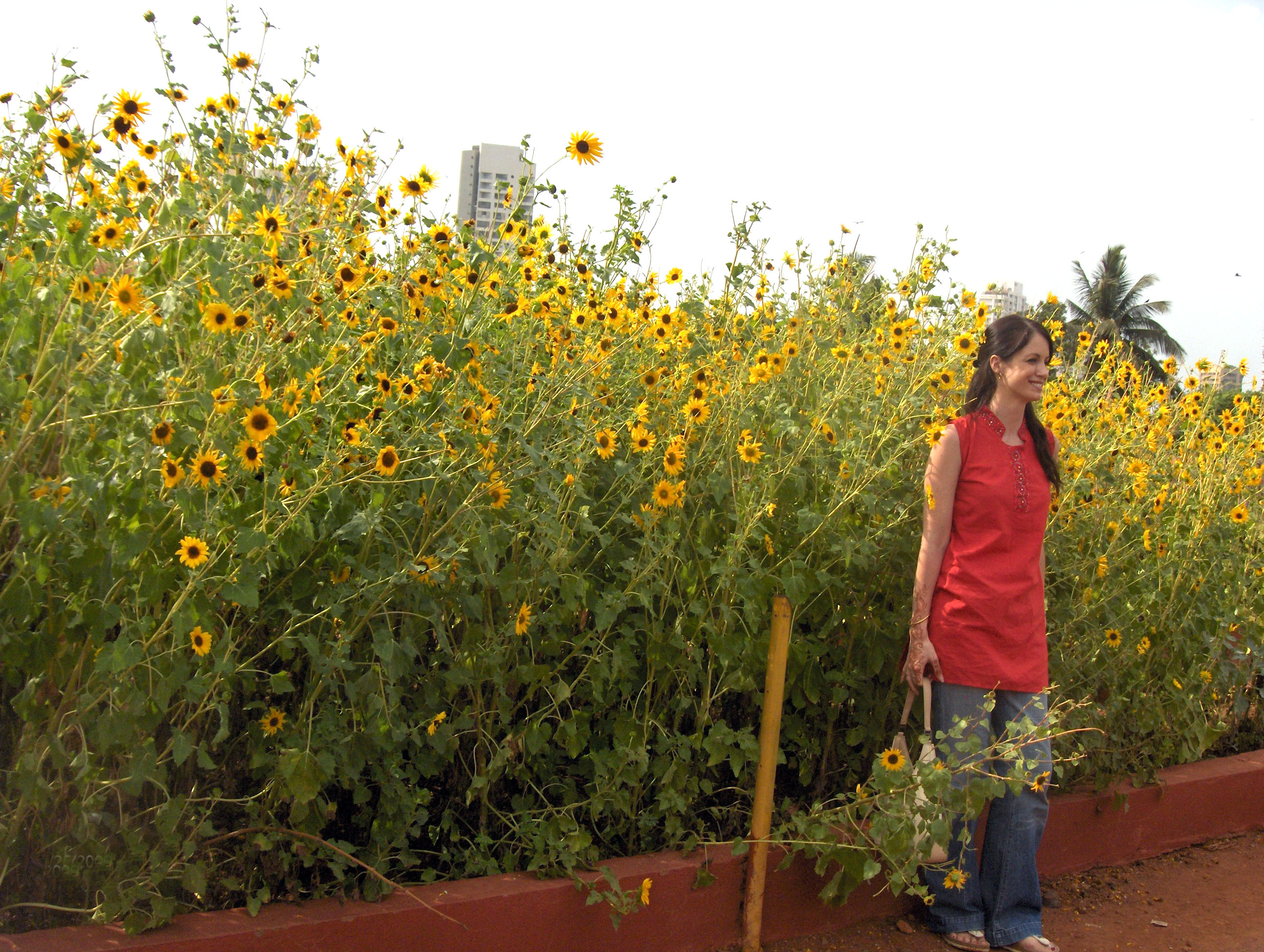
With sunflowers in Mumbai
Are you equal parts white, Indian, and a housewife, or does one of these labels apply to you more than the others?
This is such an interesting question. Funnily enough, being constantly surrounded by lovely brown skinned people, these days I often forget I’m white until someone treats me as such. I don’t feel like I’m a foreigner living in India anymore, and I find that I have trouble relating to many foreigners living in India. Often, I actually feel like I’m Indian, but sometimes I get reminded that I’ll “never be Indian” so I have a bit of an identity crisis. I do feel like I’m a housewife though, despite the fact that I work. I don’t keep staff (only a maid who comes every second day to wash the floors) and I’m always at home since I work from home.
You live in Mumbai, one of the world’s most populated and varied cities. What is the first piece of advice you would give to another outsider coming to live there?
Just let go of any expectations about how you think things should be, and be prepared to adjust. You can live as grandly or as simply as you want in Mumbai, but you can never escape the day to day frustrations that come from living in India. In Mumbai, we have world class bars and shopping malls, but a severe traffic problem, water shortage, and lack of space. The problems are different to the ones you might find elsewhere in India, but they’re still there. You just have to accept it for what it is. And don’t try and replicate the life you had elsewhere.
Homemade fish curry
The phrase ‘the real India’ is one that foreigners tend to use, usually to make a distinction between how they used to perceive India and how they perceive it, or something about it, after going and spending time there. Of all the experiences you’ve had in India, which one, by your estimation, felt most like that so-called ‘real India’?
I actually see the “real India” more as the “dual India”. Everything about India is real, from a luxury hotel to a vendor selling vegetables from his wooden cart. However, an experience that I had that felt most like the so called “real India” was having to deal with corrupt customs officials at the customs office, when trying to retrieve 2 boxes of personal items that I had sent over. I don’t want to focus on something obviously so negative, but I’ve chosen this example from the point that corruption is everywhere in India, at all levels, and it affects the rich as well as the poor. There’s no escaping from it.
Is there a post on your blog that you are most proud of?
Name two countries: one you’d like to visit, and one you’d like to visit again.
A country I’d like to visit: Brazil. A country I’d like to visit again: Spain.
Guests dancing at wedding
Do you believe in God?
I believe that God is a name for the universal energy and consciousness that is present everywhere. All religions have the same aim, that is bringing people closer to the one entity labeled as “God”.
***
This interview is part of Inside the Bloggers Studio, an ongoing project of short interviews with bloggers I read and admire. (Apologies to James Lipton.) To view the archive, click the category tag in the ‘By Category’ section at the top right of this page.
I’m not sure if I’ve mentioned it explicitly before, but I am part of the Indian outsourcing world. My job at Trivandrum’s Technopark involves proofreading medical letters, and I am the only foreigner in my company. While Kerala is a world away from Mumbai, I feel qualified to pass judgment on two aspects 0f NBC’s new situation comedy ‘Outsourced’:
(1) whether or not it is true to life (because I am essentially the show’s main character)
(2) whether or not it is funny (because of my ability to notice what makes me laugh)
To answer (1), let me compare a few situations in the show to how they might play out in my life.
In the first episode, Todd meets his staff by going around the office introducing himself to each of them. The assistant manager tags along quietly beside him. In my office the manager would do all the talking, describing both me and my new colleague for each other’s benefit without either of us really having to say anything. Inaccurate.
The staff are immediately revealed to be a collection of stereotypes: the petite and quiet girl, the ambitious and business-obsessed assistant manager, the attractive and assertive girl, the cool and flirtatious young guy and the overweight dude who won’t shut up. In my office, it takes literally years for some colleagues to reveal their character to you, and generally interactions are kept to business – to wit, they bring as little character to work as possible, saving it for after hours. If you’re lucky, you get to spend time with them after hours and get to know them better. Inaccurate.
Todd’s fellow foreigners in his Outsourcing Building are a dinki di Aussie chick and Diedrich Bader. I have never seen a dinki di Aussie chick anywhere near my Outsourcing Building, and I most definitely haven’t seen Diedrich Bader. Inaccurate.
In the second episode, the office break room is shown to be colourful and filled with a number of snacks and tea-and-coffee-making facilities, with laughter emanating from the mingling men and women on the staff. My break room has some chairs and tables, a big sink, one BRU tea/coffee machine, and a water cooler. The walls are white and bare. The staff generally sit segregated according to gender, and those that mingle with the opposite sex do so very quietly so as not to attract too much attention. They are also usually married couples. Inaccurate.
Todd cannot comprehend the famous Indian head-wobble, so Asha – the attractive and assertive girl – demonstrates it for him by taking his head in her hands and moving it slowly from side to side, all the while looking into his eyes and giggling. If any single one of my female colleagues did this to me, my head would explode right there in their hands – we have barely exchanged a single handshake in two whole years. Inaccurate.
Finally, Gupta unleashes a tirade against all of his fellow staff, pointing out everything that he hates about each of them. In my office, where dancing carefully – and with a smile – around the people you dislike is elevated to an art form, this would only be within the realms of possibility if someone were drunk. It might even become likely in such a case. Gupta, however, is not drunk. Inaccurate.
Verdict: Even allowing for the fact that I work in far-more-conservative Kerala, on point (1), Outsourced gets a FAIL.
Answering (2) is much simpler: did I laugh? Well, a majority of the jokes were infantile, such as the parade of ridiculous items sold by All American Novelties, Todd’s company. Stupid does not equal funny.
Others COULD have been funny, but were lazily thrown in rather than stretched to their capacity, like when Manmeet is saying goodbye to one of his phone girlfriends and manages to sell her a teddy bear that plays recordings. He asks her what he should record into it for her to listen to when she goes to sleep at night. I would have laughed hard if he’d sat there in silence for ten seconds, getting progressively more disgusted as he listened to her obviously filthy request; as it was, he quickly told her “I can’t make a cute little teddy bear say that”. This is spoonfeeding where it really wasn’t necessary – a lot of the best humour allows room for the audience to read something into it, and I wish the writers had realised this.
Most importantly, in each episode several jokes were downright offensive, and they WERE often stretched to their limits, making for even more excruciating cringes. For example, when Todd spots a COW outside the office WINDOW and then, after listening to a long SPEECH about HINDU BELIEFS, asks “So, what time is lunch?”. NOT COOL. Also, when Gupta goes on that afore-mentioned ‘I hate you all’ rant he comes to “Mr All-American”… and has absolutely nothing to say! What?! He’s perfect, while all of the Indians have negative characteristics? Between this and the constant stereotyping, I detect a hidden agenda!
Verdict: I understand that people have different beliefs on what is and isn’t funny, but in the eyes of this viewer, Outsourced is DOUBLY NOT FUNNY – once for failing to make me laugh, and once for pissing me off at the same time.
I guess all this indicates that the show is on the fast track to cancellation. However, as Peta Jinnath Andersen notes in her article at The NRI, the pilot pulled in an impressive number of viewers, so who knows? She and Amitha Knight, who are both Indians in the USA, have written well about it, so check out their pieces (both of which are of course much more insightful than mine).
As it stands, I will be tuning in for the third episode to see if it can elevate itself in any way. Even with the bar set so low, I’m not holding my breath.
I usually skim over and delete forwarded emails within seconds of receiving them, but when Sean-Paul Kelley’s scathing assessment of India popped up in my inbox, I carefully read and re-read each word with rising irritation and, ultimately, anger. Kelley is an American travel writer whose bio on several sites, including The Huffington Post, states that he has had several very good jobs, he maintains a highly regarded blog called The Agonist and he has travelled in more than 47 countries. While this last fact makes his voice a little more deserving of deliberation, it does not transform his words into gospel, even if the majority of what he writes is true; the accountants’ truth matters little if couched in words that are roundly negative, Westernist and irresponsible.
A brief summary of Kelley’s piece:
India (except Kerala) is polluted, infrastructurally backward, bureaucratically inefficient and riven with corruption. And things aren’t going to get better, because no Indians (except in Kerala) “give a shit”.
You don’t have to look far into the horizon of the mass media or the blogosphere to understand the size and darkness of the cloud hanging over next month’s Commonwealth Games in Delhi. Over here, a Reuters reporter asks how Delhi’s poor will benefit from the Games and finds no good answers; there, an IBNLive staffer suggests that the big winner will be corruption. Indeed, my colleague Vivek Dehejia has roundly denounced the CWG and gone as far as to say that he hopes that they fail. In the midst of all this bad press, there must be something good to say, somewhere, about something. Right?
Sign on the road to Mitzpeh Ramon, Israel (used with permission)
Katie Schuessler is the author of the road less traveled, a blog of her experiences travelling and volunteering in Palestine, Israel, India and Japan. The majority of her posts are from her time spent in Palestine and give a sense of the culture, landscape and people of a place that most of us only know about from news reports, as well as giving an inside look at human rights issues.
She is also a photographer, and all of the images in this post (except the peace portrait) are taken from the vast archive posted on her site. Click each one for larger size.
I discovered her blog in an odd way: looking at referrers to this site, I followed one and found it was a spam page with all Kerala-related links. Her blog was listed directly below mine as she was writing about her travels in Kerala at the time, and after clicking on it I wound up spending an hour reading through the archives. Perhaps this chance path speaks to the interconnectedness she mentions below.
Passionate and personal, her entries have a considered-yet-raw quality about them that implies an immediate clarity of her surroundings, and a well-honed belief system that nevertheless remains open to change.
***
BHM: Why did you start blogging?
KS: i started my blog specifically because i wanted people to see what was happening in the west bank through personal stories and photos, and the whole thing kind of took off from there. it was great to publish my photos and writing while traveling, and nice to give my friends and family an easy way to see what i was up to.
BHM: You mention a journal in your writing. Do you see ‘the road less traveled’ as an extension of that journal?
KS: i’ve often contemplated blogging etiquette; what sorts of things are acceptable to a broad audience, and what sorts of things does one keep to oneself? my paper journal holds much more personal information about my experiences, ideas, and even art that i may never post, whereas the blog is only peripherally personal. i’d say the two complement each other quite nicely, but if anything, the paper journal is an extension of the blog.
BHM: Can you elaborate a little on that last sentence (‘if anything, the paper journal is an extension of the blog’)?
KS: i think there are some thoughts and perceptions of mine that don’t belong on the web. for instance, when i wrote about my roommate snoring like a tuba, it felt a bit too personal and i kind of regretted it. i do think there is a time and place for such intimate expressions, and for me they manifest in my paper journal. even though my posts get pretty personal — talking about breakups, life revelations and identity crises — i never get into the gritty day-to-day details like what i ate for breakfast or who i’m spending time with on a given day. i don’t really have stringent rules about what i can and can’t post, but i hope to maintain a certain professionalism and thoughtfulness on the road less traveled that is positively absent in my paper journal.
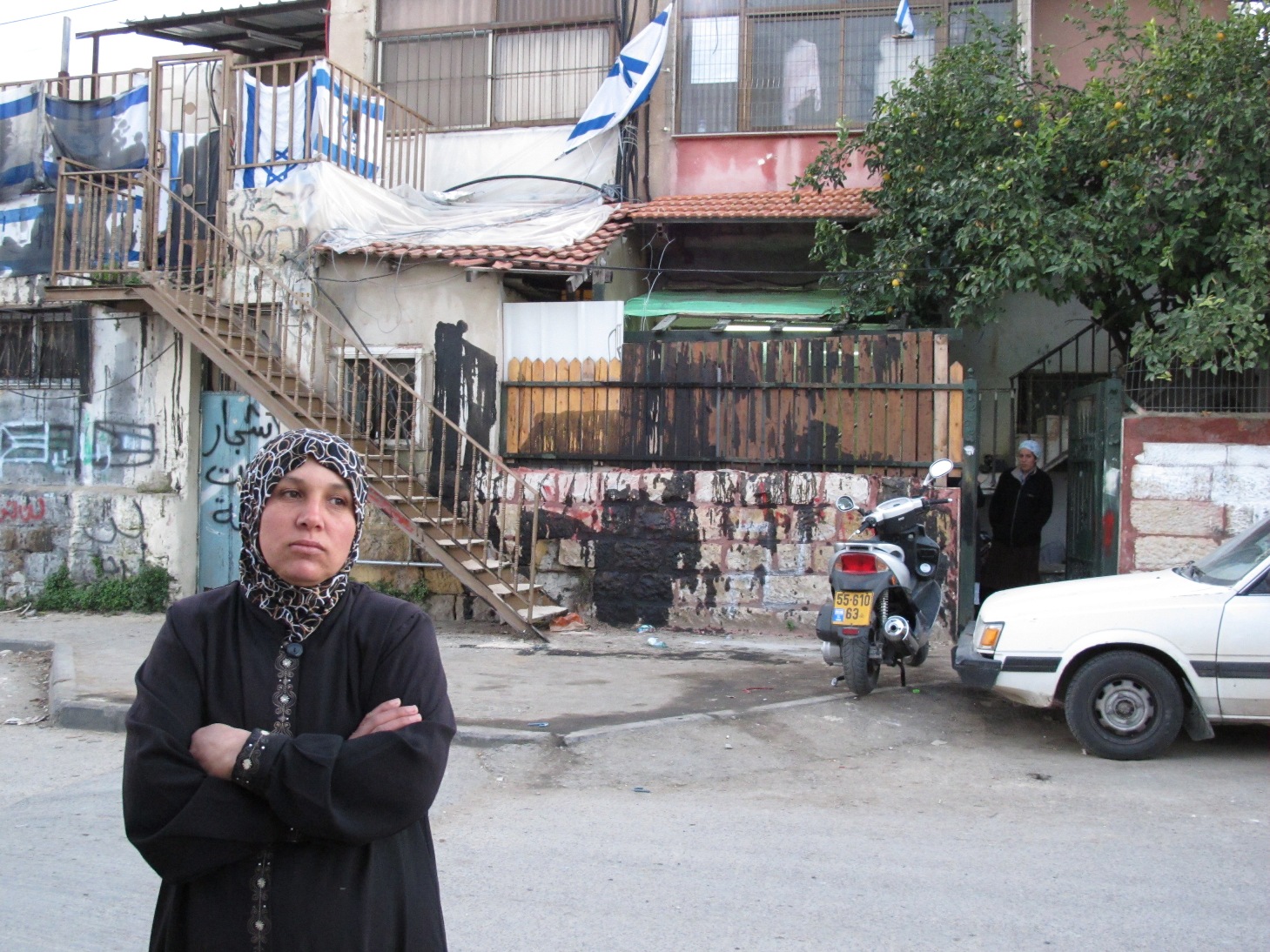
Woman forcibly evicted from her home in Sheikh Jarrah, Palestine (used with permission)
BHM: Describe something that is beautiful to you.
KS: there is something remarkable about laying in savasana (‘corpse pose,’ usually the last posture of any yoga asana practice) and feeling each cell of my body vibrating with the postures i’ve just done. from there, i like to visualize how each cell makes up my body as a whole. then i think about how more cells make up all the people and objects around me, and how we are all part of one larger cell. then i think of how this larger cell is part of the whole community surrounding us, which is made of similar cells comprising yet another big cell. this process continues to expand until i’m seeing the whole earth as one cell and feeling the power and force, yet utter lightness, of our deep interconnectedness. it’s beautiful.
BHM: What is your first memory of taking photographs?
KS: my parents gave me my first ‘real’ camera for my sixteenth birthday. it was a pentax k-1000. i spent a long time photographing flowers around the front yard of their house. focusing the manual lens was a magical experience. prior to that i had photographed with a point-and-shoot but there is absolutely no comparsion with using a manual camera. it gave me a whole new way of experiencing the world visually. later, when i went to pick up that first roll of film from the processor, i realized that i hadn’t loaded it properly and it was completely blank.
BHM: Did you display photographs publicly anywhere before you started your blog?
KS: yes, but not for quite some time. most recently i had a solo exhibition at the public library in tucson, arizona, but that was in may of 2008. it was a portrait project where i asked those who i photographed to write about peace between israel and palestine onto each of their respective photographs.
Moshe (used with permission)
BHM: I found your blog through an ad site about Kerala that also linked to mine, but I added it to my bookmarks largely because of the Palestine posts. Did your experience there have an effect on your belief system?
KS: before i left for palestine, i felt that i understood the situation. because i grew up jewish, i had the israeli and zionist perspective pretty well-covered. to learn more about palestine, i read books, magazines, and lots of online news. but unfortunately nothing could have prepared me for the reality of being there. there is no book that can describe what it’s like to live in a refugee camp under constant military surveillance. there is no magazine article that can (or that is willing to, perhaps) describe what it’s like to pass through checkpoints on a daily basis and be subjected to regular interrogation. it seems to me that there is a slow, agonizing process of trying to break people down via constant degradation — whether it’s unfair distribution of water, a refusal to grant permits to travel, housing demolition, regular raids, arrests, and murders, or even just simple, constant military presence. what’s remarkable is, the people living under that illegal occupation have such open hearts. if any part of my belief system has changed as a result of this experience, it’s that i have more faith in the strength of the human spirit. on the flip side of that, i am more puzzled than ever by the cruelty and out-of-handedness of humans making war.
BHM: Off the top of your head, which photo that you’ve posted on your blog holds most meaning for you?
KS: this is a tough question. the first photo that springs to mind is of a boy in mysore, india. he was part of a group of kids who i was visiting to drop off some photos. the kids were going nuts for the gora and the camera. somehow, amidst the chaos and silliness and posing, he gave me his full self, full of childlike innocence but also the maturity of someone who has seen a lot. it’s meaningful to me to have been able to catch that moment.
Boy in Mysore (used with permission)
BHM: Is there a post on your blog that you are most proud of?
KS: i think it’s the two posts (here and here) about water rights in the west bank. it’s a fascinating subject to me, and at the crux of the human rights deprivations happening there. i learned so much when i researched for that post, and felt that it was very important for people to learn about. there is no arguing about water — it’s vital for everyone.
BHM: Name two countries: one you’d love to visit, and one you’d love to visit again.
KS: i’m on an africa kick right now, but it’s hard to narrow it down to just one country. i’d probably start in east africa: somalia, kenya, uganda, ethiopia…and i would like to do another trip to palestine and india (if they’re on the same ticket, does it count as one?).
Palestinian children in volunteer-run photography class (used with permission)
BHM: A simple question for last: do you believe in God?
KS: yes, i believe in god. not in the sense of a man with a white beard and heaven and hell. but in the sense of a guiding creative force of the universe. and a trust in the earth. and a belief in our innate interconnectedness as inhabitants of this planet. and a sense of the power each of us holds to make a positive difference in our lives and the lives of others. this is divinity.
***
This is the inaugural post for Inside the Bloggers Studio, an ongoing project of short interviews with bloggers I read and admire. (Apologies to James Lipton.) To view the archive, click the category tag in the ‘By Category’ section at the top right of this page.
do the needful at the earliest – Anyone who deals with Indian businesspeople or outsourcing will be familiar with this one. According to Wikipedia, it’s a remnant of early-to-mid-20th Century British English that has died out in the native speakers but lives on in this and a couple of other colonies. Search for it in Google, with quotes, and the first few results are humorous Western perspectives of the phrase, but then you have another 260,000 results of people actually posting that phrase on the internet. Add ‘kindly’ in front and the field narrows to a paltry 103,000. I can only hope that in each case, the needful was indeed done. At the earliest. (Earliest what?)
Marley probably didn’t have the most auspicious start to life. She started out a stray pup, destined to be separated from her mother and to wander Varkala’s cliff in search of charity from tourists dining at Western-style restaurants and cafés. She would have had limited success at this, essentially a cuteness competition with the other puppies and dogs hanging around the area, until she grew big enough to be ready to have pups of her own. At that time, the restaurant and shop owners would have hounded her out, condemning her to a life of trotting and sleeping around Varkala’s streets, maybe venturing out to the cliff or beach from time to time, running in packs with other strays, and probably not living very long purely because she wasn’t blessed with genes that would make her grow big and strong.
In my childhood, I had two dreams: (1) to play for the New Zealand cricket team, and (2) for there to be cricket on television every day. In view of the fact that I am currently here writing this article instead of in Sri Lanka with the Black Caps, we can safely assume that (1) did not come true. (2), however, most certainly has, and in amongst the deluge of statistics and ludicrously controversial no-balls, I finally understand that old maxim: be careful what you wish for.






 Jdanspsa Wyksui