#NZFF: The [x] of [y]

2013 NZFF LogoI have never gotten so prepared for a film festival as I have for the 2013 New Zealand International Film Festival in Wellington. Man, I don’t think I was this prepared before moving overseas for four years. I’ve booked leave from work, prepared a backpack of essentials (including water, fruit leather, and a range of medicaments to treat these bastard cold symptoms), and bought a hardcover notebook to jot down thoughts on a jittering knee.

That last point is a first for me. I’ve been attempting to write about film on here for years, but only after I get home and try to piece it all back together in my mind. Today’s initial trials indicate that I am less able to let go and be immersed in a film if I’m taking notes, but I remember a lot more and have a much more coherent understanding of it as I watch it. Seems like a reasonable trade-off: if I really like the film, as I did in both cases today, I can watch it again without the distraction of pen and paper in future.

My first two outings of NZFF 2013 both followed the same titling format: THE [x] OF [y]. Not a trend I’m particularly fond of, but here were two excellent, very different films that bore some surprising similarities. In the first instance, the title was entirely metaphorical and had nothing to do with the literal content of the film; in the second, it was an unvarnished description of the uniquely presented hell on earth it depicted.

The Weight of Elephants | Crystal Shrine

The Weight of Elephants was a perfect way to start my festival. It’s a serious film, but very beautiful and filled with room for interpretation. It’s also very much a New Zealand story, and in the Q&A afterwards, director Daniel Borgman stated his intentions to be true to small town NZ (Invercargill in this case). I think he succeeded admirably in telling a story set in a world I could easily link back to my own childhood in Tokoroa, as well as crafting another worthwhile feature in NZ’s small town canon: Whale Rider, In My Father’s Den, Out of the Blue (which also stars Matthew Sunderland) to name three. The toetoe I’d noticed in Aro Valley on my walk to the cinema showed up on screen, too, as a key symbol in a very beautiful opening sequence. “A Kiwi film,” I thought. Naturally, Tim Tams also made an appearance later on and were appropriately fussed over.

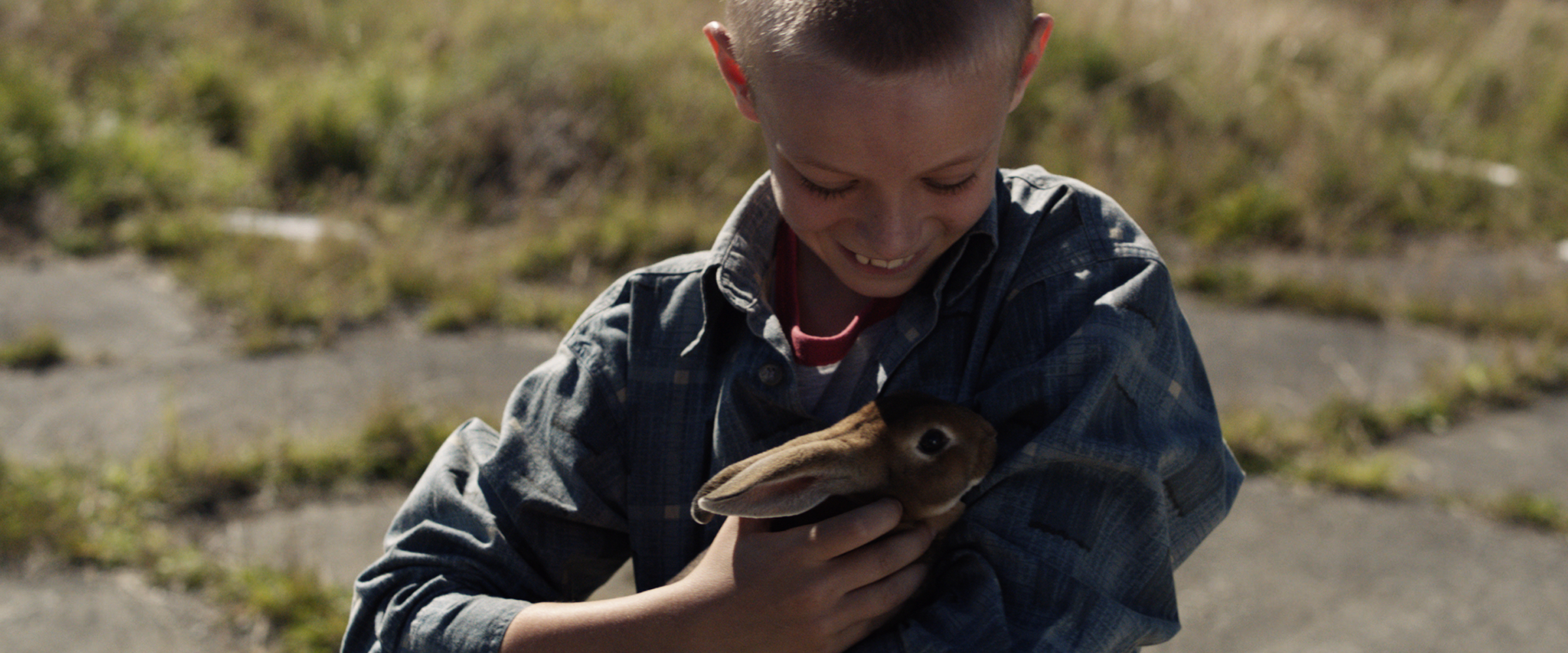
We meet 11-year-old Adrian as his lice-riddled hair is shorn off by a grandmother who really only expresses her (very genuine) love with a ‘get over it’ attitude. Adrian has no say in the matter, and this appears to be his life in a nutshell: a powerless young boy trying to figure out where he fits, virtually always dictated to unless he’s on his own. His friendships are more like ongoing negotiations as he tests others out and — more often — they test him. He’s willing to kick a rugby ball at someone he cares about if it gets him kudos with the playground bullies, but could he kill a rabbit for the same reason? We really see the world through his eyes, and as Adrian’s concept of loyalty is constantly recalibrated with each personal challenge, it all rings dauntingly true.
The Weight of Elephants | Rabbit

Borgman shows a strong hand throughout The Weight of Elephants, keeping a consistent tone of uncertainty through a mix of straightforward cinematography and glorious slow motion. His decision not to rely too much on music — indeed, much of the film carries only incidental sound — also bears fruit when the score quietly builds in the final scene, adding to its emotional payoff. He’s pleasingly comfortable with silence, rarely the hallmark of a commercially sought-after director, but skilled enough to hopefully bring his talents to mainstream success.

He would no doubt be quick to acknowledge that this film would be nothing without its child performers, who are both naturalistic and captivating. As Adrian, Demos Murphy has few memorable lines but says it all with his wide eyes and smile, and he does well to cry so much without ever seeming forced. Of his three aimless neighbours, who are his age or younger but whose worldliness makes them seem like adults, I was particularly taken with Hannah Jones as Joely. The character is only six, and Jones can’t be much older, but in her small amount of screen time she is totally captivating — a playful cherub with an unspoken darkness. If you see it (and you should), watch for the moment when she’s asked, “What’s your name?” The look on her face is perfectly enigmatic.

Just as the development and display of power is a key theme in The Weight of Elephants, it’s central to The Act of Killing, which offers regular reminders of who has it and who doesn’t. Joshua Oppenheimer’s documentary, which is unlike any other film I’ve ever seen, is as much an exploration of how power corrupts as of the long-term effects of mass murder.

The Act of Killing | Herman Koto | Filming

Today, there are three million members in the Indonesian paramilitary organisation Pancasila Youth, which is headed by one of the most repellent people I’ve ever seen in a movie: a perpetually lewd, offensively charming bastard who doesn’t replace his divots at the golf course. Pancasila is as closely tied to governmental power now as it was in 1965-66, when it played a key role in Suharto’s military coup and helped kill somewhere between 500,000 and 3,000,000 alleged Communists and Chinese Indonesians. It’s an organisation synonymous with extortionist gangsters, who (according to this film) are seen as an integral element of Indonesian society and politics. They even find repeated justification for themselves in the original meaning for the Indonesian word for gangster, preman, which was ‘free man’; this seems a particular point of pride, with the unofficial theme song ‘Born Free’ providing one of the film’s most memorably off-putting scenes.

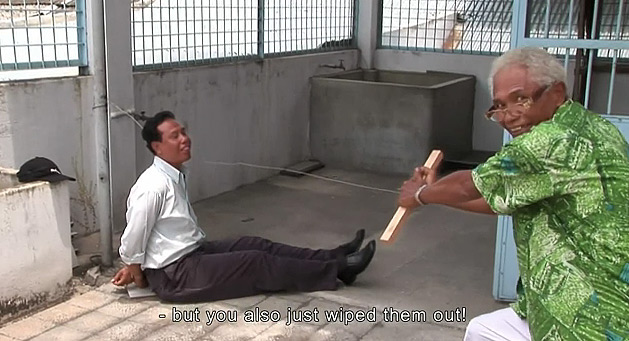
The main preman in The Act of Killing is Anwar Congo, who is estimated to have killed around 1000 people during the purge and appears to have been trying to justify it ever since. Either that, or he was getting drunk or high: “I’ve tried to forget all this,” he says as he details his preferred method of strangulation. This is the conceit of the film: Congo, and a few of his Pancasila contemporaries, are invited to re-enact their killings in a fictional film bearing the styles of the Hollywood favourites they used to exhibit in shady halls. He dresses as Pacino, Eastwood, and Gene Kelly; in his idle moments, he looks like a thinner, more drug-fucked Nelson Mandela. “There are many ghosts here,” he says as he gestures to a nondescript terrace floor, but it becomes ever more clear that the ghosts inhabit his mind. He certainly can’t escape them when he sleeps.

Act of Killing Ticket | A. O. K.
Act of Killing. Not really ok

I experienced a new kind of desensitisation to violence while watching The Act of Killing. Congo and the others described killing so often, and in such detail, even before any filmic re-enactments were shown, that I found myself nodding more and recoiling less. The killing seems mostly incidental to them in light of the far more important achievement of overthrowing Communism; indeed, most of the paramilitary guys, and ALL of the politicians, are obsessed with appearing powerful and successful. “For massacres, I usually wore jeans,” says Congo, focusing on how he ought to be attired for a particular shot. Herman, a big man who is both lovable and terrifying, blunders into politics as a means to gaining greater wealth and status. Congo’s compadre Adi sees a bigger picture — how Oppenheimer’s film could reflect badly on all of them — but even in full awareness of his own past atrocities, he’s happy to argue at length the negligible difference between cruelty and sadism.

“It’s not about fear. It’s about image,” says Adi. “The legacy.” He’s happy to go on trial for war crimes in The Hague if it brings him fame, and he says all this not as a naive pawn in a grander scheme but as a clear-eyed believer who has thought all of this through and justified his horrific actions as an absolute necessity.

It isn’t so easy for Congo, whose mind and body are slowly failing him. Confronted with what he has done, and invited to act out both parts, he sees how hollow his “relative morality” is. In a key scene, he invites his grandchildren to bear witness to his on-screen suffering, and in the same moment gains piercing insight into his victims’ plight. Here is a man who, upon reaching the twilight of his life, is literally given pause as he looks back over his deeds.
Act of Killing | Strangling technique

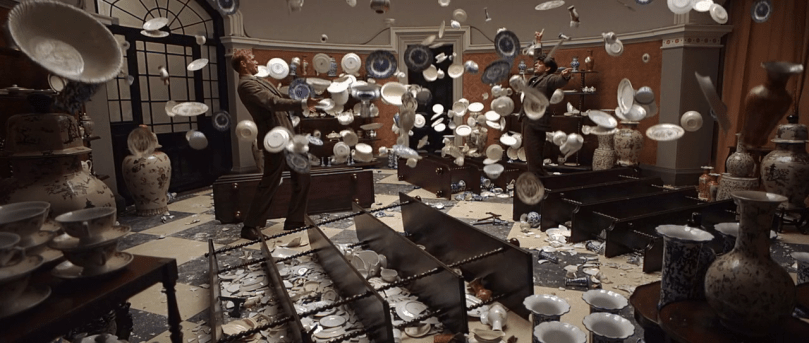
In The Act of Killing, expensive crystal sits behind locked glass as a grotesque monument to power and ego. In the more humble Invercargill homes of The Weight of Elephants, a wet finger run along the rim of a crystal glass sings — until it’s smashed. Here are two films that pick the crystal shards off the floor of human experience and place them before us as uncut diamonds.

‘A Separation’: Sacred Space

A Separation amplifies the spaces between people in a graceful, subtle manner. In a country as prescriptive as Iran, those spaces often equate to physical distance — for example, a man should not lay a hand on a woman who is not his wife — but they are also mental. When should a gap be closed and a threshold crossed? One may have the tools to extend an olive branch, but can one bring oneself to do so?

A Separation - On the threshold

Here, the simple act of shooting a scene across two rooms — the husband on the threshold, his estranged wife cutting vegetables — magnifies that space so that it becomes the third player. You can see in their eyes that they still love each other, even if they are no longer in love.  They still care about each other, still piss each other off, still completely know each other. But the space has become bigger than their mutual understanding. It pushes them to fill it with silence and insults. Their daughter is lost somewhere in that space. Soon, she will step out of it and begin to make her own place in the world.

A Separation - Cutting vegetables

I take a lot more from a scene shot and performed like that than if it they had been in the same room, stepping around each other. I make a space in my mind for their interaction, and the performers are welcome to stretch out in my imagination as much as they welcome me to insert myself into the space on the screen.

And the story continues to churn away on the screen and in my head, coming back to rest on that threshold — and on those spaces. It will carry on developing and expanding for days after I’ve seen it. I wouldn’t be surprised if I returned to this film every decade or so, seeing it differently every time.

A note on the death of Roger Ebert

Roger Ebert (Art Shay)
Roger Ebert (photographed by Art Shay)

I’ve tried several times since yesterday to sit down and write some thoughts about Roger Ebert, but every time I found my words inadequate. If you want to read something coherent about the impact Ebert has had on the world, check out A. O. Scott’s appraisal in The New York Times or Chris Jones’ 2010 profile in Esquire. There is Natasha Badhwar’s 2010 post on her connection with Ebert. You could also read my blog post on the release of Ebert’s memoir Life Itself in 2011, which is also inadequate but better than my abortive attempts in the past 24 hours. Best idea of all: spend some time looking through Roger Ebert’s Journal, the blog he maintained for several years to great acclaim. It’s also one of the few places on the internet where reading the comments is advisable.

The point is that Ebert’s work and philosophy have become part of who I am, and it’s impossible to separate his influence from anything I write — and, indeed, from a lot of what I do. He has enriched me immeasurably through his knowledge and empathy. He’s even introduced me to people I now call friends, which is about the best anyone can do.

I am desperately sad at his passing. He was, and is, My Hero. But he remains present in so many of us, and there is still so much more to be done.

‘Cloud Atlas’: Voices In Time

Cloud Atlas china dream

Cloud Atlas cannot really be described as subtle, but there’s one very subtle effect that wavers gently in and out of the film. Like another repeated metaphor, a shooting star, it’s transient and easily doubted: did that just happen? Did anyone else notice that?

The effect is aural, and something I haven’t heard in a film before. During certain lines of dialogue – perhaps only lines of significance, though I’ll have to see it again to confirm that – a second, ghostly voice is layered underneath. It isn’t loud enough to comprehend, but it’s just loud enough to hear. Cloud Atlas is told across multiple timelines, with the same actors portraying characters in each, and it seemed to me like the layered voices might have been those of characters from other timelines in the film. They could have been words in another language, or they may not have been words at all.

On top of this, the characters read about each other – about their past and future selves – in books, or watch each other portrayed on film. A diagram of the timelines in Cloud Atlas, and particularly the interactions between those timelines, would make little sense but would certainly be interesting.

We keep making the same mistakes over and over, says one character at one point. We also keep doing the same things over and over through time, whether it’s through the words we speak, the desires we hold, the truths we believe, or the music we make. Cloud Atlas itself is a nobly large-scale attempt to talk about something that has been talked about many times before: what does it mean to be human? There’s love, there’s hate, and there’s a lot in-between – including a lot of violence. As the bloodletting reached a crescendo in the third act, and as I jolted in my seat at each destroyed skull, I realised that I had rather grown to care about this world of archetypes and broad gestures. It was a pity about the bar-room brawl, and the mujer ex machina, but you can forgive something so magnificently ambitious for the odd misstep. Our world has flaws, too.

Perhaps if you see it, you’ll get what I’m talking about. Or maybe this is just my own little shooting star in the cosmos. (Did anyone else notice that?)

The Hobbit: Roll Back The Red Carpet

Today The Hobbit: An Unexpected Journey has its world premiere in Wellington – or Wellywood, as Peter Jackson, Richard Taylor, and former Wellington Mayor Kerry Prendergast wanted us to be known. (I hope you’ll indulge me saying ‘us’ even though I’ve only lived in Wellington for a year. I’ve developed quite an attachment to the city and its people.)

This premiere is quite a big deal, mainly because it is a world premiere and will be attended by the film’s stars. They held the world premiere of The Lord of the Rings: The Return of the King in Wellington as well, and it was quite an occasion – the culmination of “the single biggest phenomenon ever to hit our humble little shores”, according to one TV news reporter in this clip. That was kind of how I felt at the time, too. The Return of the King premiere seemed like a celebration of our capacity as a small country to do big things in a humble way. A couple of weeks later, I was watching ROTK in Auckland’s Lido cinema and marvelling at what they could put on the screen nowadays, let alone the fact that the visual limits of cinema were being extended right here in little old New Zealand, and by New Zealanders.

So now, almost ten years later, we have another world premiere in Wellington as Jackson returns to the wizards and elves he knows best. After I came out of Killing Them Softly last night, I found Courtenay Place closed and the red carpet being rolled out:

Red Carpet | The Hobbit Premiere | Wellington | Courtenay Place

Exciting, huh?

No, not really. To be honest with you, I’ve written The Hobbit: An Unexpected Journey off and almost certainly won’t see it in the cinema. The humility and pride of 2003 has been replaced with the political chest-beating and cynicism of 2012. But I’ll get to that in a minute.

At bottom, Peter Jackson’s The Hobbit ought to be evaluated as a Peter Jackson film – because that’s what it is, much more than it is a cultural phenomenon or a Key Government policy. On these grounds, to say that I almost certainly won’t see it is kind of crazy. As much as the Lord of the Rings films were glorified time-pass, I actually quite enjoyed them while I was in the cinema. I forgot them all pretty quickly within days and definitely didn’t watch any of the extended editions, but for those 3+ hours each December, I was entertained and got my money’s worth. That’s all you can really ask for at the movies.

I also expected King Kong to be an awful, bombastic double-rehash of a past classic and the excess of the LOTR, but I actually enjoyed it a great deal. It was as big and loud as suspected but contained unexpected emotional depths. (It also contained a scene in which a giant gorilla pile-drives a dinosaur’s jaw into the ground. I mean, come on. Awesome.) Then there was The Adventures of Tintin, officially directed by Steven Spielberg but unofficially co-directed with producer Jackson, which I loved. Very entertaining and true to the spirit of the books. They even managed to improve the storyline – as I’ve written before, Tintin books are surprisingly full of plot holes.

Going back a bit further, I will also happily watch and re-watch The Frighteners, which I think pulls off the comedy-horror tone far better than a lot of people give it credit for. Heavenly Creatures, meanwhile, is an unforgettable piece of work. I saw it with my mother in Te Awamutu and remember that we hardly said a word to each other for about twenty minutes afterwards. It was probably the first time I was stunned into silence by a film, shocked and moved to a degree that I didn’t know what to say. Jackson’s splatter films aren’t really my thing, but they are certainly admirable for their ingenuity. However, Forgotten Silver, a brilliant one-hour TV film from 1995, is Jackson’s finest hour as a filmmaker and one of my all-time favourites.

So, given Jackson’s pedigree – just don’t mention The Lovely Bones – I should be queuing up for a ticket to The Hobbit with the rest of the country. Why, then, am I casting it aside?

For a start, the manner in which the production was kept here by the Key Government seems very morally suspect. New Zealand now has separate union laws regarding film industry employees, and Warner Bros got a tailor-made tax break not offered to other studios. It was a remarkably political play, led not by our Minister for the Arts, Culture and Heritage but by our Prime Minister (who is also our Minister for Tourism), to keep the production here in New Zealand, rather than see it escape to Eastern Europe or wherever.

And with that, the Key Government was all in. Having made some very specific tax concessions, and having rewritten labour laws for the production’s benefit, they needed The Hobbit to reap some tangible rewards for the country so that the people of New Zealand would accept it. As part of the deal with Warner Bros, NZ was given the right to use The Hobbit as a Middle-earth marketing crutch for the NZ tourism industry – but naturally, the Hollywood studio wore the pants in the relationship, not the small country in the South Pacific. Tourism NZ reportedly had to go to Warner Bros to ask about pretty much anything they wanted to do in their Middle-earth campaign.

This is where things start to get a bit messy, and my head starts to hurt. Tourism NZ has been using a similarly morally suspect marketing strategy for some time, based around the inaccurate slogan ‘100% Pure’. For the release of The Hobbit, particularly the period of months either side of its Wellington world premiere and subsequent global release, that slogan has been transmuted to ‘100% Middle-earth’ (also untrue). In turn, our humility has been buried under the language of advertising, pasted on in slick, shallow layers. (Giovanni Tiso has an excellent post up about all this on his blog Bat, Bean, Beam called Leaving Middle-earth, which I highly recommend reading.)

More than anything else, though, I’m just so tired of the endless Middle-earth advertising. It’s everywhere: on lampposts in the streets, in internet banner ads, on TV, and all over Wellington’s buildings. The film, the city, and the country are all being sold in the same way, an unavoidable triple threat birthed from the one fantastic seed that is The Hobbit. Here I thought The Lord of the Rings was in-your-face with its advertising campaign but I swear it wasn’t as pervasive as The Hobbit has been. Worse still, it’ll happen all over again for the next two Decembers as Jackson stretches a 300-page book into three movies.

It’s like a formerly decent TV show has been renewed for another three seasons after jumping the shark – except as Wellingtonians, the Hobbit show is our lives, and there’s nothing we can do to keep the cameras away.

In the film The Corporation, commodities broker Carlton Brown commented that in our world today, only that which is commodified gains meaning. He said this is in relation to environmental conditions, which are not yet capable of being traded on the open market and therefore of little importance to the richest and most powerful people on the planet. This speaks to the overwhelmingly consumer-driven nature of the society we have constructed: anything and everything can be a product, as long as you can get people to buy it.

I’m no less susceptible to commodifying my surroundings than anyone else, but where that commodification is so excessive as to become blatantly intrusive, I instinctively recoil. And The Hobbit, it seems, is very much a commodity in the eyes of the New Zealand Government, to be bought and sold for as long as it is profitable. When the hype dies down and Tourism NZ/the Key Government move on and The Hobbit stops being a commodity, probably several years from now, maybe I’ll be able to enjoy it.

‘Shame’: The Skull and the Pound of Flesh

Michael Fassbender is a good-looking man but as ‘Shame’ continued on to its bitter, brutal climax, I noticed I was hardly seeing the person any more. Even the character, Brandon, who is mostly silent and empty but completely believable, was gradually stripped away. All that was left was a skull.

It was particularly obvious in one very depressing threesome scene. (The sex in this film is not at all titillating.) A skull with a body attached, gruesomely contorting the skin and flesh that encased it as it drove itself to temporary gratification. When it wasn’t having sex, or jerking off, or seeking sexual gratification in other ways – any way, really – it moved smoothly and almost invisibly in the world of men. Its work and shelter were secondary to its pursuit of every kind of orgasm.

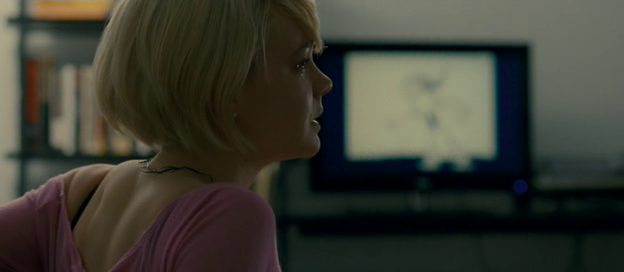
Brandon’s sister Sissy, played by Carey Mulligan, is the opposite: always on show, always giving everything she has, but almost always into holes which give her nothing back. Given their opposing personalities, Sissy and Brandon are only able to connect for brief moments, usually in mutual anger or disgust. Finally, through extreme means, they manage to feel and express affection for one another, but that too is only brief.

I really hope Brandon and Sissy help each other sort themselves out. The cycle of addiction and gratification is strong, though. It’s going to take a lot of work.

‘Melancholia’: Embracing the Fire

Justine (Kirsten Dunst), a hollow spectator on her own wedding night, searching for sensation, peers through her brother-in-law’s telescope at a hot air balloon. It is white, decorated with messages of good will from the wedding guests. They watch and cheer around her and her husband, a man who loves her but cannot make her happy, despite his desperation to do so.

But through the lens, Justine cannot make out the messages on the balloon. As it drifts away into the night, high above immaculate grounds, all she can see is the fire burning at its base. The fact that the fire sustains the wellwishers’ intentions for a long and happy marriage is irrelevant; to Justine, the fire has a clear purpose and meaning, where the fabric and ink do not. However, even the fire drifts further and further from her with each passing moment.

She turns away from the telescope and dutifully smiles to her husband. The night goes on without respite for her emptiness.

Later, she will welcome and embrace the fire and help others to do the same. The scene will play out with the same inevitability she has felt for so long, possibly years. In that moment, she will find – not happiness, not even contentedness. She will find acceptance.

Read more about ‘Melancholia’ at IMDb and in Roger Ebert’s review.

In praise of Roger Ebert

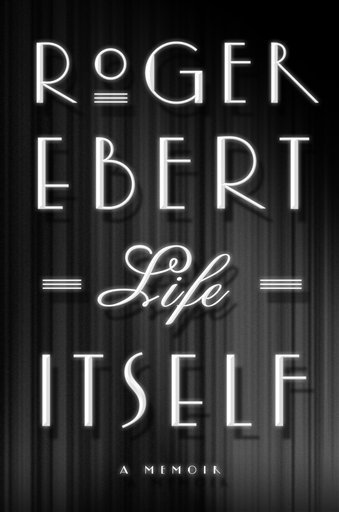
'Life Itself' by Roger Ebert, on release this week

“But now it’s getting late, which means he has his own work to do. Chaz heads off to bed. Millie, for the moment, hasn’t been seized by night terrors, and the brownstone is quiet and nearly dark. Just the lamp is lit beside his chair. He leans back. He streams Radio Caroline — the formerly pirate radio station — and he begins to write. Everything fades out but the words. They appear quickly. Perfect sentences, artful sentences, illuminating sentences come out of him at a ridiculous, enviable pace, his fingers sometimes struggling to keep up.”
-‘Roger Ebert: The Essential Man’, by Chris Jones, Esquire, March 2010

Roger Ebert, more than anyone else, is the reason why I wanted to be a writer. I think most of us have an initial reference point from whence our passions arose, like a car enthusiast’s formative obsession with the 1961 Lincoln Continental convertible or a young swimmer watching Michael Phelps sweep eight golds at the Olympics. I write because I have always written, since I was a small child, but I take my inspiration from Ebert above all others. His writing is honest, principled, informative and articulate, always entertaining, never boring.

When I first started this blog on Blogspot back in 2004, it was to practise writing film reviews, and I said in the first entry (since deleted, time wasn’t kind to those words) that I hoped I would one day be Ebert. I hadn’t actually been reading him for very long at that point – maybe a year or so at most – but he’d already become the standard to which I aspired, for reasons I’ll attempt to put into words further down the page. It was my plan to write reviews of most of the films I saw in an effort to get better at watching them, but my bigger hope was that I would at least become a better writer, if not a successful one.

Over time I’ve written less and less about film, and taken on a wide range of other writing influences. To my great surprise, it is India that has given me the inspiration, impetus and support to be a bit more successful as a writer, and not film. However, I’ve continued to read Ebert – who in fact has also written less and less about film, proportionally at least. In addition to the weekly film reviews he’s been filing regularly for over 40 years, and the other writing he’s compiled in the form of interviews, features and books, Ebert now has a blog, too. He writes on many subjects besides film, most of them aspects of his colourful life Every entry is a joy to savour. The blog was the main reason behind his winning the 2010 Webby Award for Person of the Year – not only for the quality of the blog entries he posts but also for the quality and depth in the comments he receives, which are sometimes even more fascinating than the entries themselves.

The definition of a good writer is elusive, and likely subjective. The standard of one’s readers, like the myriad folks who comment on Ebert’s blog, might be a pretty good one. But a definition that appeals to me is this: a good writer articulates thoughts in ways the reader might not have arrived at on their own. Even if they are thoughts with which the reader strongly disagrees, the writing itself can still be compelling in the hands of a vivid wordsmith. Take, for example, Arundhati Roy’s work in recent years, which can be as misguided as it is literary. On the other hand, saying what a lot of people are thinking can be even harder; one has to work the words on the page into a form that somehow impacts on a reader who agrees with them before he or she even reads them.

With Ebert, whether I completely disagree with him, completely agree or am ambivalent (I usually agree), there is always something new to discover in his words. Perhaps some film fact I never knew, or the name of a new actor to watch; most often, it is the sentences themselves that offer the greatest delight. They frequently surprise me, flicking a ‘how did he do that?’ switch in my head.

I find Ebert’s words returning to me at unexpected moments as a way of articulating what I see before me, or to offer something of value to a conversation with someone else. Ebert’s words are often so tightly formed that they sometimes seem to have always existed, like he plucked them from the sky and set them before me. And his words become part of me even as I read them.

After decades of getting those words in small chunks (though nowadays, with his blog and Twitter and Facebook etc, those chunks arrive more frequently), now we have Roger Ebert’s memoir ‘Life Itself’. Thousands upon thousands of those words, all arriving at once, and I am certain they will be just as much a joy. Thank you, Mr Ebert, for being such an inspiration.

Imprints: 127 Hours / Cee-Lo Green / Phoenix / CocoRosie

127 Hours (2010, dir. Danny Boyle): Another work of style with just enough substance from Boyle. You probably know by now that it’s a true story about a dude who gets his arm trapped under a rock in a remote canyon, and is faced with a horrible choice. James Franco is good, the film is decent and certainly uplifting, but I’d class it as merely an above-average time-passer. (W) Worth a Look.

Cee-Lo Green – The Lady Killer (2010): Could never live up to my expectations after seeing one of the greatest videos of the years, which features his ‘Fuck You’ to delightful effect, but this is a listenable combination of throwback to Motown-era charm and Gnarls Barkley-ish chopped-clean production. Bright Lights, Bigger City is the best walking or driving song in a while. (W) Worth a Look.

Phoenix – Wolfgang Amadeus Phoenix (2009): I’m still so enraptured at the way track 4, ‘Love Like A Sunset’, was used in Somewhere that when I try to listen to this album, I can barely get past it without hitting repeat. OK, the other songs are good, some of them very good, and I really like this album, and you should listen to it. ‘Love Like A Sunset’ is just ridiculously epic. (R) Recommended.

CocoRosie – La maison de mon rêve (2004): First heard of CocoRosie when they performed the best song of the 00s live with Quinn Walker, but only picked up on their debut album lately – it’s really good, discordant at first glance but quickly altering the way I interact with the world around me. The use of a Godzilla toy’s roar on opener Terrible Angels is a perfect example of their experimental, carefree sound. Don’t know what the rest of their output is like but if it’s the same feeling with better production values, sign me up. (R) Recommended.

Sofia Coppola’s ‘Somewhere’, a place worth visiting

IMDB / Ebert / Hornaday
Starring Stephen Dorff and Elle Fanning
Written and Directed by Sofia Coppola


Rating: H (Highly Recommended)

Sofia Coppola’s Somewhere is like Jackass without the stunts, or maybe Jackass when the camera isn’t rolling. I’m not just saying that because of the presence of Chris Pontius, that laconic joker famous for his ‘Party Boy’ antics. Somewhere is almost Dadaist as Coppola lingers on bizarre showbiz images such as its star covered in putty for a face mould, or a ludicrously bombastic Italian awards ceremony, and gently pulls down the façade of Hollywood nicety with a subtle, non-judgmental eye. Johnny Marco, the nearly mute anti-hero, bounces from one corner of his irrational movie star life to another – rich, unsatisfied, stagnant.

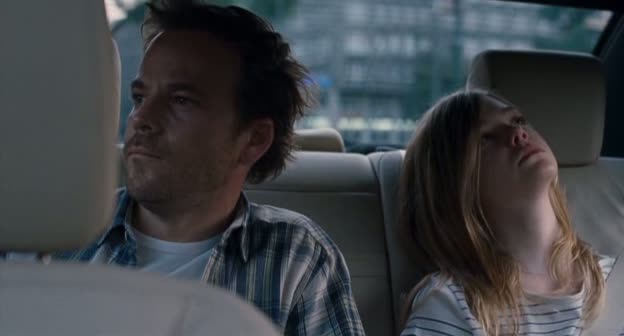
Enter his daughter Cleo, the Figure of Redemption, but don’t worry. It isn’t that kind of movie. We can only assume that prior to the events in the film, Johnny saw Cleo on a semi-regular basis but was too wrapped up in endless parties and women to truly notice her. Now, as a result of certain circumstances, she’s going to be more present in his life – for a while, at least, maybe just long enough to make a difference.

Really, it’s okay, it genuinely isn’t that kind of movie. I mean, it is: a classical story, lost and/or deluded and/or miserable soul has his life thrown into perspective by the arrival of someone with simple, innocent meaning and purpose, both in her own intentions and in her relevance to our anti-hero’s life. What’s different is that Coppola takes this story, so often overdone and blandly unsubtle in films, and strips it back to the point of elusiveness. We witness a series of disconnected moments, often played out with a near-total absence of dialogue, and rather than there being an obvious narrative thread, it’s more our own expectation that creates one.


As a result, Somewhere will be infuriating and – even worse – incredibly boring to some viewers. For those who are willing to go along with Coppola’s sound- and image-focused style and put the idea of a Good Story to one side, however, Somewhere is a meditative treat, a joy. It even approaches the divine as she pulls the whole thing together in a glorious, grand (yet still understated) finale, stretching out the back end of Phoenix’s ‘Love Like A Sunset’ – with its eerie Wendy Carlos synthesizer and subsequent glorious release – in a moment of true movie magic that I could not resist.

Stephen Dorff is very watchable in the central role; I particularly liked the fact that despite being a big movie star with an endless parade of half-naked women fawning around him, he never comes across as a total dick. He’s polite to people whether he knows them or not; perhaps the stream of ‘you are such a fucking asshole’ SMSes he receives are the result of a prior attitude we don’t get to see. Then there’s Elle Fanning, who is an utter delight as his daughter. She’s just the kind of daddy’s little girl that fathers would want to do absolutely anything for: cute, sweet, talented. The key phrase there is that Johnny does indeed want to do anything for Cleo, but it’s evident that in the past, he simply hasn’t.


Neither of these two is the star of the film. That would be Richard Beggs, sound designer extraordinaire, who would also have been the star of Lost In Translation as well if it hadn’t been for the incomparable Bill Murray. Somewhere needs to be watched with the best sound possible so that you can appreciate the space of each scene – the grumble of Johnny’s Ferrari, the crackle of his cigarette as he smokes it down to the filter. Combined with another well-employed score of popular and atmospheric music, Beggs has crafted an aural wonderland yet again.

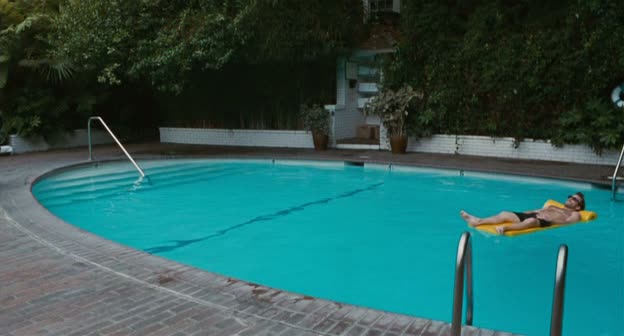
And then there’s Sofia Coppola, who by now has leapt well and truly out of her father’s shadow artistically. She stays within her limitations as a filmmaker, but what fascinating limitations. Her productions feel a little like really expensive student films in their scope, spare and mood-focused, and she is fortunate to have all the backing and support she could ever need (just check out those names in the ‘Thanks’ section of the credits). We’re fortunate that she uses that support to give us images of unexpected beauty in emptiness, like Johnny drifting lazily out of frame on a yellow Lilo inflatable sunlounger in the hotel pool, or his near-catatonic plucking of a pear from the fruit bowl on his coffee table, only to return it seconds later.


You may not learn anything from Sofia Coppola’s Somewhere, save for a few insights into the private lives of Hollywood stars. If you’re willing to submit to her freeform approach to filmmaking, though, you’ll be rewarded with another immensely satisfying tone poem of real lives and subtle movie magic. It’s not as good as Lost In Translation, of course, which she is unlikely to better even if she makes movies for another 50 years, but Somewhere is fit to be mentioned in the same breath, and it stands firmly on its own as a showcase for the gifts of sound and vision.