You’re Very Not Welcome

Those who know me or follow me on Twitter have heard all about my bizarre and extended difficulty at leaving India. For those who don’t, or who want to get ‘reacquainted with the facts’ as Gandhiji would say, here’s a quick summary (feel free to skim over, this isn’t the important bit):

1) I was asked to leave India because my salary is too low. The Foreigners Regional Registration Office (FRRO) in Thiruvananthapuram told me that I had to get out before July 5, which was when my final visa extension would expire.

2) However, in two and a half years here I’ve never received an actual physical stamp of extension from Delhi, so Immigration rejected me at Mumbai airport and scolded me for not having an exit permit. (The FRRO had told me that I didn’t need anything to leave.)

3) I returned to Kerala to get the exit permit, which I was assured would be ready by Friday 8th July (yesterday); it wasn’t, of course. This meant rebooking my flight a second time. The FRRO insists to me the exit permit will be ready on Monday 11th; I’ll take a train to Mumbai on Tuesday 12th and fly on Wednesday 13th, hopefully to be in NZ Thursday 14th.

4) [I’ll leave this space blank for whatever goes wrong in the coming days. There will surely be something.]

(I acknowledge that it is ultimately my fault that I’m in this mess, because if I’d done more research back at step (1) I’d have known of the need for an exit permit. I’ve lost upwards of Rs 30,000 as a result, which was all the money I’d saved for my intended one-month holiday in New Zealand (most of which would go towards a tour of the country to visit family), so when I get back to NZ it will be for an indefinite period of time and I will be looking for work straight away.)

Okay. Those are the facts. What I want to talk about now are the implications I derive from this saga about where I am or am not welcome.

In India, a key philosophy is that ‘the guest is God’ – or, in other words, a visitor is a blessing and should be treated as such. Whenever I visit somebody’s home, all the family members present will be called to come and welcome me. I’ll be seated in the most comfortable chair in the living room and someone will bring tea and a selection of snacks (or, if it’s around lunch or dinner, a small meal). The TV will be switched on so that I have something to watch, if I so wish, and to make me feel at home (I don’t own a TV but okay, the gesture is sweet). Until the time I leave, the house’s entire focus will be on me. If a child sleeping in another room wakes up and starts crying, someone will quickly go and return with them, missing only a few seconds of doting on me, the guest.

This literal sequence of events has happened many times over during my three years in India. Apart from that, I am very fortunate in that I know many wonderful people in India (again, both in person and on Twitter) who have made me feel extremely welcome here. I’ve even felt at times like I belong – which is ideally how it should be. We’re all human, after all.

The past month or so, however, has been a constant struggle against a system which simply does not care, and certainly makes no effort to make me feel welcome. I’m by no means saying that I deserve special treatment – and my experience is not even close to the worst it can get for a foreigner, let alone a poor farmer in Bihar – but between traditional Indian hospitality, which I so keenly feel among regular people, and the impenetrable bureaucracy of the government and its processes, there’s an enormous disconnect.

When one government worker rebukes me loudly and openly for following the instructions of another government worker – which is what happened at the airport – I certainly don’t feel welcome, even as I was being told I couldn’t leave. When one government worker rebukes me for following his own instructions – which is what happened the moment I got back to the Trivandrum FRRO – I feel absolutely insane, like an insignificant insect who keeps knocking on the door of the system, thinking ‘this time they’ll listen’. The FRRO then went on to lie to me about what he would do to help me, just to get me out of his office; once my planned exit permit fell through yesterday, he finally adopted a remorseful and guilty tone, though of course he didn’t apologise.

I still take responsibility for not getting things done the right way at the start, but all this just made me think that there’s only one place where I am truly welcome, and that’s New Zealand. Why? Because I hold a New Zealand passport. Most of my family is there, and they do accept and support me wonderfully, but the passport is the key here. After all, there are kind and genuine people everywhere, and thus potential for feeling a sense of belonging wherever you go, but the only order of law that will serve my interests is that of New Zealand.

Naturally, every single one of my calls to the New Zealand Consulate in Mumbai was answered respectfully and with great care, including several times by the Consul General himself. Concurrently, I spent three days calling the Trivandrum FRRO while I was in Mumbai but he rejected the call or let it ring every single time; I had to travel 2000 kilometres over land just to speak with him. This now does not surprise me. He is part of a system which is neither set up to look after nor care for me, let alone make me feel welcome.

So, back to New Zealand I go, unsure of my next move. I had intended to come back to India at the end of July – I even booked a return ticket – but that is now impossible for a number of reasons both financial and temporal. New Zealand is my legal home and I can live there largely free of the hassles of bureaucracy, so it makes sense to be there while I get back on my feet.

The most distressing implication, for me, is that in today’s world one simply cannot expect to feel automatically welcome with one’s fellow men and women around the world. In fact, the opposite is true. In India, since the 26/11 Mumbai attacks and the David Headley scandal, the majority of people – especially government officers – are extremely suspicious of foreigners. By the sounds of things, it’s the same everywhere. Foreigners have plenty of trouble trying to enter or remain in the United States, in Europe, and in New Zealand. The fallacy that outsiders pose the greatest threat to a nation’s security has become rule of law.

I’ve made a number of deep and strong human connections in India, connections that I hope will last for a very long time, and I have in many ways felt at home here. Those connections, those people, are a home of sorts. (I’ve been thinking a lot about what ‘home’ is lately, especially since I was asked to leave India; am working on a long-form post about it.)

Those connections will have to wait, though, or at least remain strong across continents until I’m in a position to wade through the bureaucracy once again. I can’t help feeling that there must be some way that we could all move freely, as if each of us were a citizen of the world rather than a particular nation. But it would require everyone to behave with the collective good, the best interests of our species, at heart. That is hugely idealistic and unrealistic to begin with; now that the system is set up to engender suspicion of foreigners and promote the idea of ‘us versus them’, such a genuine global community is unforeseeable.

It’s a bitter pill to swallow, especially when I know that in a place like in India, the prevailing traditional ideology was to be welcoming. I suppose I’m lucky that I’ve been able to experience its influence with so many great people. More than anything, those people and experiences drive me to overcome the system, to jump through its hoops and fight it if necessary, just so I can spend an extra minute in their company.

Tracks I never tire of: ‘A Higher Place’

‘A Higher Place’ by Röyksopp, 2001, from the album Melody A.M.

Röyksopp had two big hits from their debut album Melody A.M, ‘Eple’ and ‘So Easy’, both of which appeared on almost every chillout compilation album for the next few years, and both of which had great videos.

They were decent enough tracks, and listening to them had a similar effect as popping sheets of bubble-wrap. Save for the high-pitched, bleeping melody of ‘Eple’, they weren’t that challenging, and they were a little bit fun, and they passed the time, but there wasn’t much more to them. Same deal with most of the rest of the album. For me, though, one track on Melody A.M. stood out as seeming to come from somewhere deeper, darker and more mysterious, and it was appropriately titled ‘A Higher Place’.

Röyksopp waste no time on ‘A Higher Place’. It kicks off with a three scene-setting drum hits and then goes straight into the main loop – a simple percussion sequence embellished by a few soothing synth chords, a constant floating, shimmering motif and, eventually, some minimalist vocal samples. It quickly establishes an offbeat-yet-driving tone and, apart from the subtle loop variations and chord changes, mostly stays there. The few repeated synth gestures are sporadic at first but become more frequent as the song continues – a steady, subtle escalation. There is no hint of verse or chorus, only variations on the same four-bar phrase – poison for some, but just the kind of thing I love.

The lyrics are simple – “take you to a higher place” – but ‘A Higher Place’ doesn’t necessarily take you all the way there. What it does is even better, something the best music (and art in general) manages to pull off: it suggests the existence of such heights rather than presenting them to you explicitly. The track is as ecstatic as the best scenes in Hitchcock films are scary, where the horror is suggested rather than shown. Röyksopp seem to bring you a glimpse of something out of human reach, just enough to get a sense that it’s out there, just for a few minutes.

There is one moment, at 2:44, that is among the closest to a metaphysical paradise as I know in contemporary music. The beat drops off and then all the synth and vocal samples dissipate, leaving a quick moment of silence before – the beat drops again, slightly more complex than before, with a new chord as a landmark to shift the tone a degree out. It’s a moment infused with subtle wonder, deflating my ego in a single beat and just forcing me to listen.

Read about more tracks I never tire of here.

Learning How to Blog

No, Jdanspsa Wyksui isn’t dead. Yes, this is another one of those ‘no, the blog isn’t dead, don’t leave yet, please’ posts that you see on a hundred dormant blogs anytime you crack open the Pandora’s Box of the blogosphere.

Taken with Nokia 2700 classic
Varkala beach at sunset, June 2011

The difference between those desperation posts and this one is that most of those ones are already months old and have been followed by roughly zero updates. I’m not going to do that, promise. I’ve been accumulating ideas for posts on here for a while but just never getting around to writing them up, and with a bit more time management in the forthcoming months, they’ll trickle in and (hopefully) be half-decent.

It’s not that I’ve been sitting around watching bad films or drinking lemon tea on the verandah, or whatever it is normal people do when they aren’t blogging. (Although I have at times been doing both of those things.) Apart from working three jobs (plus a secret fourth), I’ve been getting kicked out of India, shocking strangers, decrying pornography and – most terrifying of all – dabbling in economics. I’ve also been tweeting quite a lot.

So yeah, I’ve been passably busy. The question is, after hanging this blog out to dry – again – why should I come back to it, especially when I’m already writing elsewhere? And why should you bother reading it? Well, I have a lot of ideas that I want to write about somewhere but just don’t think would fit anywhere else. Things like:

Timbuk3
The future's so bright...

More than ever, though, I feel comfortable with just sitting and writing, and am figuring out how to do it better for an audience (even an audience of about 3 people) over a long period of time. If I were a pretentious git, I’d say it’s a bit like I’ve been on a sabbatical, blogging elsewhere, reading a lot, taking low-quality photographs, pursuing new and old interests… learning how to blog, because I never really figured out exactly how.

What this most likely means is that you can expect to be very bored, very soon. Still, I try to keep in mind that I write for myself first and foremost and that if anyone else is happy to tag along, that’s a bonus. I’m hoping I get this right from now on, and you enjoy reading my words almost as much as I enjoy writing them.

Music, An Anchor for Memory

Right now I’m listening to ‘Province’ by TV on the Radio and it’s hot and humid, but the feeling inside and around my body is bitterly cold. The sounds of music and exploding crackers are pretty much constant outside from the three separate temple festivals going on near my house in this little tourist town in rural India, but through these headphones, the song takes me back to an inner silence deeper than most I’ve known.

Return to Cookie Mountain, TV on the Radio’s second album, came out in 2006 and I bought it the same weekend it was released. It was the middle of winter and I was living in Christchurch – yeah, that place that got hit by a big earthquake a month ago, but not as big as the one in Japan, but still pretty big.

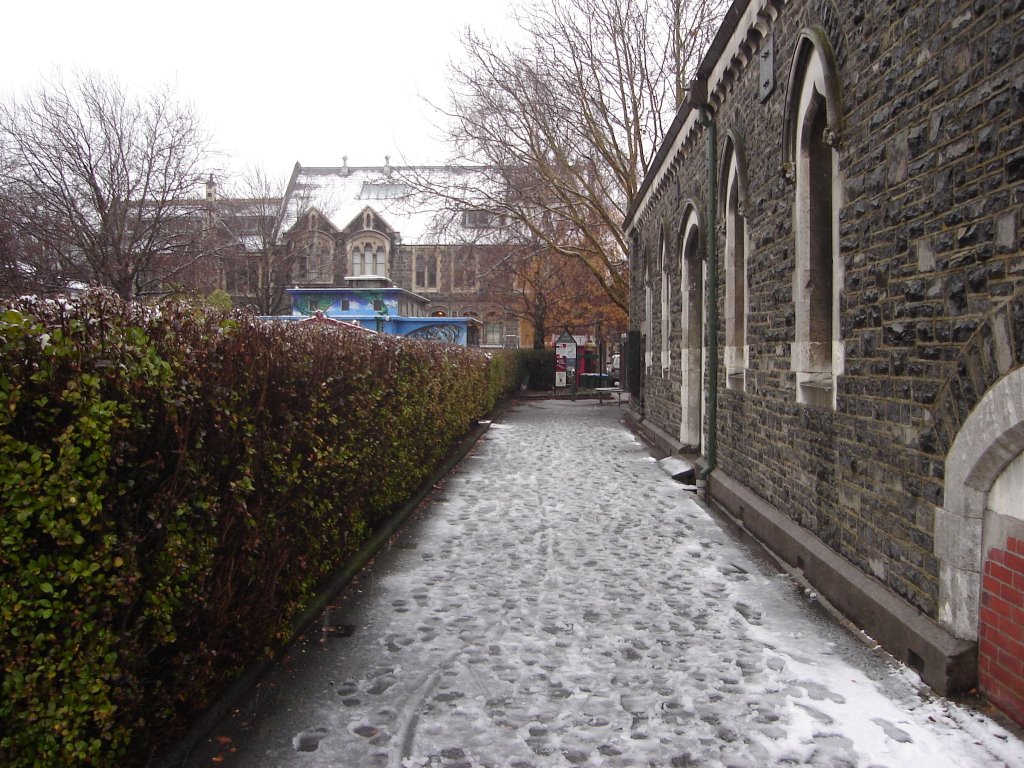
I was living in the centre of town, in a building which apparently no longer exists, and working just a few minutes away next to the city’s main landmark: Christchurch Cathedral, and its Cathedral Square. I walked that 750 metres to work and back hundreds of times over a year and a half living in that flat, and while the brilliant blue skies and pleasant, dry and warm summers were wonderful, I’ll always remember Christchurch for its winter.

Christchurch winters aren’t desperately cold by global standards, hitting probably -5°C most nights in the July that Return to Cookie Mountain came out. This was cold enough for me, though, having grown up in the warmer North island, but luckily there was a trade-off: of the hundred bone-chilling nights of each year, one (or maybe two if we were very lucky) would be covered with real snow.

To warm that chill in my bones in the evenings, I’d take my CD player and listen to something as I walked. The walk to work was only a song’s worth, or half a song if I was listening to Orbital, and while I sometimes had my earphones in as I walked in the door of the souvenir shop I worked at, I usually felt like I was being a bit gratuitous. I mean, how hard could it be to walk five minutes without a personal soundtrack to occupy me, to handle the world outside my home without cutting out its sounds and replacing them with something which seemed more like part of me?

The walk to the video shop, however, was different. I would go to Alice in Videoland every Thursday evening to drop off last week’s rentals and pick up new ones. Wednesday and Thursday were my days off back then, my weekend, and I could hardly think of a better way to spend an hour than browsing the shelves at Alice’s. And being a full fifteen minutes away, I could fit in three songs, making the CD player a much more reasonable option – and for a good month or so, those three songs were the first three tracks of Return to Cookie Mountain.

I’d throw on my long black jacket, shove the CD player in the inside pocket, lock the flat behind me and press play as I got out into the street. Shuffling my gangly, poorly conditioned limbs along those gold-tinged, immaculately paved streets with TV on the Radio in my ears was pretty much perfect. I’d go into and through a near-empty Cathedral Square and as I came out the other side to cross Colombo St; a gust of icy wind from the Port Hills would throw my hair up and cool my face, and I’d wrap the front of my coat closed to ward off the cold.

Right about then, Province would start up. And I’d listen to it, Adebimpe, Malone and Bowie wailing about love in harmony as I walked on down High St Mall and then High St, past that cafe (whose name I’ve forgotten) I ate at with Ed and Rach, past Helen’s design studio, the song closing out just as I stepped off the street and into Alice’s – ah, heaters – the new releases there, as always, to greet me.

And I never forgot that feeling, somehow, without ever thinking about it. The music gave me an anchor on which to hang the cold, the coat, the flat and the paving stones, the cathedral and Alice’s, all those feelings enveloped by the sounds in my ears. On those 15-minute walks, ‘Province’ took on its own private meaning for me, one which I didn’t realise at the time: it would be the song that took me back to a certain time in my life, a particular feeling, the subtly indescribable emotion and physicality of it.

It’s simple, really. The memory is stronger than the song, but as an element of my life which remains constant however far I get from the memory, the song is what brings it all back. That’s to say, I can listen to ‘Province’ today in my hot house in India and it will still be the same ‘Province’ as it was four and a half years ago on the cold, dry, clean streets of Christchurch. The memories, dormant in this magnificent organ called a brain, come flooding back as clear as ever when I hear those simple chord progressions struck firmly on the piano.

It isn’t classical conditioning, but I’m sure there was something I concurrently studied in psychology classes that matches up. I see songs like ‘Province’ as an anchor on which I hang my memories, and it may have only been a flash of a millisecond back in 2006 where I felt the music, the cold, the city and everything else that stayed with me, but sometimes that’s enough to bring it all together and cohere into a memory that stays with you for the rest of your life.

Now, tell me your musical anchors.

(My brother wrote about this ages ago, so check out his post too. I give him the credit for getting the idea out first and for being an inspirational older brother who inadvertently plants ideas in my head.)

“The joke happens in real life and then I blog about it”


Jayanth Tadinada, aka g2, is the author of gtoosphere, a blog of satire inspired by his life as an IIT student and a member of India’s growing upper middle class youth. He is also my colleague on The NRI, contributing regularly hilarious posts such as his aam aadmi interviews.

His posts on gtoosphere are a mix of observations about television media, social networking culture and Indian society in general, and they often seek to explode myths and inspire people to look at the world around them in a more mindful way. In the line with his heroes, his method of confronting people is to amuse, something at which he succeeds apparently effortlessly. His irreverent ideas come across as equally inspired by Indian and American senses of humour, and will hopefully strike a chord with many.

Jayanth did me a favour and answered a few questions to help me get this Inside the Bloggers Studio thing rolling again, even though he is a busy college student preparing to join the salaried masses.

***

Why did you start blogging?

There was a phase when I was bunking a lot of classes and yet I was not happy. (Those were pretty depressing times!) I felt I needed a better reason to continue bunking classes. So I thought a hobby might help.

In your first blog post, you mention a diary. Is gtoosphere an extension of that diary, and do you still write it alongside your blog?

No, I don’t write a diary in the traditional sense anymore. I maintained a diary for a couple of years in high school. It was mostly about what was happening in my life around that time. After coming to IIT, I no longer felt the need to keep an account of things happening in my life.

I was into reading psychology for fun (nerd alert), interpretation of dreams and stuff like that. I started maintaining a dream diary where I describe the dreams I have at nights (afternoons actually). We remember our dreams only for a very few minutes after we wake up. So I always sleep with a book and a pen somewhere close to my pillow. (Yeah, I know that’s weird!)

For the last year and a half or so, I developed the habit of noting down funny ideas, silly observations and interesting thoughts as soon as they pop in my head. I store them in Google Wave (yes, Wave!) and refine them from time to time. So technically, I do write a diary but it’s more about what is going on in my head rather than what is going on in my life.


What is your first memory of writing creatively?

The first time realized I enjoyed writing was when I was writing essays in high school. Most of the topics were very dull and ordinary like ‘your hometown’ or ‘post man’. I took it as a challenge to write those essays in interesting ways.

I often broke the conventional school essay format and made up stories with long dialogues, exaggerated descriptions and bizarre storylines loosely inspired from the Famous Fives and Hardy Boys I was reading at the time! Luckily my English teachers did not discourage that sort of behavior and often rewarded me (with generous grades) for my attempts, however lame they were!

Describe something that is beautiful to you.

I consider any of the little things that momentarily make me lose sense of time as beautiful. It could be a movie or a book; a conversation or a cat playing; filter coffee, National Geographic channel, a warm shower on a cold morning, dessert before main course, an intelligent conversation, yawning, huge spiders, useless trivia… it’s a very long list.

I also find extremely complex stuff like snakes, Scarlett Johansson, the human brain, religion, the Internet, Godavari, classical music, history etc. all to be very beautiful.


gtoosphere fits quite nicely into Indiblogger category of ‘humour’. Are you ‘the funny one’ among your friends in real life?

Yes, I am definitely ‘a funny one’ if not ‘the funny one’. Most of my friends have a very good sense of humour too. I get most of my ideas from the conversations I have with my friends and my brother.

What differences are there between telling a joke in real life and telling it on your blog?

The joke happens in real life and then I blog about it. That is usually how it is. A joke in real life is about timing and spontaneity, it just happens. But when you’re writing a joke, you have the time to think and build the context. So the onus is on how funny the idea is to begin with. Maintaining the flow, the punch lines, the comic art – all just follow from the idea.


Speaking of Indiblogger, you’re quite active on there, as well as on Facebook and sporadically on Twitter. How important are social networking sites in relation to your blog?

Very important! They are the lifeline for my blog. I would have never got myself to write anything more than sticky notes if it is not for the instant feedback that I get from readers through social networking sites.

Comic art is integral to many of your posts. Which do you enjoy more, drawing/design or writing?

What I enjoy most is the ideas – coming up with them and connecting two or three ideas that people wouldn’t otherwise think of connecting. That is what drives me. I also immensely enjoy the process of refining the lines over and over trying to find that elusive economy of expression. I feel I am moving in a direction where words come easier to me than strokes.


Name some of your favourite satirists, and whether they’ve influenced your own creative style.

The first comedian that comes to mind is Jerry Seinfeld (his standup). He has this ability to point out really silly things around you which makes you go, “how did I not think of that first?” In one of his interviews, he explains that he never uses profanities in his material because he feels that (in many cases) they are a shortcut to get a few cheap laughs. I adopted that policy for my blog too.

One more thing I picked up from him is to not misrepresent anything just for the sake of getting a laugh. This pushes me to work from an honest feeling about something. So when I joke about how the aam aadmi doesn’t deserve any sympathy, I really mean it!

George Carlin is a personal hero of mine. His body of work is just so vast that it’s an encyclopedia on how to construct a joke. The philosophical undercurrent that runs through his material had a huge influence on not just my writing but on me as a person as well.

Larry David, the genius behind Seinfeld (the sitcom) and Curb Your Enthusiasm is another big influence. He kind of convinced me that profanities are funny when used in a tasteful way but I decided to stick with Seinfeld on that one ;)

When it comes to political satire, Jon Stewart is the best it can get. All my posts on politics and media were directly or indirectly inspired by him. I also like Bill Maher (I did a couple of “New Rules” posts) and Woody Allen.

I love Telugu comedy in general. I think we people have an amazing sense of humour. I am a huge fan of Mullapudi Venkataramana. He is a genius when it comes to capturing the beauty, the simplicity and humour in middle class life – something that our entertainment industry completely overlooks.

Is there a post on your blog that you are most proud of?

If I have to choose one, I’d probably choose my take on Meter Jam. This campaign sort of summed up the attitude of the young city folk of my generation. They protest because it is cool and they only do it in the comfort of their Twitter and Facebook accounts. Their anger in most cases is justified but none of them are inclined to do anything more than cathartically yell at the symptoms.

I am also proud of the articles I wrote for The NRI. I really pushed myself to write about issues that I wouldn’t have written otherwise and they were very well received too.


Do you believe in God?

Depends on how you define God. When I was 13 or 14 years old, I was like, “If the Gods are really that powerful, why do I even have to pray? Don’t they have access to the wish list on my Facebook profile?” That was when I realized praying for material things makes no sense. I’ve been kind of agnostic since then.

But I feel that Hinduism (technically, it’s too broad to be an -ism) is an awesome religion to be born in. It gives you a lot of freedom of thought. You can be atheist or agnostic and still be a Hindu. The line between culture and religion is really blurred in India. I never pray but I do celebrate all festivals. (If you remove the puja from the festivals, all you’re left with is good food, family reunions and fun activities. Now who doesn’t like that?

I love the culture. I love the mythologies. I have immense respect for the religion and its philosophy. I just don’t subscribe to the over-the-counter-30-million-Gods-in-the-skies version of it! I only scratched the surface of Hindu philosophy and I definitely want to go deeper. Not now but maybe later!

***

This interview is part of Inside the Bloggers Studio, an ongoing project of short interviews with bloggers I read and admire.  (Apologies to James Lipton.)  To view the archive, click here.

Talking points from India v Bangladesh

I have written before about being tired of too much cricket, but this World Cup is in India, and I’m beginnning to care more the national team’s fortunes. I think that just happens to everyone who stays here long enough, because India is completely cricket mad. It’s not that every last person is in a cricket thrall, but even if only half the population cared – and I’m guessing the percentage is a little higher than that – you’ve got 500 million plus flag-waving, tv-shooting supporters.

In the first match of the tournament yesterday, India thrashed their co-hosts Bangladesh with a fantastic batting performance. Follow the link below for my talking points from the match, including why Virat Kohli is the most dangerous player in India’s batting lineup, but for now here’s why the Kerala connection – wild and wacky fast bowler Sreesanth – was my favourite thing about the day:

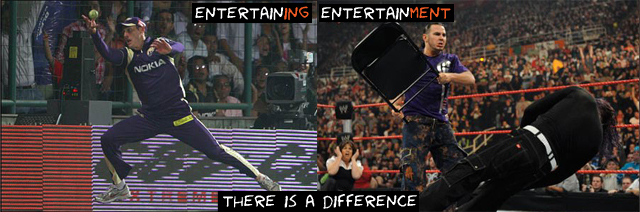
Personally, the best moments of the day came when Sreesanth was bowling. He’s the one wild card in India’s pack: utterly unplayable one ball, overstepping and shipping wides the next. To me, he looks perpetually in need of a cigarette. Even if he goes for ten an over, I hope he keeps his place purely for the entertainment value he brings.

Read more at The NRI…

My First Meditation

A couple of years ago, a friend recommended that I try meditation. I had a lot of barriers up and found it hard to focus on anything, let alone what I wanted to do with my life, and she thought meditation might help.

Well, it took me three whole years, but I finally tried it. Gavin, a guy I met via CouchSurfing, turned out to have experience with Vipassana meditation and offered to lead us in a short session. In times past I would’ve said something like, “Yeah, we should totally do that sometime, that’d be awesome,” and then never actually done it. This time, I jumped at the chance.

The experience was full of unexpected lessons, ideas and delights. Above all, it brought home how quickly and far the mind can wander:

Start with the breath, the air crossing my upper lip. My… moustachioed upper lip. The air’s only coming out of my right nostril. The left one must still be blocked from that strange illness I had last week. The vitamin B complex tablets seem to have fixed me up, though.

Come back to the breath. In… and out, my chest expanding and contracting. The guests in the next room are talking in French. I should study French again. God, I studied it for five years in high school, and it would be so great to be able to speak it properly. Maybe I should ask Franҫoise to teach me.

Come back to the breath. In. Out. I like that name. Franҫoise. What was the name of that Spanish woman in my second year German class? Ah, Florencia. Beautiful name, Florencia. The way it rolls off the tongue is so pleasing. Florrrrrrencia. If I have a daughter someday, I might call her that. Florencia.

Read more at The NRI…

Fair/Lovely/(Evil)

Last week I wrote about how I am treated as a white guy in India – but what about the opposite, the darker-skinned individuals in this society? Well, to put it bluntly, they are treated much worse.

As I suggested in part 1, the disadvantages of having dark skin are entirely cultural. The relevant cultural factors could be ancient, like caste and untouchability, or modern, like job and marriage market prospects, or a combination of both. Physicality isn’t in question: light skin doesn’t make you run faster, jump higher or think better. But sometimes, cultural and social pressures are more vivid and powerful than a physical disadvantage could ever be.

Enter big business. Cosmetics. Fair is Lovely. Fair is Handsome. It must be true: these words fit together so cosily on those little boxes of cream you can buy at Big Bazaar or your local pharmacy.

Read more at The NRI…

Imprints: 127 Hours / Cee-Lo Green / Phoenix / CocoRosie

127 Hours (2010, dir. Danny Boyle): Another work of style with just enough substance from Boyle. You probably know by now that it’s a true story about a dude who gets his arm trapped under a rock in a remote canyon, and is faced with a horrible choice. James Franco is good, the film is decent and certainly uplifting, but I’d class it as merely an above-average time-passer. (W) Worth a Look.

Cee-Lo Green – The Lady Killer (2010): Could never live up to my expectations after seeing one of the greatest videos of the years, which features his ‘Fuck You’ to delightful effect, but this is a listenable combination of throwback to Motown-era charm and Gnarls Barkley-ish chopped-clean production. Bright Lights, Bigger City is the best walking or driving song in a while. (W) Worth a Look.

Phoenix – Wolfgang Amadeus Phoenix (2009): I’m still so enraptured at the way track 4, ‘Love Like A Sunset’, was used in Somewhere that when I try to listen to this album, I can barely get past it without hitting repeat. OK, the other songs are good, some of them very good, and I really like this album, and you should listen to it. ‘Love Like A Sunset’ is just ridiculously epic. (R) Recommended.

CocoRosie – La maison de mon rêve (2004): First heard of CocoRosie when they performed the best song of the 00s live with Quinn Walker, but only picked up on their debut album lately – it’s really good, discordant at first glance but quickly altering the way I interact with the world around me. The use of a Godzilla toy’s roar on opener Terrible Angels is a perfect example of their experimental, carefree sound. Don’t know what the rest of their output is like but if it’s the same feeling with better production values, sign me up. (R) Recommended.

Sofia Coppola’s ‘Somewhere’, a place worth visiting

IMDB / Ebert / Hornaday
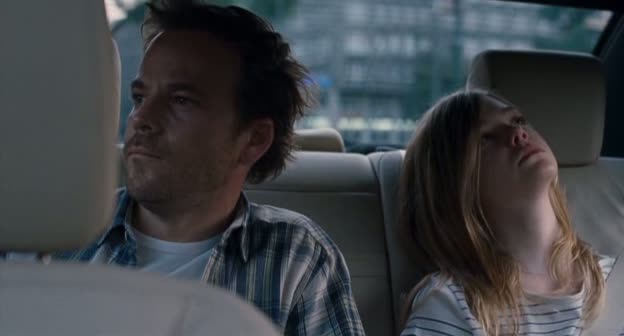
Starring Stephen Dorff and Elle Fanning
Written and Directed by Sofia Coppola


Rating: H (Highly Recommended)

Sofia Coppola’s Somewhere is like Jackass without the stunts, or maybe Jackass when the camera isn’t rolling. I’m not just saying that because of the presence of Chris Pontius, that laconic joker famous for his ‘Party Boy’ antics. Somewhere is almost Dadaist as Coppola lingers on bizarre showbiz images such as its star covered in putty for a face mould, or a ludicrously bombastic Italian awards ceremony, and gently pulls down the façade of Hollywood nicety with a subtle, non-judgmental eye. Johnny Marco, the nearly mute anti-hero, bounces from one corner of his irrational movie star life to another – rich, unsatisfied, stagnant.

Enter his daughter Cleo, the Figure of Redemption, but don’t worry. It isn’t that kind of movie. We can only assume that prior to the events in the film, Johnny saw Cleo on a semi-regular basis but was too wrapped up in endless parties and women to truly notice her. Now, as a result of certain circumstances, she’s going to be more present in his life – for a while, at least, maybe just long enough to make a difference.

Really, it’s okay, it genuinely isn’t that kind of movie. I mean, it is: a classical story, lost and/or deluded and/or miserable soul has his life thrown into perspective by the arrival of someone with simple, innocent meaning and purpose, both in her own intentions and in her relevance to our anti-hero’s life. What’s different is that Coppola takes this story, so often overdone and blandly unsubtle in films, and strips it back to the point of elusiveness. We witness a series of disconnected moments, often played out with a near-total absence of dialogue, and rather than there being an obvious narrative thread, it’s more our own expectation that creates one.


As a result, Somewhere will be infuriating and – even worse – incredibly boring to some viewers. For those who are willing to go along with Coppola’s sound- and image-focused style and put the idea of a Good Story to one side, however, Somewhere is a meditative treat, a joy. It even approaches the divine as she pulls the whole thing together in a glorious, grand (yet still understated) finale, stretching out the back end of Phoenix’s ‘Love Like A Sunset’ – with its eerie Wendy Carlos synthesizer and subsequent glorious release – in a moment of true movie magic that I could not resist.

Stephen Dorff is very watchable in the central role; I particularly liked the fact that despite being a big movie star with an endless parade of half-naked women fawning around him, he never comes across as a total dick. He’s polite to people whether he knows them or not; perhaps the stream of ‘you are such a fucking asshole’ SMSes he receives are the result of a prior attitude we don’t get to see. Then there’s Elle Fanning, who is an utter delight as his daughter. She’s just the kind of daddy’s little girl that fathers would want to do absolutely anything for: cute, sweet, talented. The key phrase there is that Johnny does indeed want to do anything for Cleo, but it’s evident that in the past, he simply hasn’t.


Neither of these two is the star of the film. That would be Richard Beggs, sound designer extraordinaire, who would also have been the star of Lost In Translation as well if it hadn’t been for the incomparable Bill Murray. Somewhere needs to be watched with the best sound possible so that you can appreciate the space of each scene – the grumble of Johnny’s Ferrari, the crackle of his cigarette as he smokes it down to the filter. Combined with another well-employed score of popular and atmospheric music, Beggs has crafted an aural wonderland yet again.

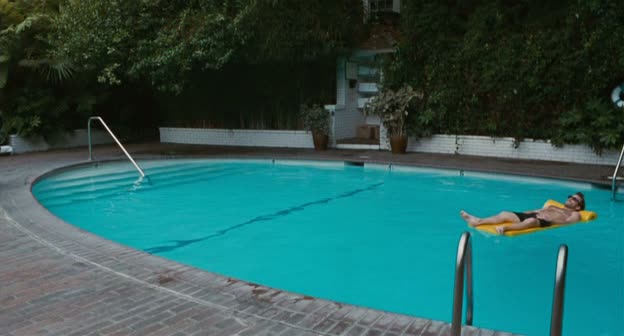
And then there’s Sofia Coppola, who by now has leapt well and truly out of her father’s shadow artistically. She stays within her limitations as a filmmaker, but what fascinating limitations. Her productions feel a little like really expensive student films in their scope, spare and mood-focused, and she is fortunate to have all the backing and support she could ever need (just check out those names in the ‘Thanks’ section of the credits). We’re fortunate that she uses that support to give us images of unexpected beauty in emptiness, like Johnny drifting lazily out of frame on a yellow Lilo inflatable sunlounger in the hotel pool, or his near-catatonic plucking of a pear from the fruit bowl on his coffee table, only to return it seconds later.


You may not learn anything from Sofia Coppola’s Somewhere, save for a few insights into the private lives of Hollywood stars. If you’re willing to submit to her freeform approach to filmmaking, though, you’ll be rewarded with another immensely satisfying tone poem of real lives and subtle movie magic. It’s not as good as Lost In Translation, of course, which she is unlikely to better even if she makes movies for another 50 years, but Somewhere is fit to be mentioned in the same breath, and it stands firmly on its own as a showcase for the gifts of sound and vision.