Little Miss Sunshine (2005) (W)

IMDb / Cale
Written by Michael Arndt
Directed Jonathan Dayton & Valerie Faris

Little Miss Sunshine is proudly and unabashedly a feel-good film, daring you to remain cynical through its outrageous, transparently sentimental conclusion. Usually I would gag and spit as things turned sappy, but in this case I smiled and clapped along, content to be caught up in one family’s great reconciliation. The difference is that in most of these films, the characters never really behave like real people, and there comes a point where you realise you’ve been hoodwinked into watching stereotypes for an hour and a half. Here, the family dynamic resembles something like reality: the ‘fuck’ count is through the roof, Mom and Dad bicker and row then laugh about it, and they’re always having to rush to get places on time.

The title refers to a beauty pageant for 6 and 7 year-olds. The youngest of the Hoover clan, Olive (Abigail Breslin), has reached the finals. To me, this is a uniquely American concept: dress little girls up in cute costumes, slather them with makeup and fake tan, push them to cultivate a ‘talent’ that has virtually no use in later life, and most importantly, have them smile all the time. These parents create a somewhat lifelike robot then parade it in a horrible freakshow to see which one will be declared most frightening.

Olive isn’t all white teeth and peroxide hair, though; she’s an original, and not just because of her oversized spectacles and straggly hair. She’s a living, breathing entity, unlike all those other girls because she has cultivated original thought processes. She’s there because she enjoys it, not because her parents (Greg Kinnear and Toni Collette) have pushed her into it. Kinnear’s Richard is a pathetic creation, an aspiring self-help guru who will never know true positivity; Collette’s Sheryl is, well, it’s Toni Collette, so you know she’s somehow different from all the other characters she plays, despite being identical on paper. This actress needs to be rewarded with more great roles like what she was given in Japanese Story – she’s always compelling, always believable, always consistent.

Rounding out the family are Paul Dano, Steve Carell and Alan Arkin as the moody teenager, suicidal brother and crazy grandfather respectively. Again, in two words I can only describe them as though they are pure stereotypes, but each one is unique and well-acted. Especially Dano, whose sense of comedic timing is perfect. He’s taken a vow of silence, and when he eventually breaks it, it’s a great mixture of comedy and pathos. Carell is known as a talented comedian, and he’s funny here, but there’s a depth to his work that suggests a fine capacity for drama. Arkin’s completely carefree performance is good, too.

I spend so much time describing the actors’ work because it is so important in a film such as this. So many family comedies fail due to the lack of chemistry between the players; if even one character doesn’t work, a true family dynamic cannot be felt. I applaud these guys for getting it right. If there is a weak link here, it’s Kinnear, but only because he is just okay where everyone else is very good or excellent.

A point I would like to make is that by presenting such an awful, grotesque spectacle as the Little Miss Sunshine pageant we are shown, Dayton and Faris are contributing to the whole horrific concept. The girls that play these brief singing, dancing and smiling roles were probably cast by requesting cute little girls from talent agencies – some of whom, I’m sure, have been press-ganged into such an early career by their parents. I guess you have to undermine such things from within – there’s no other way they could have done it, really. Still, it’s the sort of thing I notice.

We’re all fucked up, and that’s okay. Not a particularly profound or new message, but while Little Miss Sunshine doesn’t break any new ground, it manages to be entertaining and absorbing for its duration. It has flaws and missteps – scenes that we would’ve been better off without, obvious plot devices – but I’m willing to forgive those of a film that practically has me up out of my seat cheering at a group of people performing cathartic dance steps. Many critics have called it ‘quirky‘, but I say it is those other ridiculous, unbelievable family comedies that are quirky; this one has a beating heart, an awareness of how we actually treat each other.

’25th Hour’ (2002) (C)

IMDb / Ebert / Bisley
Written by David Benioff, based on his novel
Directed by Spike Lee

Again and again and again, directors insist that the American Dream doesn’t really exist. It is just that, a dream, unattainable for 99% of the population, yet still they strive, hoping for success they will never achieve. With 25th Hour, Spike Lee gives us his typically proselytizing insight into this idea – a mixture of racial intolerance, a drug dealer’s downfall, racial intolerance, the World Trade Center, and racial intolerance. There are flashes of excellence, moments of superb realism, but they are always quickly flushed away by Lee’s desire to preach, or his reliance on filming things in an unnecessarily over the top way.

Virtually all the characters in the film are, in some way or another, pathetic. Edward Norton’s Monty is a dealer, about to go inside for seven years, giddy with remorse for wasting such a large portion of his life. Philip Seymour Hoffman’s schoolteacher lusts after one of his students (played by Anna Paquin as a slutty motormouth – where will she end up?), and looks horribly out of place in a club with his baseball cap and nerdy glasses. Barry Pepper’s investment banker is a success in his professional life, and presumably also a success with women, but one gets the feeling that some kind of moral satisfaction is missing from his life, and he knows it. Of the three friends, he is closest to the so-called dream because he has worked to get to a certain place professionally and has made it, but he realises that his position is such that he will never be truly happy with his lot.

Then there’s Monty’s dad (played by Brian Cox), an Irish immigrant who owns a bar and misses his wife (and will soon miss his son). He is happy, and has done all he can to give himself a good quality of life, but the fact remains that his son chose a life of crime and is now going to be punished for it. So now we have a good, honest man who, through no fault of his own, has hardship thrust upon him. You can do most things right, and then have the rug pulled out from underneath you. At the film’s end, in a particularly frustrating sequence, he tries to persuade Monty to run from the law and start a new life – a pathetic, hopeful dream that has absolutely no chance of coming true.

The one who bucks the trend is the improbably named Naturelle, played by Rosario Dawson with strength and grace. Throughout the course of the film, she is bombarded with accusations, yet she remains composed and true to her character, clearly feeling strong emotions but refusing to let them override the situation. Still, she’s losing her partner. One feels that she will wait for him, despite her youth and his shady past. But if that does happen, will their new life be a happy one? Monty appears to have changed, but what will he be like after seven years in the can?

All this is fine, but what bugs me is Lee’s approach. The actors fight so hard to offer subtle, detailed characterisations, especially Hoffman and Norton, but his direction frequently takes the focus away from them onto his flashy camerawork, or his political agenda. Can’t we have a Spike Lee film without big bad racial stereotypes being painted onto panes of glass then SMASHED with the Hammer of Equality? I’m sick of it. Yes, it’s awful that a lot of people still think this way, but the way he presents these stereotypes does more to promote them than it does to tear them down. I’d much rather he just ignored them and filled his films with people of different, mingling ethnicities. There’s a taste of that with Naturelle being Puerto Rican, but you quickly forget that after his slick montages of blacks, Sikhs, Arabs, Mexicans, Koreans… etc.

The American Dream angle only became apparent to me during Cox’s final speech. Up until then, it had been an interesting, if somewhat misguided look at redemption, friendship and companionship. The film was suddenly twisted into something much grander in scope, and consequently it became a much deeper failure. I loved some moments – listen closely to the banter between friends, it’s just like real people – but the moments I really, really hated were double that. I’ll check out some earlier Lee someday, but for now, I’m sick of his greedy directorial style and heavy-handed treatment of potentially interesting themes.

Borat (2006) (R)

Full title: ‘Borat: Cultural Learnings of America for Make Benefit Glorious Nation of Kazakhstan’
IMDb
Written by Sacha Baron Cohen & Anthony Hines & Peter Baynham & Dan Mazer
Directed by Larry Charles

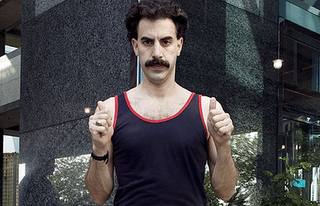
Every last frame of Borat is designed to incense, to enrage, to get you off your feet and yelling abuse at the screen. To offend. It is expressly designed to piss you, the paying audience member, off; a shallow exercise in depravity and baseness, a shameless effort to perpetuate stereotypes that haven’t been a problem for 25 years or more. It makes a mockery of anything and everything we hold sacred.

Borat underhandedly takes the guise of a comedy. We see the ‘hero’, this one-joke fake whose very existence makes fun of an entire nation, as he travels across the United States from setup to unfunny, defamatory setup. Much has been made of the anti-Semitism in the film – the Jews did 9/11, the Jews will take your money, the Jews will kill you, and so on – but the film contains even greater shocks. Racism and homophobia are celebrated, churches are ridiculed. A bear is cruelly mistreated, as is a pet chicken.

The most outrageous section of the film is an extended sequence of full male nudity. I have never, in all my years reviewing films, come across anything as outrageous and purposeless as this sequence. A tip: it isn’t enough to simply show something like this for it to be funny. It needs to work in the context of the film. Not that this scene could ever be funny – it’s as provocatively poor a bit of comedy as you’ll see.

Clearly, Sacha Baron Cohen is not a student of classic British comedy – his work here bears no resemblance to the intelligence of Monty Python, Steptoe & Son or Blackadder, instead stooping to the present American trends of lowest-brow humour such as that espoused by the idiots on shows such as Jackass. It’s symptomatic of this worldwide trend away from smart comedy. There is no satire here, no trace of irony. We are shown gag after unfunny gag, thrown at us in the hope that something sticks. It isn’t the volume of jokes that matters, Mr. Baron Cohen, but the quality of them. Go back from whence you came, and don’t try this sort of thing again…

NOT!

Waves (2006) (H)

NZFF
Directed by Li Tao

Waves achieves that most encouraging potential of documentary film: the presentation of events that constitute a unique experience for the individuals on screen, while also inviting the audience to respond and relate to what’s going on based on their own personal experience. It follows brief periods in the lives of four Chinese teenagers attending Hutt Valley High School as international students, achieving a rare level of intimacy that keeps you fascinated by these people as it provokes you to consider your own position. I’ll get this out of the way immediately: it falls short of the highest rating because of some distracting technical issues and often limited documentary technique, but I am at pains to insist that the content is good enough to carry these failings.

First we meet Ken. The message from his story is that no matter how well you manage to adapt, no matter how friendly your hosts and new classmates are, there’s no place like home. Over at Lumière, they’ve made special mention of the scene in which he breaks down crying while looking at a photo taken back in China. It is incredibly moving, but the conversation he has with his father that immediately precedes it is just as important to note – especially when he says “Oh, you’re on a business trip”. It’s the purest portrait of alienation cinema has to offer, and it is all the more surprising given that it comes immediately after he has so happily celebrated Father’s Day with his homestay family. Yes, things are going fine for Ken (later we see that he’s coping wonderfully at school, too), but it doesn’t take a lot of reminding that the comforts of home are sorely missed.

Rose is next, and her story provides many of the film’s most delightful moments. At first the focus is narrow: we see her hanging out with a few other Chinese students, at home in her bedroom, and studying in class. She seems just as alienated as Ken did. However, Tao steadily reveals more details until we see just how remarkable this girl is – she’s pursuing academic opportunities she would have ignored back home, she speaks good English with a Kiwi accent, and most of all, she is popular and well-liked by many at school. This is illustrated best by a brief shot of the gifts she receives for her birthday just from other students – a desk drawer stuffed to overflowing with chocolates, flowers and toys. She hasn’t just come here to study; she’s really making the most of the experience.

Her to-camera musings on the differences between the Chinese and Kiwi cultures throw up many questions. She says that in China you are more driven, better focused, but less individual; in New Zealand, you are encouraged to be unique and pursue that which appeals to you. Which is better? Who is to say? Rose prefers the freedom afforded her in New Zealand, but her parents might feel it is impractical to be studying music and design. I believe that any individual of capable thought should be allowed to seek out whatever path in life they wish, as long as they are not doing harm to others; when I have kids, I will have similarly open expectations of them as my parents had of me. Being allowed to experience two cultures growing up, Rose has the ability to transcend them both and be truly international; she’s the most assimilated of the four, and to these Kiwi eyes, the smartest and most interesting. She is the most like a Kiwi, and I respond well to that; however, I think it’s just as much the case that she is a special, unusually socially capable person.

With Lin, Tao focuses completely on the trials and tribulations she experiences leading up to the school ball. It’s a snapshot of the challenges our wonderful country presents, as well as a sometimes painful reminder of how god-damned difficult high school could be sometimes. Lin struggles to reconcile the ball with Chinese values; back home, she would be studying for exams, not having a night of fun. Indeed, she swings back and forth between whether to go or stay in studying, as she has trouble finding a dress and a partner. We have all had these impending major engagements that we worry about a great deal, thinking of all the things that can and surely will go wrong, only to find that everything comes together on the day. Somehow. I imagine she would have had similar problems with coming to New Zealand, but it looks like that worked out okay, too.

If Lin had difficulty getting her head around how things go in New Zealand, Jane flat out rejects them. She has no desire to enjoy this country the same way she enjoys her homeland. It’s just a step along the way, a period of her life best lived as alone as possible for fear of becoming attached to something she is sure she will soon leave behind. As Tao narrates, she is part of the group at school that remains quiet in the background – she is what most Kiwis would say is a ‘typical’ Asian student. She so misses home that she keeps her watch set to Beijing time. To me, this is a little bit sad, like she’s missing out on something that could be wonderful. That’s just my point of view, though. To her, the maximum amount of isolation is necessary to survive as the person she is. Where I would want to get to know as many different people as possible, she wants only to complete the qualifications and go back to where she is happy and feels comfortable. And there’s nothing wrong with that.

All this is particularly interesting to me, because I will soon become an outsider in a foreign country. I’m going to Japan next year, and I wonder, what will be the same? Will it be me switching off the lights and sobbing as I look at pictures of me with my family? Granted, I am older than these four were coming here, but I am sure some of my experiences won’t be too far removed from theirs. That’s the great beauty of this film: it gives you brief portraits of four very unique individuals, but contributes so much to our universal understanding of each other as a species. Equally as impressive, it does it without once hitting us over the head with an idea.

In the post-screening Q & A (or what I caught of it before running off to work), Tao stated that she ostensibly made the film for the parents of these international students, so that they could see what life was like for their children; however, upon completing it and showing it to others, she saw that it could have an impact on many Kiwi viewers. I would go further than that. I would suggest that, in a Western society that is increasingly assimilating itself with previously ignored (and even feared) cultures such as China, almost anyone could be moved to think deeply by this film. Of course there were a select few walkouts – we obviously still have some way to go – but too bad for them. Waves is a more insightful and provocative film about New Zealand and the global society than any that has been made for a long time.

Two Great Films About World War Two

Der Untergang (Downfall) (2004) (E)
IMDb/ Ebert / Hoberman
Written by Bernd Eichinger
Directed by Oliver Hirschbiegel

Idi i Smotri (Come and See) (1985) (E)
IMDb / Tobias / Reichert / Danks
Written by Ales Adamovich
Directed by Elem Klimov

Downfall and Come and See are not really all that similar, formally at least. However, they are the last two films about World War Two that I watched and, better than any other war films I’ve seen, they show the horror, the insanity and the hopelessness of war. I decided to write about them together because of this link, and to try a slightly different format. Both films offer a viewpoint we are not really accustomed to, whatever we know about the war, and neither becomes jingoistic or clichéd.

Downfall follows the last day or two of the Third Reich before the Russians take Berlin and end Hitler’s mission. To begin with, it is notable for being a German film that takes a point of view inside Hitler’s bunker – that of his secretary, Traudl Junge. Junge died in 2002, having offered an intimate account of those last days in both a book and a documentary film (which I have not seen). Downfall is based on her book, as well as on Inside Hitler’s Bunker by Joachim Fest. It amalgamates these two reliable sources into a definitive film on the subject, a film that is masterful in every aspect.

Technically, it is magnificent. One feels truly transported to the real scenes as they occurred, like in so few other films (especially war films). Clearly, the crew have meticulously researched the necessary details to come up with a realistic setting. It is director Hirschbiegel’s task to make this setting cinematic, and he does so without ever resorting to cheap camera or editing tricks. He allows the inherent fascination of the subject to come through, shooting it in a variety of ways to maximise its effect. Shots down long rooms are memorable, but so are wide shots of Berlin being bombed, and tight closeups on an actor’s face. He never puts a foot wrong.

With that out of the way, I can focus on the people. Junge is portrayed as extremely vulnerable, perhaps only halfway aware of the grand situation but acutely aware of the danger of remaining in the bunker. Lara, the actor, is so pretty it’s easy for her to tug at our heartstrings, but she doesn’t fall back only on that. Her dialogue is delivered directly, nervously, but always warmly, and one cannot help but wish dearly that she will survive. Of course, we already know that she does – spoken comments from the real Junge bookend the film – but one becomes so immersed in the experience, you more or less forget what you knew beforehand.

Junge is the only person who can bring out vulnerability in Hitler, as evidenced by the shot above. He is often warm and friendly, but we only see weakness in him when he looks into Junge’s eyes, and they are great moments. We do also see him becoming angry and irrational, and Ganz’s work in these scenes is absurdly good. His performance as a whole is the high watermark of a glittering career that has seen him work with Schaffner, Herzog and Wenders. Any doubts you might have about an actor being able to convincingly portray Hitler are quashed as soon as he appears on screen.

Eva Braun seems in denial of the whole thing. She insists that the dancing continue at a party that is being bombed and, in yet another image burned into my brain, applies lipstick in the mirror and half-smiles. Half of her fights to believe that there is still hope against the other half which knows, very practically, that the end is very close indeed. It’s horrible to imagine that struggle of faith – how would you cope if the tanks were bearing down but you husband insisted on remaining to the last?

Possibly the most distressing scene in the film concerns Frau Goebbels and her children; even if you know what happens, it is incredibly affecting to watch. She is the most unshakeable character in the film, the most brainwashed, heavily influenced as she is by her husband (who, in one scene, shows himself to be of very weak will as he waits outside a particular bunker). Nearly everyone retains some semblance of faith in the Fuhrer and the Fatherland, but they are all without hope. The practicality of the resolution of many – suicide – is jarringly insane, but clearly the only way they see to end the conflict. There is so much death, it is overwhelming but never desensitizing. I nearly bawled my eyes out in several places. And when genuine hope finally appears, it is as though a great weight has been lifted.

The immersive realism of Downfall is in direct contrast to the atmosphere and occasional beauty of Come and See. It is more like a collaboration between Kubrick and Herzog on a brutal, unflinching war film. Produced by the Soviet Union government to commemorate 40 years of the war having ended, it focuses on how Bielorussia (now independent as Belarus) was caught between Moscow and Berlin and was more or less completely sacked.

We follow a boy of 12, Florya, as he joins the army in the crusade against the Evil Hun. Very quickly, his illusions of glory in Stalin’s service are shattered – his company leaves him behind to guard the camp, which is subsequently bombed to oblivion. Thus begins a series of episodes as Florya attempts to gain a foothold in the war, something, somewhere, anything to give his life meaning beyond continued survival.

Downfall illustrates the hopelessness of war on a personal level; Come and See illustrates it for the many, forcing you to appreciate the unbelievable horror of it all. There are burned bodies still breathing and talking; entire towns incinerated; captured soldiers pleading for their lives. I foolishly ate a sandwich as I watched, and countless times I would get it within an inch of my mouth before being frozen in horror at what I was seeing. It is a relentless stream of remarkably shocking images, tied together through the plight of this young, no longer innocent boy.

The images are depraved, but there is a poetry about them all. A cow’s rolling eyeball is mesmerizing, as is a human face laughing rapturously as it looks upon intensely evil deeds. In a way, much of this film is quite beautiful, conveying an ethereality of war that most films eschew in favour of gritty realism. This doesn’t diminish its impact; in fact, it hits even harder when you are made aware that none of this is a dream. It really happened, probably much like this. It would have been difficult to believe, at any stage, and always horrifying. I must also make note of the sound design, which is amongst the most impressive in all the films I have seen. It goes some way towards immersing us in the hellish, bewildering environment of war.

Aleksei Kravchenko gives one of the great child performances as Florya. For the second half of the film, he rarely speaks, but his face ages visibly – not just with the makeup. Starting out a fresh-faced, smiling, hopeful boy, his facial expression becomes flatter and more hopeless as time wears on. Finally he becomes angry, and in a completely against-the-grain (but certainly effective) montage he unleashes all his aggression, signalling a new focus in his life. He has found a reason to march with the army, and the necessary will to be taken seriously. Like the will of the characters in Downfall, his drive is profoundly affecting in its insanity.

This was director Klimov’s last film, though he lived for a further eighteen years. I can understand why one might end their career with a film as stunning as this. It isn’t as complete a film as Downfall, particularly in its one-sidedness, but its unflinching eye hits you harder. I warn you, do not watch these two films on a double-bill – the effects could be dire. Do watch them both, though, if you can and feel you’re up to it. I haven’t seen two better films about war, ever, nor have I seen two films which so conclusively argue against there being any more war.

Well, this turned out to be more like two reviews back-to-back than a comparison piece. Oh well. I am still learning.

Smash Palace (1981) (H)

IMDb / Ebert
Written by Roger Donaldson, Peter Hansard and Bruno Lawrence
Directed by Roger Donaldson

With the World Cup on, I have set little time aside for watching films. Those which I have watched – The King of Comedy and The Baxter – did not inspire me to write. Especially not The Baxter, which was boring, stupid and not funny. Thankfully, I have been stirred back into life by Smash Palace. It is the sort of film that doesn’t force itself on you, instead picking you up along with it and keeping you involved until it is over; it’s a restrained treatment of extremely sensitive and dramatic content, the sort of film I would be proud to have made.

Smash Palace concerns what happens when two people experience a strong physical attraction, know they probably aren’t right for each other but go ahead and have a kid anyway. Everything will be all right, surely. We’re okay right now, why shouldn’t we be in ten years’ time? But now their daughter is turning 10 (or so), and the attraction is buried underneath daily disagreements, which turn into arguments then violent rows. Many of us can relate to this topic in one way or another. A great number have been in relationships that just didn’t work out how we expected them to. Some have experienced a similar scenario as children.

There is nothing left to keep Al (Bruno Lawrence) and Jacqui (Anna Jemison) seeing one another – nothing, that is, except young Georgie (Greer Robson). Both have a profound love for their child that cannot be taken away, so when Jacqui leaves and takes Georgie with her, it causes massive difficulties. Al wants to see Georgie, but Jacqui feels threatened by him and wants him kept away. Desperate measures are taken by both parties. One of them goes much too far, but for us watching, is it really so unreasonable? We feel such an attachment to these characters, we really want the best for all of them, so it isn’t particularly surprising when Al picks up his shotgun and goes bush. Shocking and moving, but not surprising.

Almost any actor would fail to pull us along with Al as he behaves more and more irrationally. Bruno Lawrence, however, is no hired hand. Everything he does, whether it’s a shotgun or a spanner in his hands, feels totally grounded in reality. A few scenes of contrived, plot-oriented dialogue are delivered convincingly without breaking stride; well-written, spontaneous scenes are so perfect as to sometimes inspire tears. Jemison does very well in a part that many viewers would hate, balancing playful and tense carefully.

It’s Robson who steals the show, though. What a shame that she went on to little more than Shortland St. and Celebrity Treasure Island. At no point does it seem like she is playing anyone other than herself, which is so rare in a child actor. Usually, they either act up for the cameras (annoying) or can’t deliver their lines convincingly (distracting). Robson gets everything right. There’s a scene with Lawrence (pictured above) in which they’re tinkering with the racecar, and she asks him how he met her mother. Nothing is wrong with that scene. There is more truth in that scene than in a thousand lofty-minded American indies; whatever reservations I had about the film were put aside at this point.

Donaldson’s technique has gotten worse over the years. These days, he’s become used to being a studio director-for-hire, such that his recent, more personal projects have been maybe a little to slick for the subject matter. Back in 1981, however, he was developing confidence in his craft, and it shows. Often, his slightly wayward writing is reined in by effective, restrained, and very cinematic technique. A slow zoom here, a swift edit there – it all combines to tell the story with great economy, but without losing any of the impact. Most of all, he allows the actors to be great, so they are. In particular, the final few shots sum up the film in a way that could not be bettered.

Now that this is available on DVD with the also good but vastly inferior Sleeping Dogs, Kiwis have no excuse to not see this important film. I’d like to be able to say that we’ve gone on to make many films like Smash Palace, but really, we haven’t. Instead of producing more of these small-in-scope but wide-in-impact films, we’re more like the bulk bins aisle in the supermarket – a cheap, identical alternative to the international (American) brands. Whale Rider is as close as we’ve come in a long time, but that was let down by a slightly Hollywood ending. In My Father’s Den was excellent, but it never came close to the immediacy and spontaneity of Smash Palace. It’s a beautiful, shattering film.

Spellbound (2002) (E)

IMDb / Ebert / Lieberman
Directed by Jeffrey Blitz

The more movies I watch, the more I tend to think documentaries offer the best hit-rate in cinema. (Herzog would take issue with me here and say that documentaries should not be categorised apart from fiction – to him, they are all films, and while I agree with this I am separating them to make my rather simplistic point.) There’s plenty of pap, of course, but then there are films as sublime as Spellbound, films which find great stories in the everyday and present them in a way that captivates and extends far beyond their seemingly limited focus. I laughed, I thought deeply, and I was brought to the verge of tears twice – once in sympathy, once in elation.

The spelling bee is an American tradition that hasn’t really affected the rest of the world, kind of like baseball. It’s huge there, but we don’t give it a second thought. Each year, around 10 million kids up to the age of 14 take part in school spelling bees; of these, some go to the city and county competition. 249 winners will eventually take part in the National Spelling Bee in Washington, the holy grail of spelling. Jeff Blitz chose 8 kids from very different backgrounds and went to their homes to interview them and their family, then followed their progress in the national competition. His film shows that the simplest ideas and methods are often best, especially in film – tell the story straight, and if it’s good, people will listen.

Of the eight, three are the children of immigrants. Angela is the daughter of a Mexican couple who speak no English; Neil is the son of a wealthy, extremely driven Indian couple; Dupur the daughter of a relaxed Indian couple, almost a direct contrast to Neil’s parents. These three families epitomise the American Dream. They came to America with the express purpose of finding a better environment for their children to grow up in, and, in different ways, they all feel they succeeded. The American Dream is usually talked about in terms of opportunity for wealth and success for the individual, but Spellbound showed that it has much more to do with one’s legacy. Families move there simply because it has more to offer their kids than their home country.

One gets the feeling that Neil and his father would have succeeded in any environment because they are so ruthlessly driven – Rajesh (his father) and his brother built his second house themselves, brick by brick, and the way he walks around his neighbourhood, it’s like he owns the whole street. Still, he is at pains to point out the difference between their current position and where they were, how it is immeasurably better here. Most poignant is Angela’s dad, who earns barely more than the paltry pay he used to get in Mexico, but he is happy that he has done well because his children are happy and advantaged. The kids of each of these families are very much Americans, and their parents couldn’t be happier.

The American kids are equally diverse, from a hyperactive, incredibly annoying boy to a black girl from a poor Washington, D. C. neighbourhood who just loves words. While the kids themselves are quite fascinating, it’s the interviews with their families that are most illuminating. They offer insight into the incredible strength of the family bond, the importance of hard work, the sometimes anti-intellectual attitude of many Americans (including children), and a lot more which I’ve forgotten – indeed, it seemed like every time one of the parents said something, I immediately started thinking hard about the implications of what they had to say. It’s not earth-shattering stuff, but it is broad and affects pretty much all of us.

Quite apart from being an endlessly intriguing document of Americana, Spellbound is, in its final half hour, filled with tension. Even though you’ve only spent about ten minutes in the company of each of these children and their families, you really feel like you know them, so when you see them get up on that stage it becomes almost unbearable. Up to this point, Blitz’s editing work has been impressive, but it is during the rounds of the spelling bee that it achieves greatness. He cuts between the child on stage and more interview footage from before and after the event – kind of like a reality TV show, except good, and you actually care for the outcome. Many times I gritted my teeth and gripped my head in my hands, wishing aloud that they would spell the word correctly. My hat is off to you, Mr. Blitz, for making me care so much about a child getting a string of letters right.

It becomes clear by the end of the film that all the people in the film are very similar. They have had vastly different life experiences, but they share many similar philosophies. A lesser film would have placed the differences at the centre of our attention, because it’s easier to extract drama that way; instead, Blitz somehow finds common goodness in virtually everyone. He’s taken a simple idea and chosen a simple structure to present it in, and the result is a success on every level. There is no manipulation, no artificiality. He gets everything out of the material without ever making his presence felt. It’s all about the people, and despite whatever first impressions one might make, they are shown to be amazing, important people. This is how movies should be made.

Mission: Impossible III (2005) (W)

AKA ‘Action Movie’
IMDb / Ebert
Written by Screenwriters
Directed by a Director

Action Movie is the latest vehicle for Movie Star, and it’s definitive multiplex entertainment. You go down the cinema these days, and they’re not even trying to draw you in anymore. The screens are eight times bigger than before, and the sound is up past 11, and they just beat you into submission. And in the case of Action Movie, I didn’t even try to put up a fight. I sat back passively for a couple of hours and lapped it all right up.

I haven’t seen the two earlier installments in the Action Movie franchise, but that didn’t cause any confusion in terms of understanding the plot. My confusion stemmed solely from the gaping plot holes and jumps in logic. Hang on, that isn’t true – I wasn’t confused by them, I was totally passive. So, I must’ve just accepted them and moved on. This is a movie that has no truck with explaining the central object of everyone’s desire. You come out wondering ‘So was the rabbit’s foot actually the anti-God?’ without a shred of irony. I also wasn’t confused by where the action was set because of the titles that would appear on screen whenever the location changed. ‘Berlin, Germany’, for example, or ‘Shanghai, China’. Not America, then.

There’s a theory that the bigger and more outlandish the stunts, the better the quality of the production. If that theory is valid, then this is a very high quality production. They take a standard issue helicopter chase – normally no big deal – and put it through a wind farm! A bloody wind farm! Imagine: two helicopters, one with terse, fearful good guys, the other with nameless faceless evil ones (in this case, Germans), ducking and weaving through one wind turbine after another. I don’t need to tell you how the baddies get done in, nor do I need to point out further how audaciously ingenious this scene is. It was topped by the causeway chase/battle, though, a True Lies-inspired sequence of dangling, shooting, and shit blowing up. My absolute favourite sequence would have to have been Mask Sequence 1, though (there’s more than one). It was practically stunt-free, but it had two different versions of Character Actor, so I giggled joyously throughout.

Product placement gets a highly commendable pass as well. They had the Budweiser “wassup” exchange, a shiny new Nokia was practically glued to the hands of Movie Star, a Lamborghini had a featured blowing up, and whatever other new shit I subconsciously buy over the next couple of weeks. There are even elements of 80s Action – “Remember how I said I would kill you last? I lied” sort of stuff. No messing, the Screenwriters knew what they were doing. I’ll bet they really hit their stride around the 15th draft.

Movie Star is very well supported. Stunning Asian Woman, Wisecracking Black Man, Surly Black Man, Impossibly Cute Wife (who happens to be handy with a gun, too), Wacky British Nerd, Amusing (and in this case, Androgynously Attractive) Irish Man… all the stock players pulled out to say some words and generally look beautiful. When a movie has not one but two Agent Bilkins figures, you know you’ve got a hit. Not to mention Character Actor – why the hell shouldn’t you take that big payday? There’s no reason not to. Don’t listen to the naysayers. You deserve it, and your lack of scenery-chewing is to be commended.

It’s all about Movie Star, though. Right from the start of the opening credits, where they boldly display: ‘A Movie Star/Bigshot Producer Production’. It’s his show, and his massive, religiously misguided ego is nearly always front and centre. Do I mind? Hell no! This guy kicks eight kinds of ass. He does calculations on windows with available chalk, then swings from one building to another. He dies, or should die, maybe ten times in the film but always gets away clean. In fact, the best part of the whole movie is the end – him and everyone else have died around 3o collective deaths, but they’re all there in a Return of the King style slow-mo love-fest. It’s divine cinema.

Well done, Director, you’ve made the transition from Action TV Serials to Action Movies. Action Movie is the real deal, an edge-of-your-seat ride that offers infinite thrills and spills. It’s the consummate moviegoing experience. Even the pre-show program was louder and went for longer than usual. Get ye to the cinema and soak up the adrenaline pouring off the screen, then go forth and commit wondrous deeds, like getting up in the morning for runs, or learning how to shoot a weapon. It’s a life-changing experience.

Coffee and Cigarettes (2003) (W)

IMDb / Ebert
Written and Directed by Jim Jarmusch

So much of Coffee and Cigarettes is dull, uninspired and near worthless, with only some beautiful black and white cinematography propping it up. Certain segments, however, are quite brilliant – patches of genuine greatness amongst a whole lot of nothing. (When I think about it, you could probably say the same thing about Jarmusch’s recent Broken Flowers). The segments in question are entitled ‘Cousins’ and ‘Cousins?’, and rather than relying on the beauty of their images to make them remotely worthwhile, they would have been just as intriguing had they been shot on low-definition digital video or Super 8 film.

‘Cousins’ stars Cate Blanchett as herself and as her fictional cousin Shelly. The character Cate is a famous movie star, back home in Australia on the press junket, and she’s taking a few minutes off to see her cousin, Shelly. Shelly is stereotypical Aussie white trash with a broad accent and a straight-ahead way of thinking, which is not without insight. The way they interact is such a treat to watch, because they behave exactly like real people, even though they are caricatures.

Shelly’s behaviour is cold and somewhat cynical, but it is totally genuine. With her, we never get the feeling she’s concealing anything, or putting on a mask to satisfy the company she’s with. She lies, but she does it out of boredom, not malice. Cate, on the other hand, is more or less just going through the motions, smiling widely and emptily while she searches for words to fill the silences. She wants to engage in equal conversation with this person, her cousin, but she quickly loses the required effort to make it happen. She betrays her lack of interest by getting names wrong. They’re so different, what would they have to talk about?

Their stilted conversation is so divine and rare in cinema, and extremely unusual in a film in which most characters seem like just that – characters, there to speak cool or contrived dialogue, not to come across like real people. I don’t know how improvised it is, but going by the rest of the film, I’ll give a little credit to Jarmusch and a lot to Blanchett. She is so good here – not only did I forget she was playing two parts, but I forgot she was playing a version of herself. And she is exceptionally beautiful, but that goes without saying.

‘Cousins?’ stars Alfred Molina and Steve Coogan, two fine British actors. Molina has broken into the US market and put down roots in L. A.; Coogan only visits the States when he has to, despite a growing profile there and a desire to become more famous. They have obviously never met before, and like the cousins of the earlier segment, they engage in awkward conversation that never really has a chance to get going. Molina is too friendly and genuine, and Coogan too guarded and cynical.

The difference here is that this is a meeting that was set up (by Molina) for a reason, and when that information is revealed, Coogan becomes even more guarded and disinterested, and we wait for the painful episode to end, knowing that they’ll probably never see each other again. But then the dynamic changes again, and suddenly the tables are turned. Being such good actors, Molina and Coogan totally nail it. I’ve admired the work of both of them in anything they’ve done, as comic and dramatic actors, and never for a moment does this episode feel forced or artificial. It doesn’t quite have the great layers of subtext that ‘Cousins’ has – this is more of a directly told story – but it is still great.

The others… well, the Iggy Pop/Tom Waits one was pretty good, and the one with GZA, RZA and Bill Murray was entertaining, as was the one with the White Stripes, but each of these suffered from trying too hard to be cool. The rest were all bores, and only those two discussed earlier transcended the screen to really leave an impression. They are so excellent that you should see Coffee and Cigarettes just for them, a pair of diamonds amongst a collection of dullards. I’m not motivated to see any more Jarmusch in a hurry, even though many say he is great; most of what I’ve seen seems to have focused on feeling and looking really hip, forgetting to actually mean anything of consequence. I’ll hopefully be proved wrong.

Quick Change (1990) (C)

IMDb / Ebert
Based on the novel by Jay Cronley
Written by Howard Franklin
Directed by Howard Franklin and Bill Murray

Quick Change is an unusual beast. It’s derivative of hundreds of other heist/getaway films, but it stars Bill Murray and Jason Robards in the crook and cop roles. It’s a comedy, but there are no big laughs to be had. There are a couple of swear words which, if removed, would have earned the film a PG-13 rating in the USA, and opened it up to a wider audience who might have been able to enjoy it more. (At this point the review could easily degenerate into a criticism of modern censorship, in particular the MPAA, but you already know how ridiculous it is so I won’t bother.)

It’s also Murray’s only credit as director. Co-director, actually. His pal Howard Franklin had written the script and he was attached to star, but they couldn’t find someone to direct it, so they decided to do it themselves. Not surprisingly, they take few risks. In fact, the film looks and feels like so many other films of the period that, over time, it will likely become indistinguishable from them in my memory. It’s utterly mediocre, totally unmemorable, but passable entertainment for an hour and a half. It’s the sort of film a nine year-old boy might watch over and over again because it was the first film of its kind he’d seen, and maybe revisit for nostalgic purposes later in life (probably to be disappointed).

Is that good enough? Is it okay for just that kid to get a real kick out of it? At least it isn’t a shameless, money-grabbing exercise, like a really bad sequel, or a film that coasts on the stature of its stars without making any effort to be good. Quick Change is far more noble than those films, because its agenda is simply to entertain you – it makes it a lot easier to forgive than if it had clearly been focused on your wallet. But look again at the picture above: it sums up the film, and those hundreds of other films like it. It’s Bill Murray, a big star whom millions of people love to watch, dressed up as a clown whose purpose it is to entertain. He’s not smiling. His heart isn’t in it. He’s put on all this makeup and silly clothes and said “Laugh at me”, but it’s hard for us to laugh because we can tell he isn’t really enjoying it himself. It’s not like he lacks sincerity, but he’s distracted, and we can see that.

This isn’t to say Murray is bad. He’s the same as ever, which is fine, but it’s clear he doesn’t really believe in the material. The other actors are the same, going through the motions, except Randy Quaid whose hideous overacting can be painful. It’s work, a job to pay the bills in-between the good scripts they might sometimes be able to do. There are no behind the scenes interviews on this DVD, but if there were, I don’t think anyone from the cast or crew would be saying “As soon as I read the script I just had to do it”, or “My job is easy because the material is so good”; they’d be saying “I really admire my colleagues, and it’s a pleasure to work with them”. And, like the clown who isn’t smiling, we wouldn’t really believe them.

Throw in a typically grating early 90s score, and you have a film that is average-to-poor in all respects. Reviews of such films are hardest, because there’s nothing to champion and nothing to rail against. They’re just there, and you’ve seen them, and you don’t care about them any more. I would recommend Quick Change only to Murray and Robards completists, but even those people will almost certainly get a greater kick out of watching Groundhog Day for the 37th time.